


Engineering Guide to Metal Mesh Pop Filters in Industrial Filtration Systems
In the landscape of industrial fluid dynamics and pneumatic engineering, the term "pop filter" often transcends its common consumer audio associations. In a B2B context, a metal mesh pop filter refers to a high-performance, durable component designed to manage high-velocity fluid streams, dissipate energy, and prevent particulate ingress or egress in pressurized systems. These components are essential in protecting sensitive equipment from sudden pressure surges—often referred to as "pops" in pneumatic lines—while maintaining precise filtration standards.
For engineers and procurement professionals, selecting the right Wire Mesh Filter Cylinders & Tubes is a critical decision that impacts the longevity of downstream components, the purity of the process media, and the overall efficiency of the industrial system. This guide explores the technical specifications, material considerations, and engineering principles behind industrial metal mesh filtration solutions.
1. Operating Principles of Industrial Metal Mesh Pop Filters
At its core, a metal mesh pop filter operates on the principle of mechanical straining and kinetic energy dissipation. Unlike polymer-based filters, which may deform under high-pressure spikes, stainless steel mesh provides a rigid geometric structure that remains stable under varying flow conditions.
Kinetic Energy Dissipation
In pneumatic exhaust or high-pressure gas sampling, fluid often exits an orifice at sonic or near-sonic velocities. A metal mesh structure acts as a baffle. As the gas passes through the complex tortuosity of the wire weave, the kinetic energy is broken up into smaller eddies. This reduces noise (acting as a silencer) and prevents the "sandblasting" effect that high-velocity particles can have on adjacent equipment.
Surface vs. Depth Filtration
Most industrial pop filters utilize surface filtration. The particles are captured on the upstream side of the mesh. This is advantageous for B2B applications because it allows for easier cleaning (backwashing or ultrasonic cleaning) compared to depth media like felt or pleated paper, which trap contaminants within the matrix and often require complete replacement after a single pressure event.
2. Material Science: Why Stainless Steel Dominates
The choice of material for a metal mesh pop filter is dictated by the chemical environment, operating temperature, and mechanical stress. Kaifil specializes in utilizing high-grade alloys to ensure these components withstand demanding industrial cycles.
* AISI 304 Stainless Steel: The standard choice for general industrial applications. It offers excellent strength and good corrosion resistance in non-acidic environments. It is frequently used in hydraulic breathers and pneumatic mufflers.
* AISI 316L Stainless Steel: For pharmaceutical, food and beverage, or marine applications, 316L is the preferred alloy. The addition of molybdenum provides superior resistance to pitting and crevice corrosion, particularly in chloride-rich environments. The "L" (low carbon) designation is crucial for welded components, as it prevents carbide precipitation during the welding process, ensuring the structural integrity of the filter seam.
* Specialty Alloys: In highly corrosive chemical processing, alloys such as Monel or Hastelloy may be employed. These are used when the filtration media involves aggressive acids or high-temperature steam that would degrade standard stainless steel.
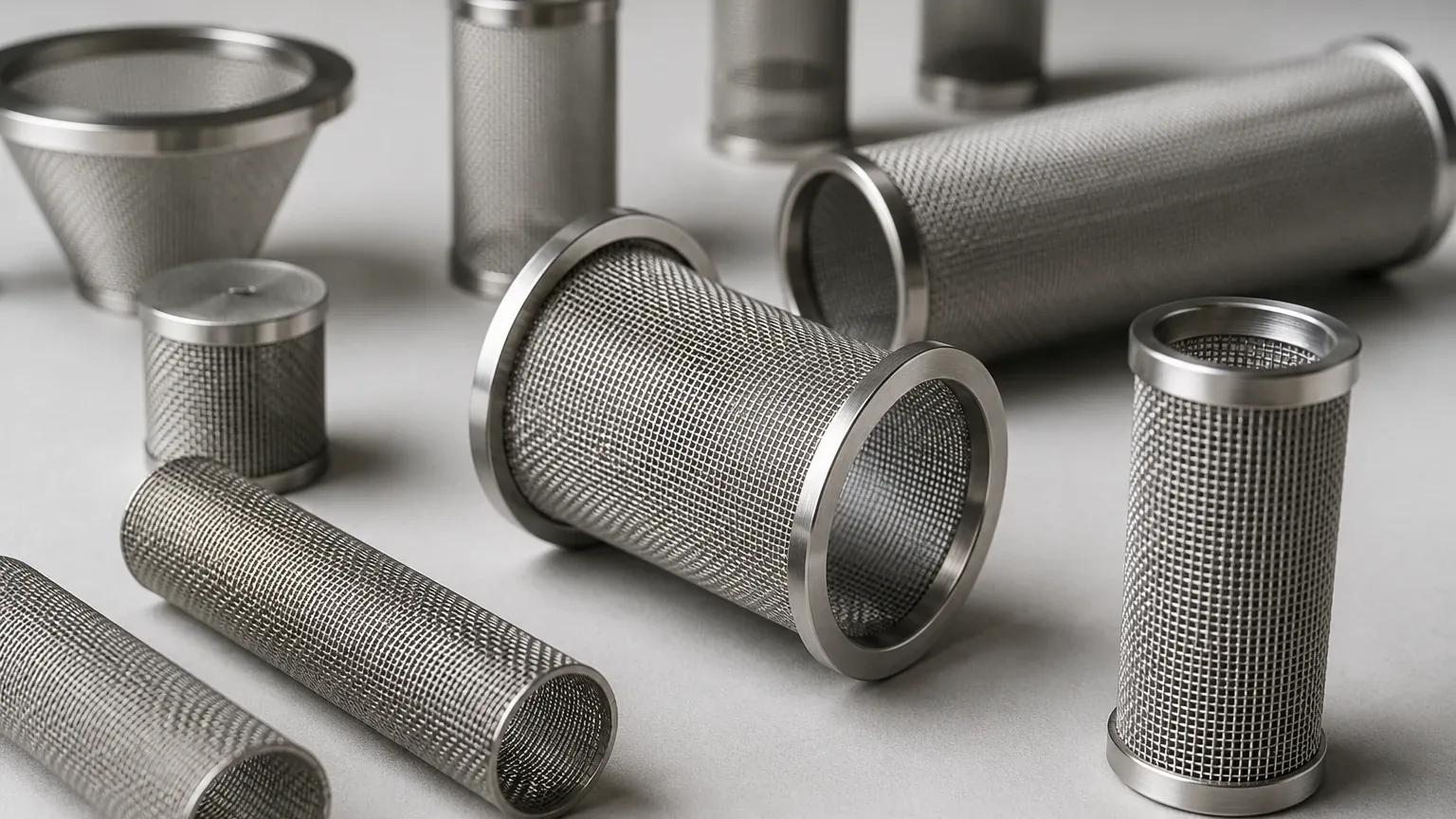
3. Structural Configurations of Wire Mesh Filter Cylinders & Tubes
The geometry of the filter is as important as the mesh itself. Industrial filters are typically manufactured as Wire Mesh Filter Cylinders & Tubes to provide the highest surface-area-to-volume ratio and inherent structural strength against internal or external pressure.
Single-Layer vs. Multi-Layer Construction
* Single-Layer Tubes: These are cost-effective and suitable for low-pressure applications where the mesh wire diameter is thick enough to be self-supporting. They are often used as simple debris strainers.
* Multi-Layer Sintered Mesh: For high-pressure "pop" applications, multiple layers of mesh are sintered together. A typical construction includes a fine filtration layer protected by coarser drainage layers and supported by a heavy-duty perforated metal core. This prevents the fine mesh from migrating or deforming under a pressure surge.
Weave Types and Their Impact
1. Plain Weave: The simplest form, where wires cross over and under each other. It provides high flow rates but is limited in how fine the micron rating can go while maintaining strength.
2. Dutch Weave: This weave uses heavier warp wires and finer shute (weft) wires. The result is a dense, strong mesh with very small triangular openings. This is the gold standard for high-pressure industrial filtration where precision is paramount.
3. Twilled Weave: Allows for thicker wires in a given mesh count, increasing the mechanical strength of the cylinder without significantly sacrificing the micron rating.
4. Engineering Selection Criteria: Beyond the Micron Rating
When specifying a metal mesh pop filter, engineers must look beyond the nominal micron rating. A common mistake in procurement is over-specifying filtration fineness, which leads to premature clogging and excessive pressure drop.
Pressure Drop ($ΔP$) and Flow Capacity
Every filter introduces resistance. In B2B industrial systems, the "clean pressure drop" must be calculated to ensure the pump or compressor operates within its efficiency curve. As the filter loads with contaminants, the $ΔP$ increases. Engineers should specify the maximum allowable $ΔP$ before the system triggers a maintenance alert.
Nominal vs. Absolute Filtration
* Nominal Rating: Indicates the ability of the mesh to retain a majority of particles of a certain size (e.g., 90% of 20-micron particles). This is usually sufficient for pop filters used in exhaust or venting.
* Absolute Rating: Refers to the diameter of the largest hard spherical particle that will pass through the filter under specific test conditions. This is critical for high-precision hydraulic systems or pharmaceutical processing.
Mechanical Integrity and Burst Pressure
In applications involving sudden pressure releases, the filter must have a calculated burst pressure significantly higher than the system's relief valve setting. This is achieved through precision longitudinal welding (TIG or Plasma) and, in many cases, adding reinforcement rings to the cylinder ends.
5. Industrial Applications for Metal Mesh Pop Filters
Customized stainless steel filtration solutions are utilized across diverse sectors, each with unique performance expectations.
Chemical Processing and Petrochemicals
In these environments, filters must resist aggressive solvents and high temperatures. Stainless steel cylinders are used in gas stripping towers and as flame arrestor elements, where the mesh prevents the passage of a flame front while allowing gas flow.
Food and Beverage Industry
Sanitary filtration requires components that are easy to clean and free of "dead zones" where bacteria can grow. A metal mesh pop filter used in a tank vent must be able to withstand CIP (Clean-in-Place) cycles and be manufactured from FDA-compliant materials.
Hydraulic and Pneumatic Systems
In hydraulic reservoirs, air must move in and out as fluid levels change. A wire mesh breather filter prevents airborne dust from entering the oil while allowing the system to "breathe." Similarly, in pneumatic tools, these filters prevent metal shards from being ejected into the workspace during exhaust cycles.
6. Maintenance, Cleaning, and Total Cost of Ownership (TCO)
One of the primary B2B advantages of stainless steel Wire Mesh Filter Cylinders & Tubes is their reusability. While the initial capital expenditure (CAPEX) is higher than disposable plastic or paper filters, the total cost of ownership is significantly lower over the equipment's lifecycle.
Cleaning Methods
* Ultrasonic Cleaning: The most effective method for fine mesh. High-frequency sound waves create cavitation bubbles that dislodge particles from deep within the weave.
* Backwashing: For larger systems, reversing the flow of the media can flush accumulated debris from the surface of the mesh.
* Chemical Cleaning: Using compatible solvents to dissolve resins or organic build-up without damaging the stainless steel substrate.
Replacement Indicators
Engineers should monitor the pressure differential. A permanent increase in the "clean" pressure drop after cleaning indicates that the mesh is either physically damaged or blinded by sub-micron particles that cannot be removed. At this point, replacement is necessary to prevent system inefficiency.
7. Procurement Checklist for International Buyers
When sourcing custom filtration components from a manufacturer like Kaifil, providing comprehensive technical data ensures the final product meets the application's rigorous demands. International buyers should confirm the following before finalizing an order:
1. Dimensional Tolerances: Specify the inner diameter (ID), outer diameter (OD), and total length. For cylinders that must fit into existing housings, tolerances of ±0.1mm are often required.
2. Material Certification: Request Mill Test Reports (MTRs) to verify the alloy composition (e.g., verifying that 316L meets the required chromium and nickel percentages).
3. End Cap Configuration: Determine if the filter needs open ends, closed ends, threaded fittings (NPT/BSP), or specialized flanges for installation.
4. Welding Standards: Ensure the longitudinal seams are welded using burr-free techniques to prevent metal slivers from entering the process stream.
5. Testing Requirements: Depending on the criticality, you may require bubble point testing (to verify pore size) or pressure leak testing.
Conclusion
The industrial metal mesh pop filter is a specialized component that requires a deep understanding of material science and fluid mechanics. By selecting high-quality Wire Mesh Filter Cylinders & Tubes, engineers can ensure their systems remain protected against pressure surges and particulate contamination.
Kaifil's commitment to precision manufacturing and OEM customization allows for the development of filtration solutions tailored to the most demanding environments. Whether you are designing a new hydraulic system, upgrading a chemical processing line, or seeking more durable components for food-grade applications, focusing on the structural integrity and material compatibility of your wire mesh filters is the key to operational excellence.
