


Metal Mesh Pre Filter: An Engineering Guide to Wire Mesh Filtration Systems
In industrial fluid processing, the reliability of downstream equipment—such as high-pressure pumps, sensitive membranes, and fine-finish spray nozzles—depends heavily on the efficacy of the initial filtration stage. A metal mesh pre filter serves as this critical first line of defense, removing large particulates and suspended solids before they can cause mechanical wear or system clogging. For engineers and procurement specialists, selecting the appropriate Wire Mesh Filter Cylinders & Tubes requires a deep understanding of material science, fluid dynamics, and structural engineering to ensure long-term operational stability.
The Role of Pre-Filtration in Industrial Engineering
Pre-filtration is not merely about removing debris; it is about optimizing the total cost of ownership (TCO) for a filtration system. By capturing the bulk of the contaminant load, a metal mesh pre filter prevents the premature fouling of more expensive secondary filters, such as pleated polymer cartridges or ceramic membranes.
In sectors like chemical processing and hydraulic power, the presence of abrasive particles can lead to catastrophic component failure. Metal mesh filters are preferred in these environments due to their mechanical robustness and ability to withstand high differential pressures without the risk of media migration—a common failure mode in fiber-based filters. Because these components are often constructed from stainless steel, they offer a level of thermal and chemical resistance that synthetic materials cannot match.
Material Selection and Chemical Compatibility
The performance of a metal mesh pre filter is fundamentally tied to the alloy from which it is manufactured. In industrial engineering, the choice of material is dictated by the chemical composition of the process fluid, the operating temperature, and the presence of corrosive agents.
Stainless Steel Grades
1. AISI 304/304L: The standard choice for general industrial applications, offering good corrosion resistance and excellent formability. It is widely used in food and beverage applications where hygiene is paramount but chemical aggression is moderate.
2. AISI 316/316L: Contains molybdenum, which significantly enhances resistance to chloride-induced pitting and crevice corrosion. This is the preferred material for marine environments, pharmaceutical manufacturing, and many chemical processing plants.
3. Specialty Alloys: For highly aggressive environments involving concentrated acids or high-temperature oxidation, alloys such as 904L, Monel, or Inconel may be specified to ensure the structural integrity of the filter cylinders.
Surface Treatments
To further enhance performance, metal mesh filters may undergo passivation to remove free iron from the surface, or electropolishing to create a microscopically smooth finish. These treatments are essential in pharmaceutical and high-purity water applications to prevent bacterial adhesion and facilitate easier cleaning.
Structural Design: Wire Mesh Filter Cylinders & Tubes
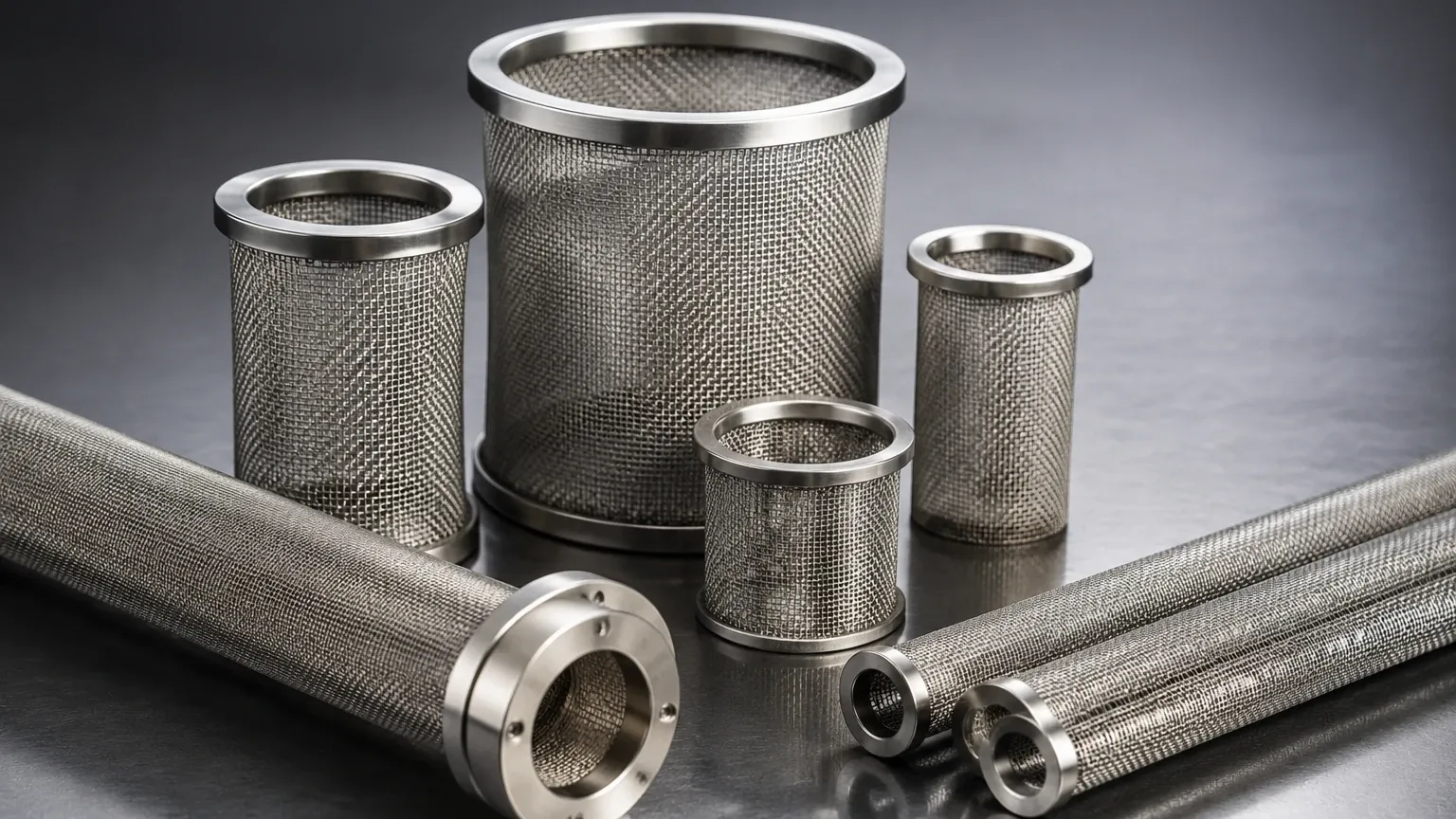
The physical architecture of the filter determines its flow capacity and mechanical strength. Wire Mesh Filter Cylinders & Tubes are typically designed in several configurations to meet specific industrial requirements.
Single-Layer vs. Multi-Layer Construction
Single-layer mesh cylinders are cost-effective for low-pressure applications where the contaminant load is predictable. However, for high-pressure systems or where fine filtration is required, multi-layer sintered mesh is often used. This process involves bonding multiple layers of wire mesh together using heat and pressure, creating a composite material that combines the fine filtration rating of a thin mesh with the structural support of a coarse, heavy-duty mesh.
Support Structures
In many industrial housings, the mesh itself is not strong enough to withstand high flow rates or pressure surges. In these cases, the mesh is wrapped around or inserted into a perforated metal core. This internal or external support prevents the cylinder from collapsing or bursting under differential pressure, ensuring that the filtration gap remains consistent throughout the service cycle.
Weave Types
* Plain Weave: The most common type, where wires cross over and under each other. It provides a high open area and low pressure drop.
* Dutch Weave: Uses larger diameter warp wires and smaller diameter weft wires. This creates a denser, stronger mesh capable of much finer filtration ratings, often used in high-pressure hydraulic pre-filters.
* Twilled Weave: Allows for thicker wires to be used for a given mesh count, providing increased durability for heavy-duty industrial applications.
Performance Metrics: Micron Ratings and Pressure Drop
When specifying a metal mesh pre filter, engineers must balance filtration efficiency with system throughput. Two primary metrics define this balance: the micron rating and the differential pressure ($ΔP$).
Absolute vs. Nominal Micron Ratings
In the context of wire mesh, the micron rating refers to the size of the largest particle that can pass through the mesh.
* Nominal Rating: Indicates the filter's ability to retain a majority of particles of a certain size (e.g., 90%).
* Absolute Rating: Refers to the diameter of the largest hard spherical particle that will pass through the filter under specified test conditions. For critical industrial processes, absolute ratings are preferred to ensure consistent protection of downstream components.
Managing Pressure Drop
The pressure drop is the difference in total pressure between the inlet and outlet of the filter. An ideal metal mesh pre filter provides the required filtration efficiency with the lowest possible $ΔP$. Factors influencing pressure drop include:
* Mesh Open Area: The percentage of the filter surface that is open to flow.
* Fluid Viscosity: Higher viscosity fluids require larger surface areas or coarser mesh to maintain flow rates.
* Contaminant Loading: As the filter captures debris, the effective open area decreases, causing $ΔP$ to rise.
Engineers must design systems with a "terminal pressure drop" in mind—the point at which the filter must be cleaned or replaced to prevent system failure or bypass.
Installation Constraints and Sealing Mechanisms
A high-quality metal mesh pre filter is only effective if it is installed correctly within its housing. Bypass—where fluid flows around the filter rather than through it—is a common issue caused by poor sealing.
End Cap Configurations
Filter cylinders are typically finished with end caps to facilitate installation. Common designs include:
* Double Open End (DOE): Requires gaskets at both ends to seal against the housing.
* Single Open End (SOE): Often features a threaded connection (e.g., NPT or BSP) or a bayonet-style fitting (e.g., 222 or 226 O-ring) at one end and a closed cap at the other.
Gasket and O-Ring Selection
The sealing material must be compatible with the process fluid and operating temperature. Common materials include:
* EPDM: Excellent for water and steam but poor for oils.
* Viton (FKM): High temperature and chemical resistance, ideal for fuels and solvents.
* PTFE: Near-universal chemical resistance but less resilient than elastomers.
Proper alignment during installation is critical. If a cylinder is skewed, the seal may fail, allowing unfiltered fluid to contaminate the downstream system.
Maintenance, Cleaning, and Longevity
One of the primary advantages of a metal mesh pre filter over disposable media is its cleanability. Depending on the application, these filters can be cleaned and reused hundreds of times, significantly reducing waste and operational costs.
Cleaning Methods
1. Backwashing: Reversing the flow of fluid through the filter to dislodge captured particles. This can often be automated within the system.
2. Ultrasonic Cleaning: Placing the filter in an ultrasonic bath where high-frequency sound waves create cavitation bubbles that strip contaminants from the mesh wires. This is highly effective for removing fine particulates trapped deep within Dutch weave meshes.
3. Chemical Cleaning: Using surfactants or mild acids to dissolve organic or mineral buildup. This must be done with care to ensure the cleaning agent does not degrade the filter material.
Inspection for Wear
During maintenance cycles, filters should be inspected for signs of mechanical fatigue, such as broken wires or distorted mesh. In high-vibration environments, the welds joining the mesh to the end caps can become a point of failure. Regular inspection ensures that the filter continues to meet its absolute micron rating.
Procurement Checklist for International Buyers
When sourcing Wire Mesh Filter Cylinders & Tubes from a manufacturer like Kaifil, providing precise technical data is essential for receiving a product that meets application requirements. Buyers should confirm the following details before finalizing an order:
* Dimensional Accuracy: Provide exact ID (Inner Diameter), OD (Outer Diameter), and overall length, including tolerances.
* Micron Rating Requirements: Specify whether the rating is nominal or absolute.
* Operating Conditions: Include maximum operating temperature, normal and peak flow rates, and maximum allowable differential pressure.
* Material Certifications: Request Mill Test Reports (MTRs) to verify the grade of stainless steel, especially for regulated industries like food or pharmaceuticals.
* Connection Type: Clearly define the end cap style and any specific threading or O-ring requirements.
* Quantity and Lead Time: For OEM applications, discuss batch sizes and shipping schedules to ensure a stable supply chain.
Conclusion
The selection of a metal mesh pre filter is a technical decision that impacts the efficiency, safety, and cost-effectiveness of an entire industrial process. By focusing on the structural integrity of Wire Mesh Filter Cylinders & Tubes and ensuring material compatibility with the process environment, engineers can implement a filtration solution that provides reliable performance over a long service life. Whether protecting a high-pressure pump in a hydraulic system or ensuring the purity of a chemical batch, the right metal mesh filter is an indispensable component of modern industrial engineering.
