


Metal Mesh Water Filter: An Engineering Guide to Industrial Filtration Solutions
In industrial water treatment and process engineering, the selection of filtration media significantly impacts system efficiency, maintenance frequency, and the overall quality of the final product. A metal mesh water filter serves as a robust, reusable alternative to disposable polymer or fiber-based cartridges. These components are engineered to withstand high temperatures, aggressive chemical environments, and high-pressure differentials that would compromise synthetic materials.
By utilizing stainless steel alloys, typically AISI 304 or 316L, engineers can achieve precise mechanical straining of particles while maintaining structural integrity. This guide examines the technical specifications, design considerations, and application parameters necessary for selecting and implementing metal mesh filtration components in industrial environments.
Understanding the Role of the Metal Mesh Water Filter in Industrial Systems
The primary function of a metal mesh water filter is mechanical straining—the removal of solid contaminants from a liquid stream based on particle size. Unlike depth filtration, which traps particles within a thick matrix of fibers, metal mesh provides surface filtration. This means particles larger than the mesh aperture are retained on the upstream surface of the filter element.
In B2B industrial contexts, these filters are often used as pre-filters to protect sensitive downstream equipment such as high-pressure pumps, reverse osmosis (RO) membranes, and spray nozzles. They are also critical in closed-loop cooling systems and process water recycling where the accumulation of suspended solids can lead to heat exchanger fouling or pipe corrosion. The durability of metal mesh allows for backwashing or ultrasonic cleaning, extending the service life of the component and reducing the total cost of ownership compared to single-use consumables.
Engineering Principles: Material Selection and Weave Patterns
The performance of a metal mesh water filter is dictated by the alloy used and the specific weave pattern of the wire. Stainless steel is the industry standard due to its corrosion resistance and mechanical strength.
Material Grades
* AISI 304: Suitable for general industrial water applications with low chloride content. It offers excellent strength and cost-effectiveness.
* AISI 316L: Contains molybdenum, providing superior resistance to pitting and crevice corrosion in saline environments or chlorinated water. It is the preferred choice for pharmaceutical and food-grade applications due to its inertness.
* Specialty Alloys: For highly corrosive chemical processing, materials like Monel or Hastelloy may be utilized, though stainless steel remains the most common for standard water treatment.
Weave Types
The geometry of the mesh determines the filtration accuracy and the flow characteristics:
* Plain Weave: The simplest pattern where wires cross over and under each other. It provides high flow rates and is easy to clean but is limited in its ability to achieve very fine micron ratings.
* Twill Weave: Each shute wire passes over and under two warp wires. This allows for heavier wires to be used for a given mesh count, increasing the strength of the filter.
* Dutch Weave (Plain and Twill): Uses different diameters for warp and shute wires, resulting in a dense, strong mesh with small, curved openings. This is ideal for high-pressure applications and fine filtration (down to 5–10 microns).
Structural Design of Wire Mesh Filter Cylinders & Tubes
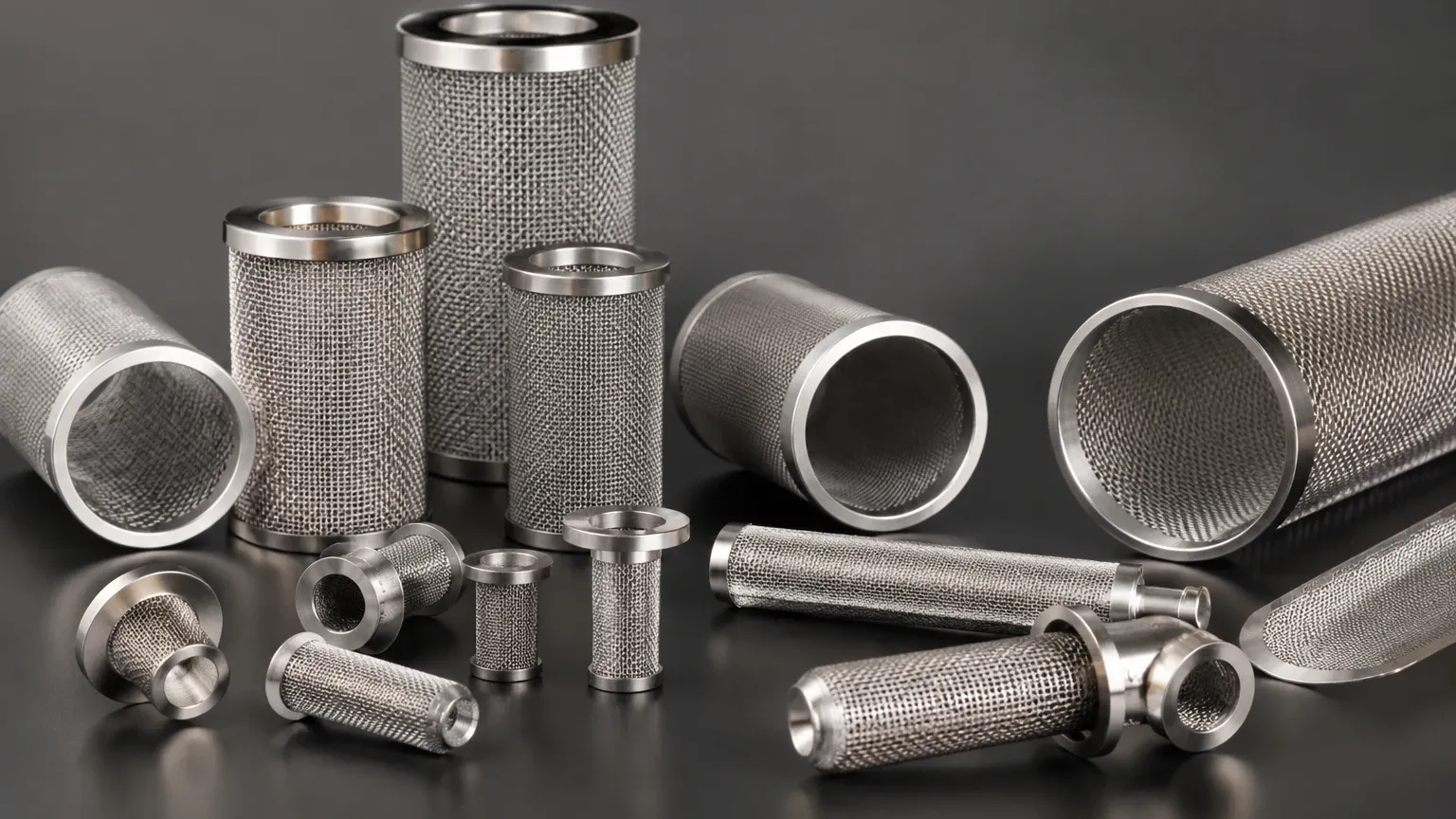
To meet the demands of industrial flow rates and pressure, mesh is rarely used as a standalone sheet. Instead, it is fabricated into rigid geometries. Wire Mesh Filter Cylinders & Tubes are the most common configurations, providing a high surface-area-to-volume ratio and ease of integration into standard filter housings.
Construction Methods
1. Single-Layer Cylinders: Best for coarse filtration or as a support structure for finer media. These are typically spot-welded or seam-welded.
2. Multi-Layer Sintered Mesh: Multiple layers of mesh are bonded together using heat and pressure without the use of binders. This creates a monolithic structure that combines fine filtration layers with heavy-duty support and drainage layers. Sintered tubes are virtually immune to media migration.
3. Pleated Designs: To increase the effective filtration area within a limited footprint, the mesh is pleated. This reduces the face velocity of the fluid, lowering the initial pressure drop and increasing the dirt-holding capacity.
Support Components
Industrial filter tubes often incorporate internal perforated metal cores or external cages. These supports prevent the mesh from collapsing under high differential pressure ($ΔP$), which can occur as the filter becomes loaded with contaminants.
Performance Metrics: Micron Ratings and Pressure Drop
When specifying a metal mesh water filter, engineers must balance filtration efficiency with system hydraulics. Two key metrics define this balance: the micron rating and the pressure drop.
Absolute vs. Nominal Ratings
* Nominal Rating: An approximate value indicating that the filter will retain a majority of particles at that size (e.g., 90%). However, some larger particles may pass through due to the irregular shape of the apertures or wire deflection.
* Absolute Rating: The diameter of the largest hard spherical particle that will pass through the filter under specified test conditions. In critical industrial processes, absolute-rated metal mesh is required to ensure consistent water quality.
Pressure Drop (ΔP)
The resistance to flow offered by the filter is the pressure drop. It is influenced by the fluid viscosity, flow velocity, and the open area of the mesh. A well-designed filter system should operate at a low initial ΔP (typically < 2-5 psi). As solids accumulate, ΔP increases. Engineering specifications must define the "terminal pressure drop"—the point at which the filter must be cleaned or replaced to prevent bypass or structural failure.
Industrial Applications and Chemical Compatibility
The versatility of the metal mesh water filter makes it applicable across diverse sectors:
* Food and Beverage: Used for clarifying process water and protecting bottling equipment. Stainless steel construction ensures compliance with hygiene standards and allows for Clean-in-Place (CIP) sterilization.
* Pharmaceuticals: Fine mesh tubes are used in the production of Purified Water (PW) and Water for Injection (WFI), where the absence of fiber shedding is critical.
* Hydraulic Systems: Metal mesh elements protect sensitive valves and actuators from particulate wear in high-pressure water-glycol hydraulic fluids.
* Chemical Processing: Used for the filtration of aggressive solvents, acids, and bases where polymer filters would dissolve or swell.
Compatibility is not limited to the fluid itself but also extends to the cleaning agents used. Stainless steel filters can withstand caustic washes and acidic descaling, which are common in heavy industrial maintenance cycles.
Installation, Maintenance, and Cleaning Protocols
Proper installation is vital to ensure that fluid does not bypass the filter element. Most Wire Mesh Filter Cylinders & Tubes utilize gaskets or O-rings made of EPDM, Viton, or PTFE to create a positive seal within the housing. Engineers should verify that the seal material is compatible with the operating temperature and chemical composition of the water.
Cleaning Methods
One of the greatest advantages of metal mesh is its cleanability. Common methods include:
* Backpulsing/Backwashing: Reversing the flow of fluid to dislodge particles from the surface. This is often automated in industrial water systems.
* Ultrasonic Cleaning: Submerging the element in an ultrasonic bath with a cleaning solution. The cavitation bubbles reach deep into the mesh pores to remove fine particulates.
* Chemical Cleaning: Using solvents or detergents to dissolve organic fouling or mineral scale.
Because metal mesh does not fatigue as easily as synthetic fibers, these elements can be cleaned dozens of times before the mesh integrity is compromised, provided the cleaning method does not exceed the material's mechanical limits.
Selection Guide for Procurement and Engineering Teams
Before purchasing or commissioning custom filtration components, procurement teams should confirm the following technical parameters with the manufacturer:
1. Operating Flow Rate: Measured in GPM or m³/h. This determines the required surface area to maintain an acceptable pressure drop.
2. Particle Size Distribution: Understanding the nature of the contaminants helps in choosing between plain, twill, or Dutch weaves.
3. Maximum Operating Pressure and Temperature: Ensures the structural supports and weld types are sufficient for the environment.
4. Housing Compatibility: Confirming the end-cap style (e.g., Double Open End, Code 7, or custom flanges) to ensure a leak-proof fit.
5. Total Cost of Ownership (TCO): While the initial cost of a stainless steel filter is higher than a disposable one, the reduction in waste disposal costs, downtime, and replacement frequency usually results in a lower TCO over a 12-to-24-month period.
By focusing on these factual engineering boundaries, facilities can implement filtration solutions that provide reliable, long-term performance in the most demanding water treatment applications.
