


Wire Mesh Filter Bag
In the landscape of industrial liquid filtration, the choice of filter media directly impacts process efficiency, downtime, and total cost of ownership. While synthetic felt and monofilament bags are common in low-temperature, disposable applications, the wire mesh filter bag has emerged as the standard for demanding industrial environments. These components, often constructed from high-grade stainless steel, provide a reusable, high-strength alternative capable of withstanding extreme temperatures and aggressive chemical profiles.
Selecting the correct filtration component requires a deep understanding of fluid dynamics, material science, and mechanical constraints. This guide examines the technical nuances of wire mesh filter bags, providing engineers and purchasing teams with the factual data needed to optimize their filtration systems.
Understanding the Wire Mesh Filter Bag in Industrial Systems
A wire mesh filter bag is a precision-engineered filtration element designed to remove solid contaminants from liquid streams. Unlike depth filtration media, which trap particles within a thick matrix of fibers, wire mesh operates primarily through surface filtration. This means particles larger than the mesh pore size are intercepted at the surface, forming a filter cake that can, in some instances, further refine the filtration process.
In industrial B2B contexts, these bags are typically integrated into standard bag filter housings (Size #1, #2, #3, or #4). However, unlike their polyester or polypropylene counterparts, stainless steel wire mesh bags offer rigid or semi-rigid structural integrity. This allows them to maintain their shape under fluctuating pressure conditions, preventing the "bypass" or "media migration" often seen with flexible synthetic bags.
For applications requiring even higher mechanical stability or specialized flow paths, engineers often specify Wire Mesh Filter Cylinders & Tubes. These components share the same foundational mesh technology but are engineered for permanent installation or high-pressure housings where a standard bag geometry may not suffice.
Material Engineering: Stainless Steel vs. Synthetic Media
The primary advantage of a wire mesh filter bag lies in its material composition. Most industrial variants are manufactured from AISI 304 or AISI 316L stainless steel. The choice between these materials is governed by the chemical nature of the filtrate and the operating temperature.
AISI 304 Stainless Steel
304 stainless steel is the standard grade for general industrial use. It offers excellent resistance to atmospheric corrosion and is suitable for most water-based applications, food and beverage processing, and light chemical filtration. It is cost-effective but may be susceptible to pitting in high-chloride environments.
AISI 316L Stainless Steel
For more aggressive environments, 316L is the preferred specification. The addition of molybdenum enhances resistance to acetic acids, sulfuric acids, and chloride-induced pitting. The "L" denotes low carbon content, which is critical for components that require welding, as it prevents carbide precipitation and ensures the structural integrity of the bag’s seams and flanges.
Thermal and Chemical Thresholds
Synthetic bags (polypropylene/polyester) typically fail or degrade at temperatures exceeding 90°C to 150°C. In contrast, a stainless steel wire mesh filter bag can operate at temperatures exceeding 400°C, provided the seals and housing gaskets are rated accordingly. This makes them indispensable in hot oil filtration, steam processing, and high-temperature chemical synthesis.
Key Technical Specifications and Weave Types
The performance of a wire mesh filter bag is defined by its weave type, which determines the micron rating, flow resistance, and cleaning characteristics. There are three primary weaves used in industrial filtration:
1. Plain Square Weave
This is the most common weave, where the warp and shute wires pass over and under each other alternately. It provides a high percentage of open area, resulting in low initial pressure drop and high flow rates. It is ideal for coarse filtration (typically 50 microns and above).
2. Twilled Weave
In a twilled weave, each warp and shute wire passes over and under two successive wires. This allows for the use of heavier wires in a given mesh count, increasing the mechanical strength of the bag. It is often used for finer filtration requirements where the mesh must withstand higher differential pressures.
3. Dutch Weave (Plain and Twilled)
Dutch weaves utilize a higher density of smaller diameter wires in one direction, creating a "tortuous path" for the fluid. This results in much finer filtration ratings (down to 5–10 microns) and superior strength. While the open area is lower than square weaves, the structural rigidity is significantly higher, making it the choice for high-pressure industrial applications.
Selection Criteria for Engineering and Purchasing Teams
When specifying a wire mesh filter bag, engineers must evaluate several variables to ensure the component meets the application's demands without premature failure.
Micron Rating: Absolute vs. Nominal
In wire mesh filtration, the micron rating is generally considered "absolute." Because the pores are fixed by the mechanical intersection of wires, they do not stretch or enlarge under pressure. This is a critical distinction from synthetic bags, which are often rated "nominally" because their fiber matrix can shift, allowing larger particles to pass through as differential pressure increases.
Flow Rate and Viscosity
The viscosity of the liquid significantly impacts the pressure drop across the mesh. High-viscosity fluids (such as resins, polymers, or heavy oils) require a larger surface area or a coarser mesh to maintain acceptable flow rates. If the required flow rate exceeds the capacity of a single bag, duplex systems or larger Wire Mesh Filter Cylinders & Tubes should be considered to distribute the load.
Differential Pressure (ΔP)
The maximum allowable differential pressure for a stainless steel mesh bag is typically higher than that of a synthetic bag. However, exceeding the ΔP limit can lead to mesh deformation or seam failure. Most industrial systems are designed for a change-out or cleaning cycle when the ΔP reaches 0.7 to 1.0 bar (10-15 psi).
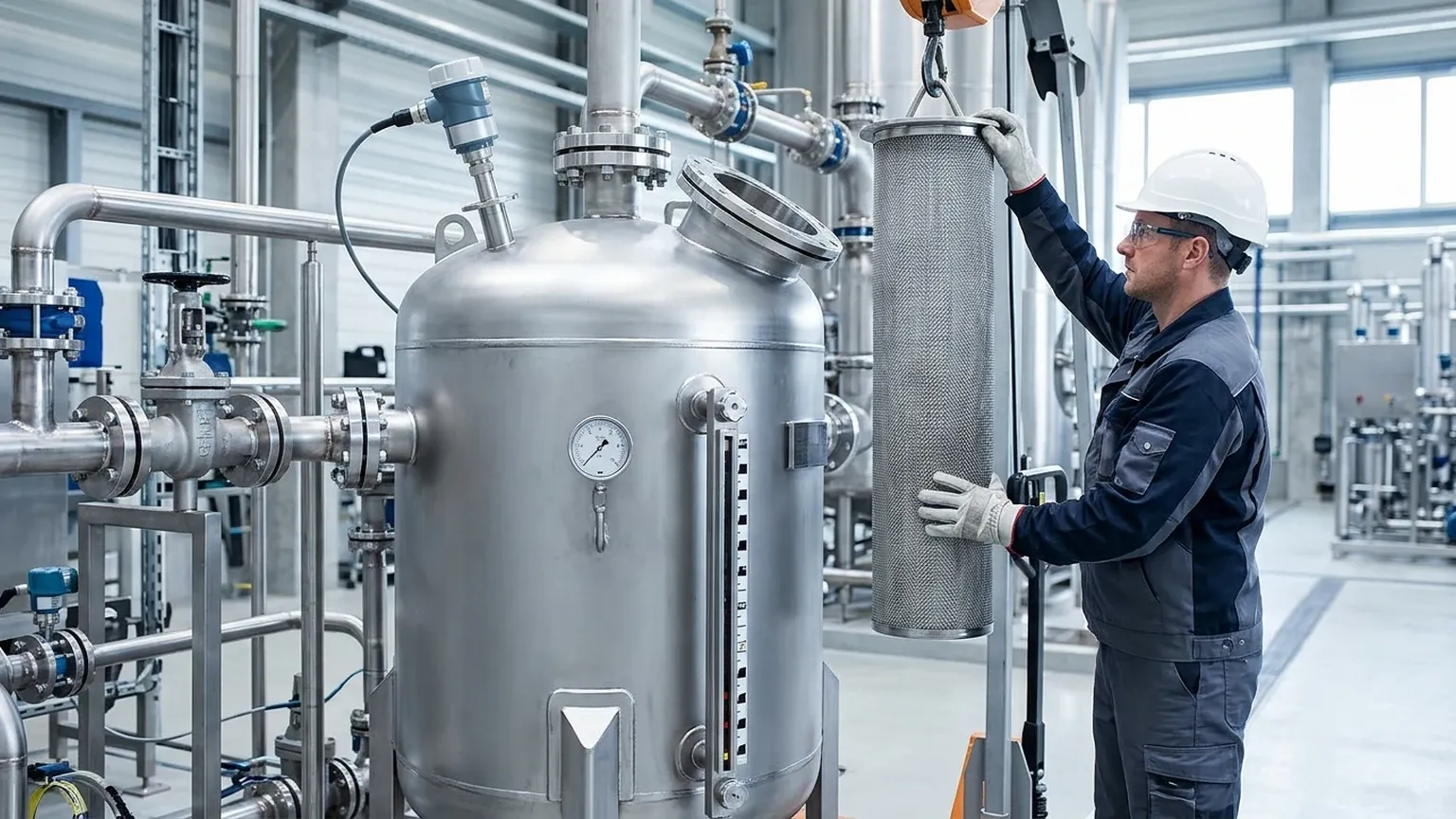
Installation Constraints and Operational Maintenance
Proper installation is essential to prevent bypass—a condition where unfiltered liquid escapes around the seal of the bag. Most wire mesh filter bags are designed with a metal ring (carbon steel or stainless steel) or a specialized flange (such as a Sentinel-style plastic flange, though less common for all-metal bags) that seats into the housing's internal basket.
Cleaning and Reusability
One of the strongest B2B arguments for wire mesh is reusability. Depending on the contaminant, these bags can be cleaned via:
* Backwashing: Reversing the flow of clean fluid through the mesh to dislodge particles.
* Ultrasonic Cleaning: Using high-frequency sound waves in a solvent bath to remove fine particulates from the weave intersections.
* Chemical Cleaning: Using compatible acids or bases to dissolve organic or mineral buildup.
This reusability significantly reduces the waste disposal costs associated with contaminated synthetic bags, aligning with corporate sustainability goals and reducing long-term operational expenditure (OPEX).
Customization and Integration with Specialized Components
Industrial processes rarely fit a "one size fits all" model. Customization of the wire mesh filter bag is often necessary to accommodate unique housing dimensions or specific filtration challenges. This includes variations in length, diameter, and the addition of reinforcement layers.
In many high-pressure hydraulic or chemical injection systems, a standard bag may not provide the necessary burst strength. In these instances, engineers transition to Wire Mesh Filter Cylinders & Tubes. These rigid components can be manufactured with perforated metal internal cores or external shrouds, providing the structural support needed to handle differential pressures that would collapse a standard mesh bag.
Furthermore, customization allows for the integration of magnetic inserts to capture ferrous fines or the use of multi-layered sintered mesh for applications requiring extreme precision and the ability to withstand frequent high-pressure pulse cleaning.
Total Cost of Ownership (TCO) Considerations
While the initial purchase price of a stainless steel wire mesh filter bag is higher than a disposable polyester bag, the TCO analysis often favors the metal solution. Factors to include in a B2B cost analysis include:
1. Replacement Frequency: Metal bags can last for years with proper cleaning, whereas synthetic bags may be replaced daily or weekly.
2. Disposal Costs: Contaminated disposable filters often require hazardous waste disposal, which is priced by weight or volume. Reusable filters eliminate this recurring cost.
3. Downtime: Longer-lasting filter media reduces the frequency of system shutdowns for filter changes.
4. Product Loss: Rigid mesh structures ensure consistent filtration quality, reducing the risk of off-spec product batches.
Conclusion
The selection of a wire mesh filter bag is a technical decision that impacts the reliability and efficiency of industrial processing. By prioritizing material compatibility, understanding weave dynamics, and considering the long-term benefits of reusability, engineering teams can implement filtration solutions that withstand the rigors of modern manufacturing. Whether the application calls for a standard bag configuration or specialized Wire Mesh Filter Cylinders & Tubes, the focus must remain on precision, durability, and the specific mechanical requirements of the fluid stream.
