


Engineering Guide to Wire Mesh Bypass Filter 50um Solutions
In industrial fluid systems, maintaining the integrity of sensitive downstream components requires a strategic approach to filtration. The wire mesh bypass filter 50um is a critical component designed to provide precise particulate control while ensuring system continuity. Unlike primary full-flow filters, bypass filters—often constructed as Wire Mesh Filter Cylinders & Tubes—serve as a secondary line of defense or a continuous polishing loop to capture contaminants that could compromise instrumentation, valves, or high-precision pumps.
Selecting a 50-micron (um) filter involves more than simply matching a pore size. It requires an understanding of fluid dynamics, material compatibility, and the mechanical stresses inherent in industrial environments. This guide examines the technical specifications, engineering considerations, and application-specific requirements for 50um wire mesh bypass filtration.
Understanding the 50-Micron Filtration Threshold
A 50um rating sits at a pivotal intersection in industrial filtration. It is fine enough to capture the majority of suspended solids, pipe scale, and metallic burrs that cause mechanical wear, yet coarse enough to maintain a manageable pressure drop in high-viscosity fluids like hydraulic oils or heavy chemical resins.
Nominal vs. Absolute Ratings
When specifying a wire mesh bypass filter 50um, engineers must distinguish between nominal and absolute ratings.
- Nominal Rating: Indicates the ability of the mesh to retain a percentage of particles of a certain size (e.g., 95% of 50um particles).
- Absolute Rating: Refers to the diameter of the largest hard spherical particle that will pass through the mesh under specified test conditions. For critical bypass applications, such as protecting industrial level measurement sensors, an absolute rating is typically preferred to ensure no particles larger than the specified gap can interfere with sensitive instrument floats or optical paths.
The Role of Wire Mesh Filter Cylinders & Tubes in Bypass Systems
The geometry of the filter element significantly impacts its performance. Wire Mesh Filter Cylinders & Tubes are the industry standard for bypass configurations due to their structural rigidity and high effective filtration area (EFA).
Structural Integrity
In a bypass system, the filter may be subjected to sudden pressure spikes if the main flow path is restricted. Stainless steel cylinders, often reinforced with internal perforated cores or external support cages, provide the mechanical strength necessary to resist collapse or bursting. Kaifil utilizes advanced welding techniques, including TIG and plasma welding, to ensure that the longitudinal seams of the cylinders maintain the same filtration integrity as the mesh itself.
Flow Dynamics
The cylindrical shape allows for uniform flow distribution across the mesh surface. This reduces localized high-velocity zones that could cause "particle breakthrough," where flexible contaminants are forced through the mesh openings by fluid pressure. By optimizing the length-to-diameter ratio of the filter tube, engineers can balance the required 50um precision with the system's total flow requirements.
Material Selection for Industrial Environments
Material science is the foundation of durable filtration. For a wire mesh bypass filter 50um, the choice of alloy dictates the filter's lifespan and its resistance to chemical degradation.
1. AISI 304 Stainless Steel: The standard choice for general industrial applications, providing good corrosion resistance and mechanical strength at a cost-effective price point. It is suitable for water treatment and basic hydraulic applications.
2. AISI 316L Stainless Steel: Specified for more demanding environments, such as chemical processing or pharmaceutical manufacturing. The addition of molybdenum enhances resistance to pitting and crevice corrosion, particularly in chloride-rich environments.
3. Specialty Alloys: In highly corrosive or high-temperature applications (exceeding 400°C), alloys like Monel, Inconel, or Hastelloy may be required. These materials maintain the 50um aperture stability even under extreme thermal expansion and contraction.
Engineering Considerations for Bypass Integration
Integrating a 50um bypass filter into an existing industrial process requires a thorough analysis of the system's operating parameters.
Pressure Drop ($ΔP$)
The clean pressure drop is a function of fluid viscosity, flow velocity, and the open area of the 50um mesh. A wire mesh bypass filter 50um with a plain square weave offers a high open area, which minimizes initial $ΔP$. However, as the filter accumulates debris, the pressure drop will rise. Engineers must specify the "terminal pressure drop"—the point at which the filter must be cleaned or replaced to prevent system bypass valves from opening prematurely.
Dirt Holding Capacity
Because bypass filters often operate continuously, their dirt holding capacity determines the maintenance interval. Using pleated Wire Mesh Filter Cylinders & Tubes can increase the surface area by 2x to 4x compared to a smooth-walled cylinder, significantly extending the time between service cycles without increasing the filter's footprint.
Compatibility with Level Measurement Instrumentation
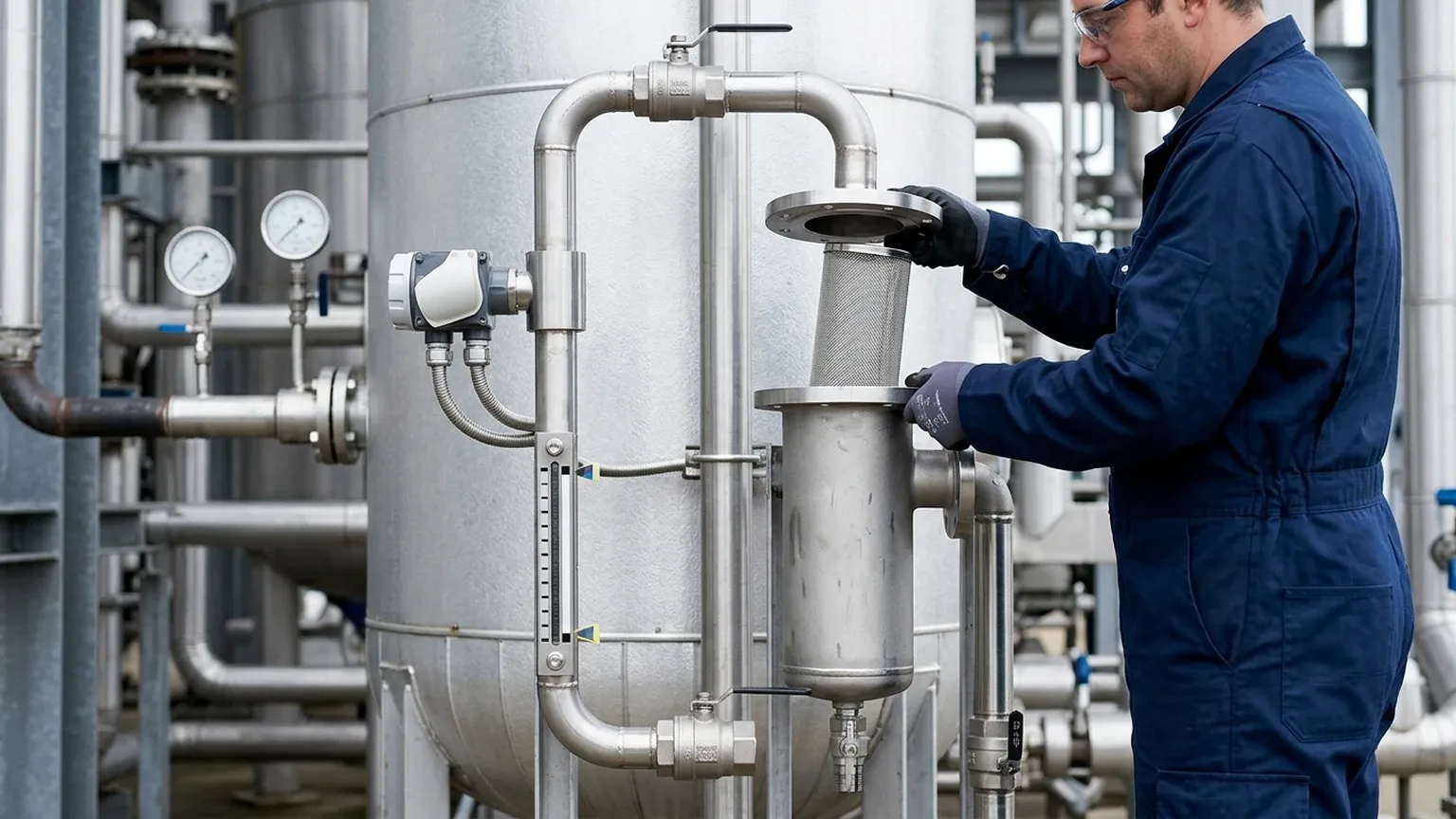
In many B2B industrial setups, bypass filters are installed upstream of level measurement devices, such as magnetic level gauges or radar chambers. A 50um filter ensures that magnetic particles do not coat the internal float (which would affect buoyancy) and prevents sediment from settling in the bottom of the chamber, which could lead to false readings or mechanical sticking. For these applications, the filter housing must be designed for easy access to allow for rapid inspection without decommissioning the entire measurement loop.
Weave Types for 50um Precision
The method used to weave the wire mesh determines the precision and strength of the 50um openings.
- Plain Square Weave: The simplest and most common weave where each warp wire crosses over and under each weft wire. It provides excellent flow rates and is easy to clean via backwashing.
- Dutch Weave: This weave uses heavier warp wires and finer weft wires driven closely together. While it provides a more tortuous path (depth filtration) and higher strength, it is more challenging to clean than plain weave. For a 50um bypass application, a Plain Dutch Weave (PDW) is often used when high mechanical pressure is expected.
- Twilled Weave: Used when thicker wires are required for a specific micron rating to increase the mesh's durability. The wires pass over two and under two, allowing for a heavier wire diameter than plain weave for the same 50um aperture.
Procurement Checklist for International Buyers
When sourcing a wire mesh bypass filter 50um from a manufacturer like Kaifil, technical buyers should confirm the following data points to ensure the component meets the application's rigorous demands:
1. Micron Verification: Request a bubble point test report or a glass bead test certification to verify the 50um absolute rating.
2. Material Certification: Ensure the supplier provides Mill Test Reports (MTR) for the stainless steel grade to guarantee chemical composition and corrosion resistance.
3. Welding Standards: For high-pressure systems, confirm that the longitudinal and end-cap welds are performed using automated processes to eliminate human error and ensure consistency.
4. Cleaning Protocols: Determine if the filter is intended for single use or if it can be ultrasonically cleaned. Stainless steel wire mesh is generally reusable, which lowers the total cost of ownership (TCO) compared to disposable synthetic media.
5. Customization Options: Confirm the availability of custom end-fittings (e.g., NPT threads, flanges, or O-ring seals) to ensure a leak-free integration into the bypass manifold.
Installation and Maintenance Best Practices
To maximize the performance of Wire Mesh Filter Cylinders & Tubes, proper installation is paramount. The filter should be oriented to allow for natural drainage during maintenance. In bypass loops, installing isolation valves on both sides of the filter housing allows for "hot-swapping" or cleaning the element while the main process remains online.
Maintenance cycles should be data-driven. By installing differential pressure gauges across the bypass filter, operators can monitor the exact state of the 50um mesh. A sudden drop in differential pressure may indicate a mesh failure or "channeling," while a rapid increase suggests a spike in system contamination that may require investigation into upstream components.
Conclusion
The wire mesh bypass filter 50um is a sophisticated engineering solution that balances precision, durability, and flow efficiency. By utilizing high-quality Wire Mesh Filter Cylinders & Tubes, industrial facilities can protect expensive instrumentation and maintain process stability in the face of varying contaminant loads. Whether the application involves hydraulic fluid conditioning, chemical purification, or protecting level measurement sensors, understanding the nuances of mesh weave, material selection, and structural design is essential for achieving long-term operational success.
