


Engineering Guide to Wire Mesh Pipe Filters: Selection, Performance, and Industrial Integration
In industrial fluid systems, the integrity of downstream equipment—such as high-pressure pumps, spray nozzles, and sensitive instrumentation—depends heavily on the efficiency of primary filtration components. The wire mesh pipe filter, a specialized variant of Wire Mesh Filter Cylinders & Tubes, serves as a critical line of defense. These components are engineered to remove particulate matter from liquid or gas streams while maintaining structural stability under varying thermal and mechanical loads.
For engineers and procurement specialists, selecting the correct filtration medium involves more than simply matching a pipe diameter. It requires a deep understanding of fluid dynamics, material science, and the specific mechanical constraints of the application. This guide examines the technical parameters that define high-performance wire mesh filtration and provides a framework for specifying these components in industrial environments.
1. Operating Principles of Wire Mesh Pipe Filters
At its core, a wire mesh pipe filter operates on the principle of surface filtration. Unlike depth filters (such as sand or fiber cartridges) that trap particles within a thick medium, wire mesh captures contaminants on the surface of the weave. This mechanism offers several distinct advantages in industrial B2B applications, including predictable pore sizes and ease of cleaning.
The Sieve Effect and Pore Geometry
The filtration accuracy is determined by the "aperture" or the clear opening between the wires. In a standard square weave, this is a straightforward calculation. However, for finer filtration requirements, specialized weaves like Dutch weave or Twilled Dutch weave are employed. These weaves create a tortuous path for the fluid, allowing for higher mechanical strength and finer micron ratings (down to 5-10 microns) without sacrificing the structural integrity of the cylinder.
Flow Dynamics and Pressure Drop (ΔP)
One of the most critical engineering considerations is the clean pressure drop. As fluid passes through the wire mesh, it encounters resistance. This resistance is a function of the fluid's viscosity, velocity, and the "open area" percentage of the mesh. An undersized wire mesh pipe filter will cause an excessive pressure drop, leading to cavitation in pumps or reduced system throughput. Engineers must calculate the effective filtration area (EFA) to ensure that the flux rate remains within the laminar flow regime whenever possible.
2. Material Selection and Corrosion Resistance
Industrial filtration environments are often chemically aggressive or subject to extreme temperatures. Kaifil specializes in stainless steel solutions because of the material's inherent durability and resistance to oxidation.
* AISI 304 Stainless Steel: The standard choice for general industrial applications, including water treatment and basic hydraulic systems. It offers good corrosion resistance and excellent formability.
* AISI 316/316L Stainless Steel: For chemical processing, pharmaceutical, and marine environments, 316L is preferred due to the addition of molybdenum, which enhances resistance to pitting and crevice corrosion, particularly in chloride-rich environments. The "L" (low carbon) designation is crucial for components that require extensive welding, as it prevents carbide precipitation that could lead to intergranular corrosion.
* Exotic Alloys: In specialized cases involving high-temperature acids or extremely caustic fluids, alloys like Monel or Inconel may be utilized to ensure the longevity of the filter tube.
3. Structural Design and Reinforcement
A wire mesh pipe filter must withstand the differential pressure that builds up as the mesh becomes loaded with contaminants. Without proper reinforcement, the mesh can collapse or deform, leading to bypass or system failure.
Single-Layer vs. Multi-Layer Construction
For low-pressure applications with large particulate, a single layer of heavy-gauge wire mesh may suffice. However, most industrial applications utilize a multi-layer sintered or composite structure.
1. The Filtration Layer: The fine mesh that determines the micron rating.
2. The Support Layer: A coarser, heavier mesh that provides mechanical backing to the filtration layer.
3. The Protective Layer: An outer layer that shields the fine mesh from mechanical damage during installation or backwashing.
Perforated Core Integration
In high-pressure hydraulic or process piping, the wire mesh is often wrapped around or inserted into a perforated metal tube. This core acts as the primary load-bearing member, allowing the filter to withstand differential pressures exceeding several hundred PSI. The alignment of the mesh seams and the welding technique (typically TIG or plasma welding) are vital to ensure there are no "weak spots" where particles could bypass the filter.
4. Customization Parameters for OEM Applications
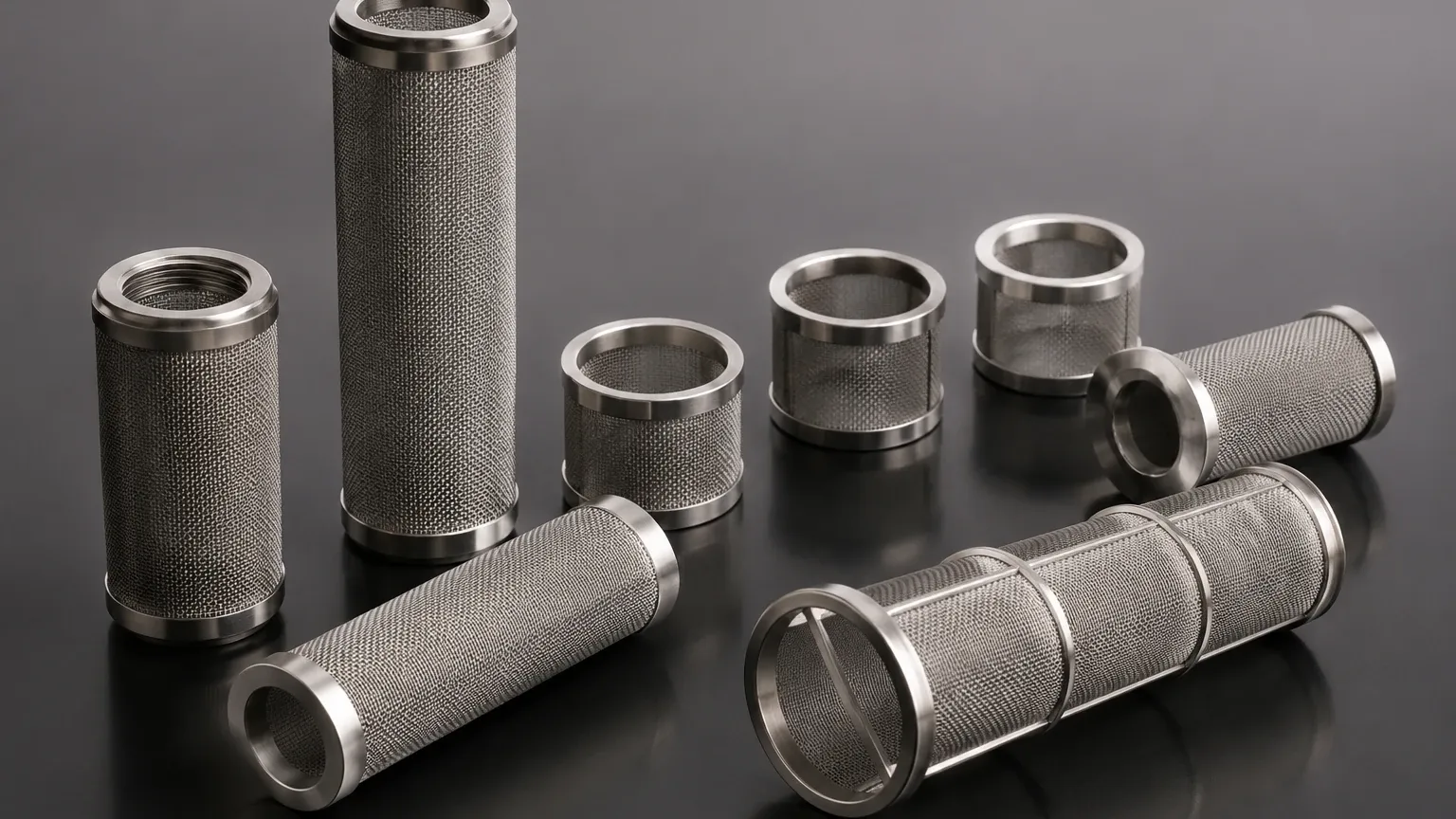
Because industrial systems vary widely in their geometry, off-the-shelf solutions are rarely optimal. Customization is a core requirement for effective system integration. When specifying Wire Mesh Filter Cylinders & Tubes, engineers should define the following parameters:
* Micron Rating (Nominal vs. Absolute): Nominal ratings indicate the ability to retain the majority of particles of a certain size, while absolute ratings guarantee 99.9% retention. This distinction is critical in pharmaceutical and food-grade applications.
* End Cap Configurations: Filters can be supplied with open ends, closed ends (flat or conical), threaded fittings (NPT/BSP), or specialized flanges. The sealing method—whether via O-rings, gaskets, or metal-to-metal contact—must be compatible with the process fluid.
* Dimensions: Precise outer diameter (OD), inner diameter (ID), and overall length (OAL) are necessary to ensure the filter fits within the housing without bypass gaps.
* Pleating: If a higher surface area is required within a small footprint, the mesh can be pleated. This can increase the effective filtration area by 3 to 5 times compared to a smooth cylinder, significantly extending the service life between cleanings.
5. Installation, Maintenance, and Total Cost of Ownership
The total cost of ownership (TCO) for a wire mesh pipe filter is influenced more by its service life and cleanability than by its initial purchase price. Unlike disposable polymer cartridges, stainless steel wire mesh filters are a long-term investment.
Cleaning and Regeneration
One of the primary benefits of stainless steel filtration is the ability to regenerate the media. Depending on the contaminant, filters can be cleaned using:
* Backwashing: Reversing the flow to dislodge particles from the surface.
* Ultrasonic Cleaning: Using high-frequency sound waves in a solvent bath to remove fine particles trapped deep within the weave.
* Chemical Cleaning: Using acids or alkalis to dissolve organic or mineral scaling (provided the material is compatible).
Installation Best Practices
During installation, it is imperative to ensure that seals are correctly seated. Even a microscopic gap between the filter end cap and the housing will allow the fluid to follow the path of least resistance, effectively bypassing the filter. In high-vibration environments, the use of reinforced support structures and secure fastening mechanisms is recommended to prevent fatigue cracking at the weld points.
6. Application Risks and Mitigation
While wire mesh filters are robust, certain application risks must be managed:
* Fatigue Failure: Constant pressure pulsations (common in hydraulic systems) can cause the wire mesh to flex and eventually fail. This is mitigated by using pleated designs with internal supports that limit mesh movement.
* Media Migration: In poorly manufactured filters, individual wires may break and enter the downstream flow. High-quality manufacturers like Kaifil use advanced sintering and welding processes to ensure media integrity.
* Incompatibility: Using 304 stainless steel in a high-chloride environment will lead to rapid failure. Always verify the chemical composition of the process fluid against the material's corrosion resistance profile.
Conclusion: Selecting the Right Filtration Partner
Specifying a wire mesh pipe filter requires a balance between filtration precision, mechanical strength, and flow capacity. By focusing on the technical nuances of weave types, material grades, and structural reinforcements, engineers can ensure their systems operate with maximum uptime and minimal maintenance.
As a professional manufacturer, Kaifil provides the engineering support necessary to bridge the gap between theoretical requirements and practical manufacturing. Whether you are designing a new system or looking to optimize an existing process, understanding the capabilities of Wire Mesh Filter Cylinders & Tubes is the first step toward achieving reliable industrial filtration performance.
When requesting a quote or technical consultation, providing detailed data on flow rates, fluid viscosity, operating temperature, and target particle size will allow for a more precise and cost-effective solution tailored to your specific industrial needs.
