


“`json
{
"body_markdown": "# Engineering Guide to Wire Mesh Filter Cylinders & Tubes: Selection and Application
In industrial process engineering, the efficiency of fluid and gas separation systems often hinges on the mechanical integrity and precision of the filtration media. Among the various geometries available, the wire mesh filter tube remains a staple due to its structural rigidity, high surface area-to-volume ratio, and predictable flow characteristics. As a specialized manufacturer, Kaifil provides engineered Wire Mesh Filter Cylinders & Tubes designed to withstand the rigorous demands of chemical processing, hydraulic systems, and pharmaceutical manufacturing.
Selecting the correct filtration component requires a deep understanding of material science, fluid dynamics, and mechanical stresses. This guide examines the technical parameters of wire mesh cylinders, offering engineers and procurement professionals the data needed to optimize filtration performance and reduce total cost of ownership.
Understanding the Wire Mesh Filter Tube Structure
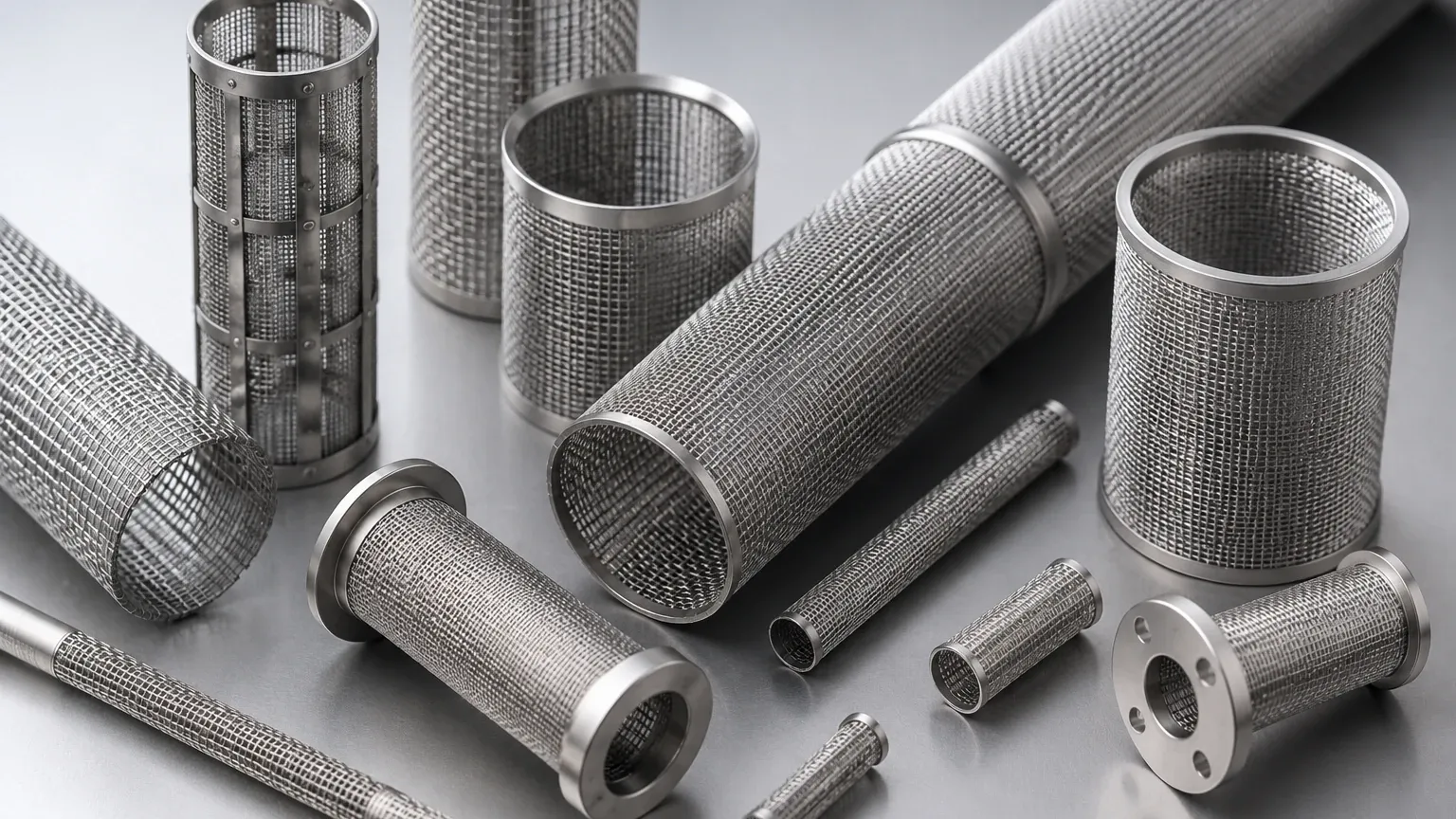
A wire mesh filter tube is a cylindrical filtration element constructed from woven metal cloth. Unlike disposable fiber filters, these metallic components are designed for durability and reusability. The cylindrical shape is inherently strong, allowing it to resist internal and external pressures that would deform flat mesh sheets.
The construction typically involves a single layer or multiple layers of stainless steel wire mesh. In multi-layer configurations, the layers are often sintered together or mechanically bonded to provide a combination of fine filtration and structural support. The longitudinal seam of the cylinder is joined using advanced welding techniques—such as TIG (Tungsten Inert Gas) or plasma welding—to ensure a leak-proof bond that matches the chemical resistance of the base material.
Key Structural Components:
1. Filter Media: The functional layer, usually a precision-woven wire mesh, which determines the micron rating.
2. Support Core: In high-pressure applications, a perforated metal tube or a coarser mesh layer is placed inside or outside the primary filter media to prevent collapse or bursting.
3. End Caps: These components facilitate the installation of the filter into a housing. Common configurations include Double Open End (DOE), Single Open End (SOE) with O-rings, or threaded connections.
Material Selection: Stainless Steel and Beyond
The choice of material is the most critical factor in determining the lifespan of a wire mesh filter tube. Industrial environments often involve corrosive fluids, extreme temperatures, and high-pressure cleaning cycles.
Stainless Steel 304
SS 304 is the standard grade for general industrial use. It offers good corrosion resistance and is suitable for most water treatment and food-grade applications where high concentrations of chlorides are not present.
Stainless Steel 316 and 316L
For chemical processing and marine environments, SS 316 is the preferred choice. The addition of molybdenum enhances resistance to pitting and crevice corrosion in chloride-rich environments. SS 316L (Low Carbon) is utilized specifically when extensive welding is required, as it minimizes carbide precipitation that can lead to intergranular corrosion at the weld seams.
Advanced Alloys
In specialized cases involving highly aggressive acids or extreme temperatures (exceeding 800°C), alloys such as Monel, Inconel, or Hastelloy may be employed. These materials ensure that the wire mesh filter tube maintains its pore geometry and mechanical strength under conditions that would cause standard stainless steel to fail.
Filtration Mechanics and Weave Types
The performance of Wire Mesh Filter Cylinders & Tubes is largely dictated by the weave pattern of the wire cloth. Each weave type offers a different balance of flow rate, filtration accuracy, and mechanical strength.
Plain Weave
This is the most common pattern, where each warp wire crosses over and under each shute wire. It provides a high percentage of open area and a straight-through flow path, making it ideal for low-pressure drop applications.
Twill Weave
In a twill weave, each wire passes over two and under two wires. This allows for the use of heavier wires for a given mesh count, resulting in a more robust wire mesh filter tube capable of handling higher mechanical loads.
Dutch Weave (Plain and Twill)
Dutch weaves utilize different diameters for warp and shute wires. This creates a dense, multi-layered structure within a single weave. Dutch weaves are characterized by their high filtration accuracy (down to 5-10 microns) and superior strength, though they typically exhibit a higher pressure drop than plain weaves.
Performance Parameters: Micron Rating and Pressure Drop
When specifying a wire mesh filter tube, engineers must distinguish between nominal and absolute micron ratings.
* Nominal Rating: Represents an approximate level of filtration, usually indicating that the mesh will retain a major percentage (e.g., 90%) of particles of a specific size.
* Absolute Rating: Refers to the diameter of the largest hard spherical particle that will pass through the filter under specified test conditions. For critical pharmaceutical or hydraulic applications, absolute ratings are mandatory to ensure system protection.
Managing Differential Pressure ($\Delta P$)
The pressure drop across a filter is a function of fluid viscosity, flow velocity, and the open area of the mesh. A well-designed wire mesh filter tube balances the need for fine filtration with the requirement for low initial $\Delta P$. As the filter accumulates contaminants, the $\Delta P$ increases. If the filter is not cleaned or replaced at the designated terminal pressure drop, the mesh may deform, or the system's pump efficiency will degrade significantly.
Engineering Considerations for Customization
Standard off-the-shelf filters rarely meet the specific needs of complex industrial systems. Customization of Wire Mesh Filter Cylinders & Tubes allows for optimization based on the following engineering factors:
Pleating for Increased Surface Area
To extend the service life between cleaning cycles, the wire mesh can be pleated before being formed into a cylinder. Pleating significantly increases the effective filtration area within the same footprint, reducing the flux (flow per unit area) and slowing the rate of pressure buildup.
Structural Reinforcement
For high-viscosity fluids or high-pressure systems, a wire mesh filter tube may require a perforated metal inner core. This core provides the necessary hoop strength to prevent the mesh from collapsing inward during outside-to-inside flow. Conversely, an outer cage may be used for inside-to-outside flow patterns.
Connection Interfaces
The method of sealing the filter into the housing is a common failure point. Options include:
* NPT/BSP Threaded Ends: For secure, high-pressure mechanical connections.
* 222/226 O-ring Fittings: Common in the food and beverage industry for sanitary, tool-free installation.
* Flanged Ends: Used in large-scale industrial piping where high flow rates and heavy filter elements are common.
Applications Across Key Industries
The versatility of the wire mesh filter tube makes it indispensable across diverse sectors.
Chemical and Petrochemical
In these industries, filters must withstand aggressive solvents and high temperatures. Stainless steel cylinders are used for catalyst recovery, monomer filtration, and protecting downstream sensitive equipment like spray nozzles and heat exchangers.
Food and Beverage
Sanitary standards require filters that are easy to clean and free of crevices where bacteria can grow. SS 316L wire mesh tubes are used for straining juices, filtering syrups, and removing particulates from steam used in sterilization processes.
Hydraulic and Lubrication Systems
Precision is paramount in hydraulics to prevent component wear. Wire mesh tubes serve as suction strainers or return line filters, removing metal shavings and environmental contaminants that could damage valves and pumps.
Maintenance, Cleaning, and Longevity
One of the primary B2B advantages of a stainless steel wire mesh filter tube over polymer-based media is its cleanability. Depending on the contaminant, several methods can be used to restore the filter’s performance:
1. Backwashing: Reversing the flow of fluid through the filter to dislodge particles from the surface of the mesh.
2. Ultrasonic Cleaning: Using high-frequency sound waves in a cleaning solution to remove fine particles lodged deep within the weave of Dutch weave meshes.
3. Chemical Cleaning: Utilizing mild acids or caustic solutions to dissolve organic or mineral deposits, provided the chemical is compatible with the filter’s alloy.
Replacement Indicators
While reusable, metal filters have a finite lifespan. Engineers should monitor for:
* Work Hardening: Repeated pressure cycles can cause the wire to become brittle.
* Permanent Deformation: If the terminal pressure drop is exceeded, the mesh may stretch, altering the micron rating.
* Corrosion Pitting: Even stainless steel can succumb to localized corrosion over time, leading to bypass leaks.
Conclusion: Selecting a Technical Partner
The procurement of Wire Mesh Filter Cylinders & Tubes is not merely a commodity purchase but a technical decision that impacts the reliability of an entire production line. Working with a manufacturer like Kaifil ensures that every aspect of the wire mesh filter tube—from the precision of the weave to the integrity of the weld—is engineered to meet specific application requirements.
By focusing on material compatibility, mechanical reinforcement, and accurate micron ratings, engineers can achieve a filtration solution that offers both high performance and long-term cost efficiency. Whether the application involves high-pressure hydraulics or sanitary food processing, the right wire mesh cylinder provides the essential barrier needed to maintain process purity and equipment health."
}
“`
