


1 4 Woven Wire Mesh
In the realm of industrial filtration and separation, precision and durability are the primary drivers of operational efficiency. Among the various specifications used by engineers and procurement teams, 1 4 woven wire mesh—referring either to a 1/4-inch aperture or a 4-mesh count—stands as a versatile standard for medium-coarse filtration, protective screening, and structural reinforcement.
Selecting the correct mesh involves more than just identifying the opening size. It requires a deep understanding of wire diameters, material grades, and weave types to ensure the component can withstand the thermal, chemical, and mechanical stresses of a specific environment. This guide provides a technical overview of 1 4 woven wire mesh, focusing on the engineering considerations necessary for high-performance industrial applications.
Understanding the Specifications of 1 4 Woven Wire Mesh
When discussing "1 4" mesh, it is critical to distinguish between the mesh count and the clear opening (aperture). In the industry, this term typically refers to two distinct but related specifications:
1. 4 Mesh: This indicates four openings per linear inch. The actual clear opening size will depend on the diameter of the wire used. For example, a 4-mesh screen with a 0.063-inch wire diameter results in an opening of 0.187 inches.
2. 1/4-Inch Opening: This specifies a clear space of 0.25 inches between wires. To achieve this, the mesh count must be adjusted based on the wire gauge. A true 1/4-inch opening often utilizes a heavier wire for structural stability, resulting in a mesh count slightly lower than 4.
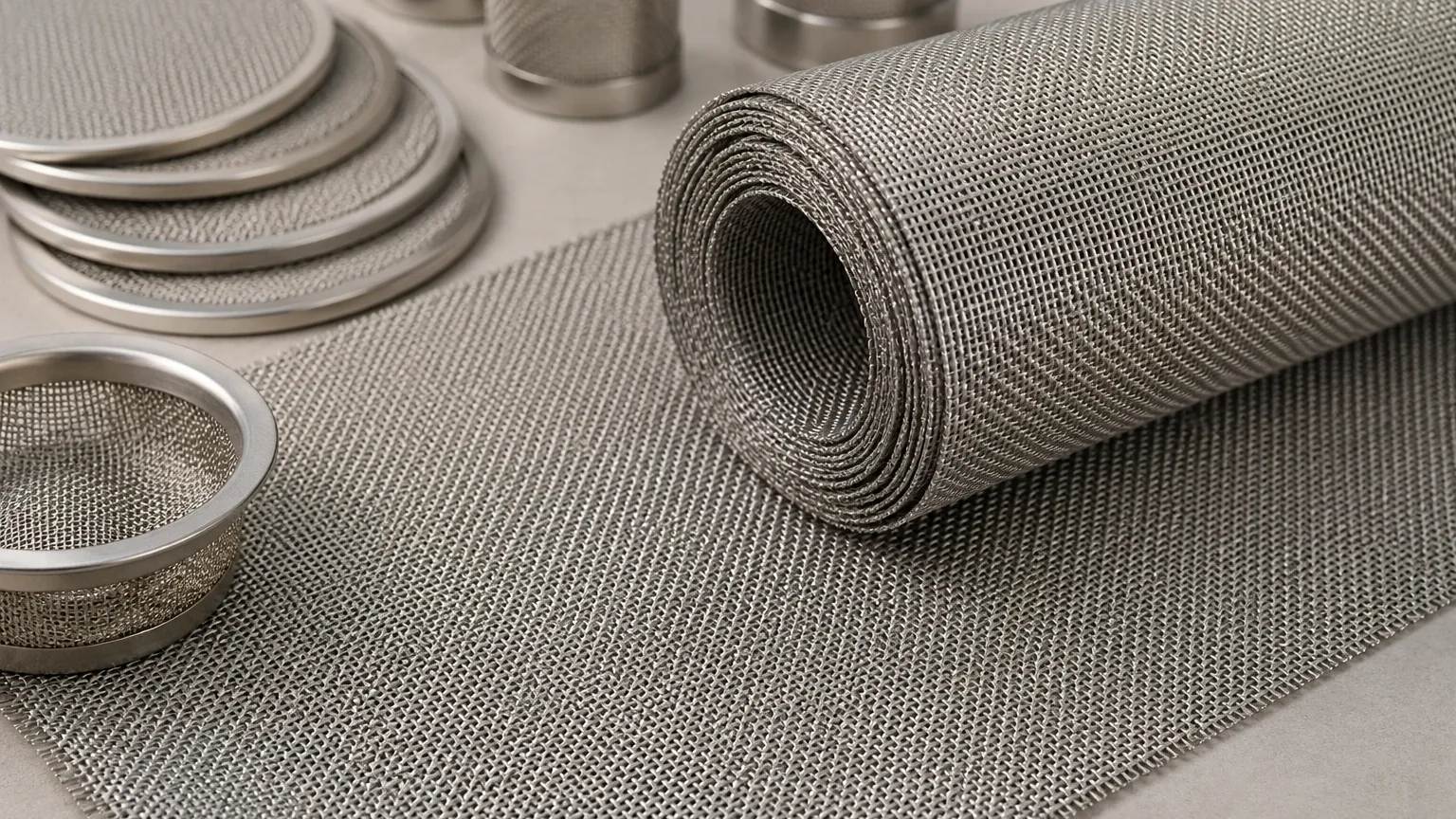
For most industrial filtration tasks, Plain, twill and dutch woven wire mesh in SS304/316L — rolls, cut mesh and framed panels. Send mesh count or micron target for a technical quote. is the starting point for determining the optimal balance between flow rate and particle retention.
The Impact of Wire Diameter
Wire diameter is the secondary variable that dictates the mesh's physical properties. A thicker wire increases the weight and mechanical strength of the Woven Wire Mesh, making it suitable for high-pressure hydraulic systems or heavy-duty vibratory screens. However, increasing the wire diameter simultaneously reduces the "open area percentage," which can restrict flow and increase pressure drop across the filter element.
Material Selection: SS304 vs. SS316L
The longevity of a 1 4 woven wire mesh component is largely determined by its alloy composition. While various metals can be woven, stainless steel remains the industry standard due to its corrosion resistance and thermal stability.
Stainless Steel 304
SS304 is the most common grade for general industrial use. It offers excellent resistance to atmospheric corrosion and is widely used in food processing and architectural applications. It is cost-effective but may struggle in environments with high chloride concentrations or extreme acidity.
Stainless Steel 316L
For more demanding environments, such as chemical processing plants, marine applications, or pharmaceutical manufacturing, SS316L is the preferred choice. The addition of molybdenum provides superior resistance to pitting and crevice corrosion in chloride-rich environments. The "L" denotes low carbon content, which minimizes carbide precipitation during welding, ensuring the structural integrity of custom-fabricated filter cartridges or framed panels.
Engineering Calculations: Open Area and Flow Rate
For engineers, the most critical metric for Woven Wire Mesh is the percentage of open area. This value determines the filtration capacity and the velocity of the fluid passing through the medium. The formula for calculating open area in a square mesh is:
Open Area % = (Aperture / (Aperture + Wire Diameter))² x 100
For a 1 4 woven wire mesh (4 mesh) with a 0.063-inch wire:
* Aperture = 0.187"
* Wire Diameter = 0.063"
* Pitch = 0.25"
* Open Area = (0.187 / 0.25)² x 100 ≈ 56%
A 56% open area provides a robust balance, allowing for high throughput while maintaining enough metal mass to resist deformation under high-flow velocities. If the application requires higher precision or finer filtration, engineers might move toward a Dutch weave, which overlaps wires to create smaller, more complex pore structures while maintaining high mechanical strength.
Common Industrial Applications
Because of its relatively large opening size, 1 4 woven wire mesh is frequently utilized as a primary filtration stage or a protective barrier in multi-stage systems.
1. Pre-Filtration and Trash Racks
In water treatment and chemical processing, 1/4-inch mesh serves as a pre-filter to remove large debris, protecting sensitive downstream equipment like high-pressure pumps and fine-micron membrane filters. Its durability allows it to handle heavy solids loading without immediate clogging.
2. Food and Beverage Processing
Stainless steel mesh is essential in food production for grading, sifting, and scalping. The 1/4-inch specification is often used for fruit processing, nut sizing, or as a support structure for finer mesh layers in juice filtration. Compliance with food safety standards requires smooth weaves that prevent material entrapment and allow for thorough Clean-in-Place (CIP) cycles.
3. Catalyst Support and Heat Treatment
In petrochemical reactors, heavy-gauge woven mesh acts as a support grid for catalyst beds. The mesh must maintain its shape under extreme temperatures. Similarly, in heat treatment facilities, 1/4-inch mesh baskets allow for uniform airflow and heat distribution around metal parts during quenching or annealing processes.
4. Protective Guards and Infills
Beyond filtration, 1 4 woven wire mesh is used for machinery safety guards. It provides a clear line of sight for operators while preventing hands or tools from entering dangerous zones. Its high strength-to-weight ratio also makes it a popular choice for architectural infill panels and security screens.
Selection Criteria: Choosing the Right Weave
The method of weaving significantly alters the performance of the mesh. While plain weave is the most common for 1/4-inch specifications, other options exist for specialized needs:
* Plain Weave: Each shute wire passes alternately over and under each warp wire. This is the most stable and economical weave for 4-mesh specifications, providing consistent aperture sizes.
* Twill Weave: Each shute wire passes alternately over and under two warp wires. This allows for a heavier wire diameter than plain weave for a given mesh count, increasing the pressure rating of the filter component.
* Dutch Weave: This utilizes different wire diameters in the warp and shute directions. While less common in 1/4-inch sizes, it is the standard for high-pressure precision filtration where a defined micron rating is required.
Customization and OEM Considerations
Standard off-the-shelf mesh rolls often require secondary processing to meet specific industrial requirements. When sourcing 1 4 woven wire mesh, engineers should consider the following customization options provided by specialized manufacturers like Kaifil:
* Edge Treatments: For mesh used in vibrating screens or removable filters, edges can be hemmed, bound with metal U-binding, or welded to prevent fraying and ensure operator safety.
* Framed Panels: Mesh can be integrated into rigid stainless steel frames for use as intake screens or architectural panels. This ensures dimensional stability under mechanical load.
* Cylindrical and Conical Shapes: For hydraulic and pipeline filtration, the mesh is often rolled and seam-welded into cartridges. Precision welding is vital here to ensure the filtration rating is not compromised at the seam.
* Surface Finishes: Options such as electropolishing can improve the corrosion resistance and cleanliness of the mesh, which is particularly important in pharmaceutical and biotech applications.
Maintenance and Total Cost of Ownership
While the initial purchase price of Woven Wire Mesh is a factor, the total cost of ownership (TCO) is driven by the replacement cycle and cleaning efficiency. Stainless steel 1/4-inch mesh is designed for long-term reuse, but its lifespan depends on proper maintenance.
Cleaning Protocols
In applications involving sticky or viscous fluids, mesh can suffer from "blinding" (clogging of the apertures). Ultrasonic cleaning or high-pressure backwashing are effective methods for restoring flow. Because stainless steel is chemically stagnant, it can withstand aggressive chemical cleaning agents that would degrade synthetic filters.
When to Replace
Industrial filters should be inspected regularly for:
* Wire Thinning: Caused by abrasive particles in the flow stream.
* Deformation: "Belly" or sagging in the mesh indicates the pressure drop has exceeded the material's yield strength.
* Pitting: Small holes or discoloration, indicating chemical attack (often a sign that a move from SS304 to SS316L is necessary).
By selecting a high-quality manufacturer that provides verified material mill certificates and precise weaving tolerances, procurement teams can significantly extend the interval between replacements, reducing downtime and operational costs.
Conclusion
The selection of 1 4 woven wire mesh is a technical decision that impacts the safety, efficiency, and cost-effectiveness of industrial processes. By evaluating the specific needs of the application—whether it be the high-corrosion environment of a chemical plant or the hygienic requirements of a food processing line—engineers can specify the exact wire diameter, material grade, and fabrication style required.
Working with a manufacturer that understands these technical nuances ensures that the final filtration component delivers reliable performance in the most demanding environments. Whether you require bulk rolls or custom-engineered filter elements, focusing on material integrity and geometric precision is the key to optimized filtration.
