


Steel Woven Wire Mesh Panels: An Engineering and Procurement Guide
In industrial filtration and separation processes, the selection of the correct media is critical to operational efficiency, equipment longevity, and product purity. Among the most versatile and durable options available to engineers today are steel woven wire mesh panels. These components serve as the primary barrier in applications ranging from chemical processing and pharmaceutical manufacturing to high-pressure hydraulic systems and food production.
Understanding the technical nuances of Woven Wire Mesh—from the specific alloy composition to the physics of the weave pattern—is essential for any procurement or engineering team. This guide provides a comprehensive technical overview of steel woven wire mesh panels, focusing on material selection, structural configurations, and performance metrics required for demanding industrial environments.
1. Engineering Fundamentals of Woven Wire Mesh
At its core, woven wire mesh is produced by interlacing longitudinal (warp) wires and transverse (shute) wires on sophisticated industrial looms. Unlike welded wire mesh, which relies on localized heat to join wires, woven mesh maintains its integrity through mechanical tension and the physical geometry of the weave. This allows for a higher degree of flexibility and a wider range of aperture sizes, which can be engineered down to the micron level.
For industrial applications, the precision of the aperture is the most critical variable. Engineers must consider the relationship between the mesh count (the number of openings per linear inch) and the wire diameter. As the wire diameter increases, the structural strength of the panel improves, but the percentage of open area decreases. This trade-off directly impacts flow rates and pressure drops across the filtration system.
When specifying mesh for high-performance environments, it is necessary to calculate the "Open Area" percentage using the formula:
*Percentage of Open Area = (Aperture / (Aperture + Wire Diameter))² × 100*
This calculation helps engineers predict the throughput capacity of the mesh and ensures that the filtration system does not become a bottleneck in the production line.
2. Material Science: Selecting the Right Alloy for Panels
The performance of steel woven wire mesh panels is heavily dictated by the metallurgy of the wire used. While various carbon steels and specialty alloys exist, stainless steel remains the industry standard due to its corrosion resistance and mechanical stability at high temperatures.
SS304 vs. SS316L
* Stainless Steel 304: This is the most common grade used in industrial filtration. It offers excellent resistance to atmospheric corrosion and many organic and inorganic chemicals. It is suitable for food processing and general industrial applications where extreme chemical exposure is not a primary concern.
* Stainless Steel 316L: Containing molybdenum, 316L provides superior resistance to chlorides and pitting corrosion. The "L" denotes low carbon content, which improves weldability and prevents sensitization—a common cause of intergranular corrosion in welded panels. This alloy is the preferred choice for marine environments, pharmaceutical manufacturing, and aggressive chemical processing.
For specialized applications, other alloys such as Monel, Inconel, or Duplex stainless steels may be utilized to withstand extreme temperatures or highly acidic environments. However, for the majority of B2B filtration needs, 304 and 316L offer the best balance of performance and cost-effectiveness.
3. Structural Variations: Weave Patterns and Their Industrial Impact
The method by which wires are interlaced determines the mesh's filtration characteristics, mechanical strength, and cleaning capabilities. Selecting the right weave is as important as selecting the right material.
Plain Weave
This is the most straightforward weave pattern, where each shute wire passes alternately over and under each warp wire. It provides the most consistent aperture size and is ideal for general-purpose filtration and screening. Because of its simple structure, it is the easiest to clean and offers the highest percentage of open area for a given wire diameter.
Twill Weave
In a twill weave, each shute wire passes alternately over and under two warp wires. This allows for the use of heavier wire diameters in a given mesh count, resulting in a more robust mesh. Twill weaves are often used when the application requires high-load capacity or when the mesh count is too high for a plain weave to be physically possible.
Dutch Weave (Plain and Twill)
Dutch weaves utilize different wire diameters for the warp and shute. Typically, fewer, heavier warp wires are combined with a high number of fine shute wires. This creates a dense, "tortuous path" for the fluid, allowing for very fine filtration (down to 5-10 microns) while maintaining high mechanical strength. Dutch weave panels are commonly found in high-pressure hydraulic filters and polymer melt filtration.
4. Designing Steel Woven Wire Mesh Panels for Specific Applications
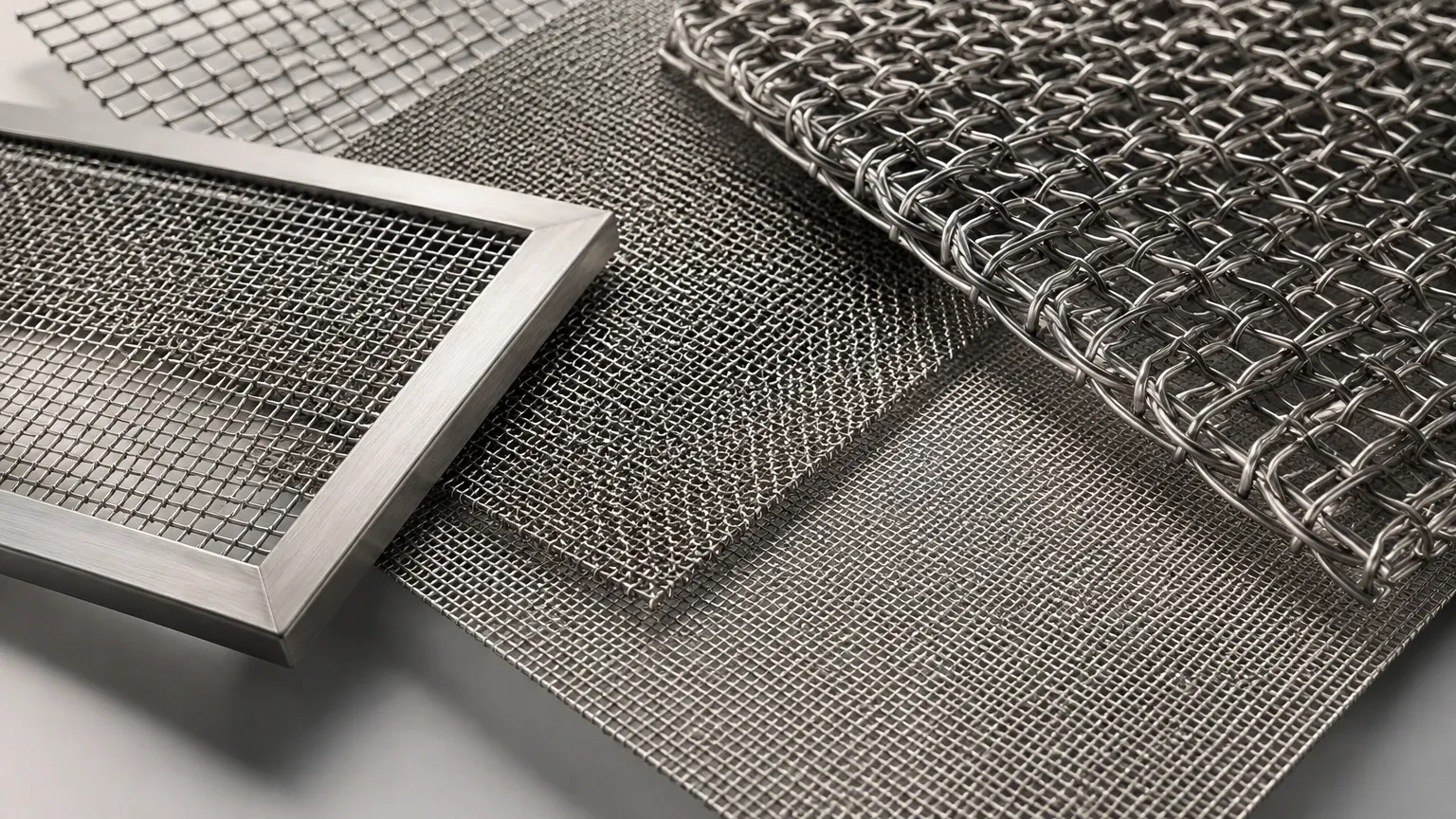
While woven wire mesh is often sold in rolls, many industrial applications require the mesh to be converted into steel woven wire mesh panels. These panels are semi-rigid components designed to fit into specific housings, frames, or vibrating screens. The transition from raw mesh to a finished panel involves several critical engineering considerations.
Framing and Edging
Raw mesh edges can be sharp, prone to fraying, and difficult to seal. To address this, panels are often finished with various edging options:
* U-Edging/C-Channel: A metal frame is crimped or welded around the perimeter. This provides structural rigidity and a safe handling surface.
* Hemmed Edges: The mesh is folded over itself to create a smooth, reinforced edge.
* Welded Frames: For heavy-duty applications, the mesh is spot-welded or TIG-welded to an angle iron or flat bar frame. This is essential for vibrating screens or large-scale architectural filtration panels.
Layering and Sintering
In demanding environments where a single layer of mesh might deform under pressure, engineers often specify multi-layer panels. These can be simply stacked or, more effectively, sintered. Sintering involves bonding multiple layers of mesh together using heat and pressure without the use of binders. This creates a monolithic panel that combines a fine filtration layer with several coarser support layers, offering unmatched durability and backwashability.
5. Performance Metrics: Aperture Precision and Flow Rates
When evaluating steel woven wire mesh panels, technical professionals must look beyond the basic dimensions. Performance is measured by how the mesh interacts with the process fluid over time.
Micron Rating: Absolute vs. Nominal
* Nominal Rating: Refers to the ability of the mesh to retain a certain percentage of solids of a specific size. It is an indication of the "average" pore size.
* Absolute Rating: Refers to the diameter of the largest hard spherical particle that will pass through the mesh under specified test conditions. For critical pharmaceutical or chemical processes, the absolute rating is the only reliable metric.
Pressure Drop (ΔP)
Every filter media introduces resistance to flow. A high initial pressure drop can indicate that the mesh is too fine for the application or that the wire diameter is too thick, reducing the open area. Monitoring the rate at which the pressure drop increases during operation is the standard method for determining the replacement cycle of the panel. If the ΔP increases too rapidly, it may suggest that the mesh is surface-loading rather than depth-loading, or that the cleaning interval needs to be adjusted.
6. Quality Control and Risk Mitigation in Procurement
Procuring industrial filtration components involves managing risks related to material integrity and manufacturing tolerances. Substandard Woven Wire Mesh can lead to catastrophic equipment failure or product contamination.
Common Risks to Evaluate
1. Wire Slippage: In low-quality weaves, the wires may shift during operation, altering the aperture size and allowing oversized particles to pass through. High-quality manufacturers ensure proper tensioning during the weaving process to prevent this.
2. Material Impurities: Using "recycled" or non-certified stainless steel can lead to premature corrosion, especially in acidic environments. Always request Material Test Reports (MTRs) to verify the chemical composition of the alloy.
3. Weave Irregularities: Variations in the loom's tension can cause "streaks" or uneven apertures across the panel. Visual inspection and micron-testing are necessary to ensure consistency across the entire surface area.
OEM and Customization
For many B2B buyers, off-the-shelf solutions are insufficient. Working with a manufacturer like Kaifil, which specializes in custom stainless steel filtration, allows for the development of panels tailored to specific flow rates, housing geometries, and chemical compatibilities. Customization ensures that the filtration component is an optimized part of the system rather than a compromised add-on.
7. Maintenance and Longevity Considerations
The total cost of ownership for steel woven wire mesh panels is determined not just by the purchase price, but by how many times the panel can be cleaned and reused. Unlike disposable synthetic filters, stainless steel mesh is designed for longevity.
Cleaning Protocols
* Backwashing: Reversing the flow of fluid to dislodge particles trapped on the surface. This is most effective with plain and twill weaves.
* Ultrasonic Cleaning: Using high-frequency sound waves in a cleaning solution to remove fine particulates from the deep pores of Dutch weave or sintered panels.
* Chemical Cleaning: Using specific solvents or acids to dissolve organic or inorganic scaling. It is vital to ensure the cleaning agent is compatible with the mesh alloy (e.g., avoiding high concentrations of hydrochloric acid on 304 stainless steel).
Replacement Cycles
Even the most durable panels will eventually succumb to mechanical fatigue or permanent fouling. Signs that a panel requires replacement include visible deformation (bowing), broken wires, or a "base" pressure drop that remains high even after thorough cleaning. Establishing a regular inspection schedule helps prevent unplanned downtime and ensures the filtration system continues to operate within its design parameters.
Conclusion
Steel woven wire mesh panels are indispensable tools in modern industrial processing. By understanding the technical variables—from alloy selection and weave patterns to framing options and flow dynamics—engineers and purchasing teams can select filtration solutions that offer the best performance and durability. Whether the goal is to protect sensitive downstream equipment or to ensure the purity of a final product, the precision and reliability of high-quality woven wire mesh remain the gold standard in industrial separation technology.
