


Welded vs Woven Wire Mesh: An Engineering Guide for Industrial Filtration
In industrial filtration and material separation, the choice between welded and woven wire mesh is a fundamental engineering decision that impacts the efficiency, longevity, and cost-effectiveness of a system. While both products are manufactured from metallic wires—most commonly stainless steel—their structural properties, manufacturing processes, and performance characteristics differ significantly.
For engineers and procurement teams in the chemical processing, pharmaceutical, and food and beverage sectors, understanding the nuances of welded vs woven wire mesh is essential for optimizing process flow and ensuring regulatory compliance. This guide examines the technical distinctions, application suitability, and selection criteria necessary for high-performance industrial environments.
Understanding the Core Differences
The primary distinction between these two materials lies in how the individual wires are joined to form a grid.
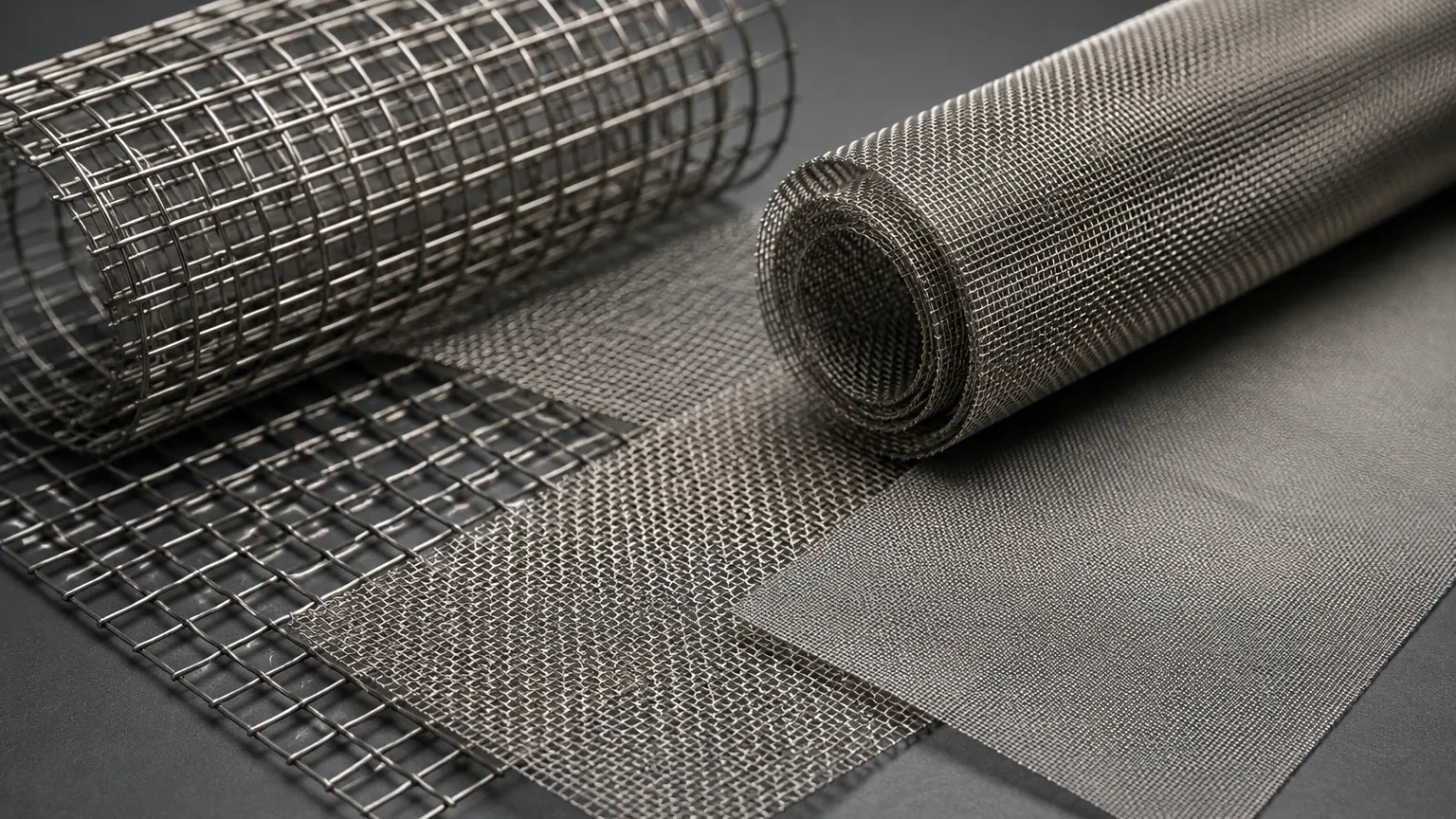
Woven wire mesh is produced on large industrial looms. The process involves interlacing horizontal (weft) wires over and under vertical (warp) wires. This mechanical interlocking creates a flexible yet stable cloth. Because the wires are not permanently fused, the mesh retains a degree of flexibility, which is often advantageous in applications involving vibration or thermal expansion.
Welded wire mesh, conversely, is formed by placing wires in a grid pattern and using electrical resistance welding at each intersection. This creates a rigid, permanent bond. The resulting structure is exceptionally stable and maintains its dimensional integrity even when cut into irregular shapes, as the individual wires cannot shift or unravel.
Manufacturing Methods and Structural Characteristics
The Weaving Process
Industrial weaving allows for a vast range of configurations. Beyond the standard square mesh, specialized patterns such as Dutch weaves or twill weaves can be produced. These complex patterns enable the production of very fine filtration media where the "aperture" is not a straight-through hole but a tortuous path, enhancing particle retention.
For technical specifications, Plain, twill and dutch woven wire mesh in SS304/316L — rolls, cut mesh and framed panels. Send mesh count or micron target for a technical quote. This variety is critical when engineers need to balance flow rates with specific micron ratings.
The Welding Process
Welded mesh is typically restricted to larger aperture sizes compared to woven options. The welding process requires a certain wire diameter to ensure a strong bond without burning through the metal. While this limits its use in fine filtration (sub-100 micron), it provides superior structural support. The rigid joints mean the mesh can act as a self-supporting component in baskets, guards, or heavy-duty strainers.
Filtration Precision and Micron Ratings
When comparing welded vs woven wire mesh for filtration tasks, precision is usually the deciding factor.
1. Aperture Consistency: Woven wire mesh can achieve incredibly tight tolerances. In high-precision industries like pharmaceuticals, a woven mesh can provide absolute filtration ratings down to 5 or 10 microns.
2. Pore Geometry: Woven Dutch weaves (Plain Dutch, Twilled Dutch) create a three-dimensional pore structure. This allows for high flow rates while capturing fine particles. Welded mesh is almost exclusively limited to square or rectangular openings, making it more suitable for coarse straining or as a support layer for finer media.
3. Stability Under Pressure: In high-pressure hydraulic or liquid filtration, woven mesh may require a support layer (often a coarser welded mesh or a perforated metal sheet) to prevent the wires from shifting, which could enlarge the pore size. Welded mesh, being fused, does not suffer from wire migration, but its larger openings often make it unsuitable for the primary filtration stage.
Mechanical Strength and Industrial Durability
Structural integrity is where the two materials diverge most sharply. Engineers must evaluate the mechanical stresses the mesh will encounter, including pressure drops, physical impact, and cleaning cycles.
* Flexibility vs. Rigidity: Woven mesh is "pliable." It can be wrapped around cylinders or pleated to increase surface area in filter cartridges. However, if the mesh is not properly tensioned or framed, the wires can move under the force of the fluid.
* Shear Strength: Welded mesh offers higher shear strength. If a section of the mesh is punctured, the rest of the grid remains intact. In woven mesh, a break in a single wire can lead to the "unraveling" of the surrounding area, potentially leading to a catastrophic failure of the filter element.
* Vibration Resistance: In vibrating screen applications, woven mesh is often preferred because the mechanical interlock can absorb some of the energy. However, the constant rubbing of wires against each other (fretting) can eventually lead to wear and failure. Welded mesh, being a solid unit, does not suffer from fretting but can be prone to fatigue cracking at the weld points if the vibration is excessive.
Material Selection: Stainless Steel 304 vs. 316L
Regardless of whether the mesh is welded or woven, the choice of alloy is critical for industrial longevity. Kaifil specializes in stainless steel solutions because of the material’s resistance to corrosion and temperature extremes.
* SS304: The standard grade for many food and beverage applications. It offers good corrosion resistance and is cost-effective for general industrial use.
* SS316L: The "L" stands for low carbon, which is crucial for welded mesh. In the welding process, standard 316 can suffer from "sensitization" or carbide precipitation at the weld points, leading to localized corrosion. 316L prevents this, making it the gold standard for welded structures in marine or highly acidic environments. For woven mesh, 316L provides superior resistance to chlorides and pitting, which is essential in chemical processing and pharmaceutical manufacturing.
Application-Specific Selection Criteria
To determine the right solution, engineers should answer the following questions during the design phase:
1. What is the Target Micron Rating?
If the application requires capturing particles smaller than 100 microns, Woven Wire Mesh is almost always the necessary choice. Welded mesh is typically manufactured with openings ranging from 1/4 inch down to perhaps 20 mesh (approx. 900 microns).
2. Is the Mesh a Support Component or the Primary Filter?
In multi-stage filtration, a coarse welded mesh is often used as a "backup" or support cage to provide the structural rigidity needed to withstand high differential pressures, while a fine woven mesh serves as the actual filtration interface.
3. What are the Cleaning Requirements?
Industrial filters are often cleaned via backwashing, ultrasonic baths, or chemical CIP (Clean-in-Place) systems. Woven mesh, particularly Dutch weaves, can be more challenging to clean because particles can become wedged in the complex pore structure. Welded mesh, with its simple through-hole design, is very easy to clean but may not provide the required level of filtration.
4. Will the Mesh be Formed or Fabricated?
If the design requires the mesh to be deep-drawn, pleated, or heavily formed, woven mesh is superior due to its inherent ductility. If the part needs to be a flat, rigid panel that can be bolted into a frame without sagging, welded mesh is the more efficient option.
Total Cost of Ownership and Maintenance
While the initial purchase price is an important factor, the total cost of ownership (TCO) includes installation, maintenance, and replacement frequency.
Welded mesh tends to have a lower initial cost for larger aperture sizes and is easier to install as a structural component. However, if the weld quality is poor, the mesh can fail prematurely in corrosive environments, leading to frequent downtime.
Woven wire mesh represents a higher precision product. While the cost per square foot may be higher—especially for complex weaves or high mesh counts—the ability to achieve specific filtration targets and the capability to be pleated into high-surface-area cartridges often results in a lower TCO through extended service life and better protection of downstream equipment (like pumps and valves).
Replacement cycles should be determined by monitoring the pressure drop ($\\Delta P$) across the filter. A sudden drop in pressure might indicate a tear in a woven mesh or a weld failure in a welded grid, while a rapid increase indicates that the mesh is blinded and requires cleaning or replacement.
Conclusion
The debate of welded vs woven wire mesh does not result in a single "better" product, but rather a better-suited product for a specific industrial challenge. Woven wire mesh remains the industry standard for precision filtration, offering unparalleled versatility in pore size and material flexibility. Welded wire mesh serves as the backbone for structural support and coarse separation, valued for its rigidity and dimensional stability.
At Kaifil, we understand that every industrial environment has unique demands. Whether you are designing a new chemical processing line or optimizing a hydraulic system, selecting the correct mesh type is the first step toward operational excellence. By considering the mechanical stresses, chemical environment, and required filtration accuracy, engineers can ensure they select a solution that balances performance with durability.
