


Engineering Guide to Woven Wire Mesh 1 Inch: Specifications and Industrial Applications
In industrial filtration and structural engineering, the selection of a specific mesh size is dictated by the balance between flow rates, particle retention, and mechanical durability. Among the coarser specifications, woven wire mesh 1 inch serves as a critical component in heavy-duty applications ranging from primary wastewater screening to safety guarding and architectural reinforcement.
Understanding the technical nuances of this specification—specifically the distinction between mesh count and clear aperture—is essential for engineers and procurement teams. As a manufacturer specialized in precision stainless steel filtration, Kaifil provides high-performance Plain, twill and dutch woven wire mesh in SS304/316L — rolls, cut mesh and framed panels. Send mesh count or micron target for a technical quote. to meet these demanding industrial requirements.
Defining Woven Wire Mesh 1 Inch: Mesh Count vs. Aperture Size
When discussing "1 inch" in the context of Woven Wire Mesh, there is often a need for clarification between two distinct measurements: the mesh count and the clear opening (aperture).
1 Mesh (1 Opening per Linear Inch)
In technical terms, a "1 mesh" refers to one opening per linear inch, measured from the center of one wire to the center of the next. Because the wire itself has a specific diameter, the actual clear opening will be 1 inch minus the wire diameter. For example, if a 1-mesh screen uses a 0.135-inch wire, the clear opening is 0.865 inches.
1-Inch Clear Aperture
Conversely, many engineers require a 1-inch clear opening to ensure that particles or objects of a specific size can pass or be retained. In this case, the center-to-center distance will be 1 inch plus the wire diameter. Specifying the clear aperture is common in mining, aggregate processing, and large-scale debris filtration where precise sizing is more critical than the number of wires per inch.
Material Selection: Stainless Steel Grades for Industrial Environments
The longevity of woven wire mesh 1 inch depends heavily on the alloy selected. While carbon steel or galvanized options exist for low-stakes environments, industrial applications typically demand the corrosion resistance and mechanical properties of stainless steel.
SS304 (Standard Industrial Grade)
Type 304 stainless steel is the most common material for coarse woven mesh. It offers excellent resistance to atmospheric corrosion and many organic and inorganic chemicals. It is widely used in food processing, security fencing, and general industrial screening where extreme chemical exposure is not a primary concern.
SS316/316L (Marine and Chemical Grade)
For environments involving chlorides, acids, or marine conditions, SS316 is the preferred choice. The addition of molybdenum enhances its resistance to pitting and crevice corrosion. SS316L (low carbon) is specifically utilized when the mesh must be welded into frames or cylinders, as it prevents carbide precipitation during the welding process, maintaining the integrity of the corrosion resistance at the joints.
High-Temperature and Specialty Alloys
In specialized heat-treating or chemical processing applications, alloys such as SS310 or Inconel may be required. These materials maintain their tensile strength and oxidation resistance at temperatures exceeding 800°C, where standard 304 or 316 would fail.
Technical Parameters: Wire Diameter and Open Area Calculations
The performance of woven wire mesh 1 inch is defined by its "Open Area" percentage. This metric determines the flow capacity and pressure drop across the mesh.
The Impact of Wire Diameter
For a 1-inch mesh, wire diameters typically range from 0.080 inches (approx. 2mm) to 0.250 inches (approx. 6.3mm).
- Thicker Wires: Increase the weight and structural load capacity of the mesh but decrease the open area and flow rate.
- Thinner Wires: Maximize the open area and reduce the overall weight of the panel but may require additional support structures to prevent sagging or deformation under pressure.
Calculating Percentage Open Area
The formula for calculating the open area of a square woven mesh is:
Open Area % = (A² / (A + d)²) x 100
*Where A = Aperture (Clear Opening) and d = Wire Diameter.*
For a 1-mesh screen with a 0.120" wire diameter:
- Aperture = 1.0" – 0.120" = 0.880"
- Open Area % = (0.880² / 1.0²) x 100 = 77.44%
Engineers must balance this percentage against the expected physical impact or pressure the mesh will encounter during operation.
Primary Industrial Applications for Coarse Mesh Solutions
Because of its high strength and large openings, woven wire mesh 1 inch is rarely used for fine filtration but is indispensable for primary separation and protection.
1. Pre-Filtration and Trash Racks
In water treatment and chemical intake systems, 1-inch mesh serves as the first line of defense. It captures large debris, branches, and plastic waste before the fluid reaches finer secondary filtration stages or sensitive pump impellers. This protects downstream equipment from mechanical damage and clogging.
2. Safety Guarding and Security
In manufacturing facilities, heavy-duty woven mesh is used to create machine guards. The 1-inch opening allows for visual inspection and airflow while preventing personnel from reaching into moving parts. Its woven structure provides superior impact resistance compared to expanded metal or plastic alternatives.
3. Catalyst Support and Bed Retention
In petrochemical reactors, coarse stainless steel mesh acts as a support grid for catalyst beds. It must be strong enough to hold tons of catalyst material while providing a high open area to minimize pressure drop in the gas or liquid flow.
4. Architectural and Structural Reinforcement
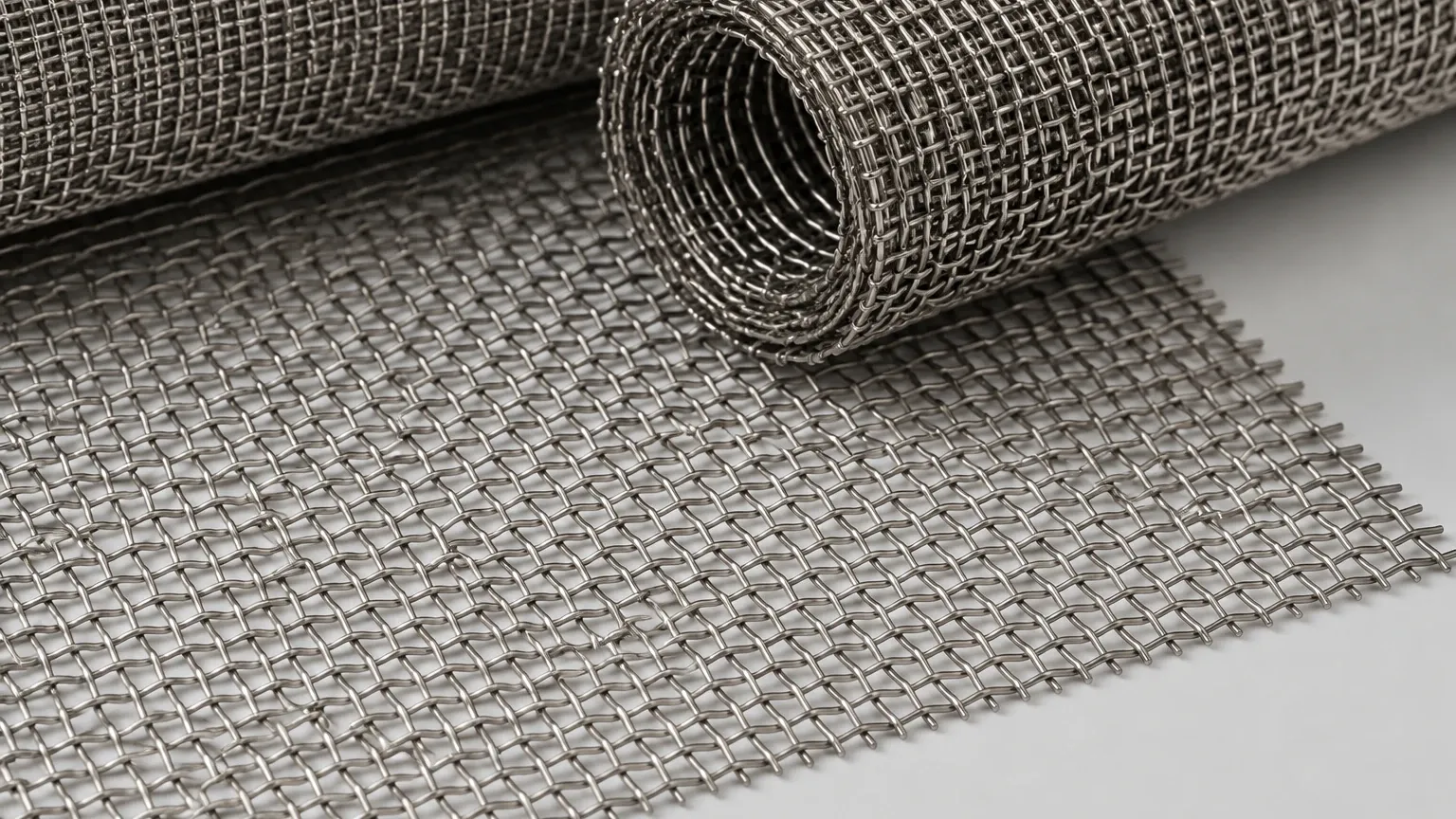
Woven wire mesh 1 inch is increasingly used in architectural applications for parking garage facades, infill panels for railings, and wall cladding. It provides a modern aesthetic combined with natural ventilation and high durability.
Engineering Considerations for Durability and Load Capacity
When integrating woven wire mesh 1 inch into an industrial system, several engineering factors must be addressed to ensure long-term reliability.
Weave Styles: Plain vs. Intercrimped
While fine mesh is often plain woven, coarse mesh like the 1-inch variety frequently utilizes an intercrimp or lock-crimp weave.
- Plain Weave: Each warp wire passes alternately over and under each weft wire. This is standard for lighter wire diameters.
- Intercrimp: Extra crimps are provided in the wires between the intersections. This is ideal for large openings with relatively thin wires, as it locks the wires in place and prevents "shifting" or racking of the mesh.
- Lock-Crimp: The wires are crimped at the intersections to lock them together securely, providing maximum dimensional stability for heavy-duty vibrating screens.
Edge Treatments and Framing
For 1-inch mesh, the edges can be a safety hazard and a point of structural weakness. Kaifil offers several edge treatments:
- Raw Edges: Wires are simply cut, suitable if the mesh is being welded into a recessed channel.
- Hemmed/U-Binding: A metal U-channel is welded over the edge for safety and to provide a mounting point.
- Hooked Edges: Specifically for vibrating screens, where the mesh must be tensioned across a deck.
Custom Fabrication and OEM Capabilities
Standard off-the-shelf mesh rolls often do not meet the specific tolerances required for precision industrial equipment. Customization is where Kaifil’s manufacturing expertise provides the most value.
Dimensional Precision
For OEM applications, such as internal components for hydraulic tanks or large-scale food dehydrators, the mesh must be cut to exact tolerances. Kaifil utilizes advanced shearing and laser cutting technology to ensure that every panel fits perfectly into the customer's housing, reducing assembly time and eliminating the risk of bypass.
Formed Components
Woven wire mesh 1 inch can be formed into cylinders, cones, or baskets. Despite the thickness of the wire, specialized rolling equipment allows for the creation of rigid, self-supporting filter elements. These are often used in intake strainers for offshore oil platforms or large-scale cooling towers.
Quality Assurance and Procurement Checkpoints
To ensure the total cost of ownership is optimized, purchasing teams should confirm several technical details before finalizing an order for woven wire mesh 1 inch:
1. Material Certification: Request MTRs (Material Test Reports) to verify that the alloy (e.g., SS316L) meets international standards for chemical composition.
2. Wire Gauge Consistency: Variations in wire diameter can affect both the aperture size and the weight of the shipment. Ensure the manufacturer adheres to strict wire drawing tolerances.
3. Flatness Requirements: For large panels used in architectural or guarding applications, the mesh must be professionally leveled after the weaving process to remove internal stresses and ensure it remains flat during installation.
4. Cleaning and Passivation: For food-grade or pharmaceutical applications, the mesh should undergo ultrasonic cleaning and passivation to remove manufacturing oils and enhance the protective oxide layer of the stainless steel.
By focusing on these technical parameters, engineers can select a mesh solution that provides the necessary filtration performance while withstanding the physical rigors of the industrial environment. Kaifil’s commitment to quality and engineering support ensures that every custom filtration solution—from coarse 1-inch mesh to fine micron-rated cartridges—is optimized for its specific application.
