


Woven Wire Mesh Brass: Engineering Properties and Industrial Selection Guide
In the field of industrial filtration and separation, material selection is as critical as the geometric configuration of the mesh itself. While stainless steel is often the default choice for high-temperature and highly corrosive environments, woven wire mesh brass serves as a vital technical alternative for applications requiring specific electrical, thermal, and mechanical properties. Understanding the nuances of brass alloys within the broader context of Woven Wire Mesh allows engineers to optimize filtration performance while managing costs and equipment longevity.
Understanding the Fundamentals of Woven Wire Mesh
Industrial woven wire mesh is produced by weaving individual wires over and under one another in a precise, repeatable pattern. This process creates a stable medium with consistent aperture sizes, which are essential for accurate particle retention. The performance of a mesh is defined by its mesh count (the number of openings per linear inch), wire diameter, and the alloy from which the wire is drawn.
When selecting a mesh, engineers must balance the need for a high "open area"—which facilitates flow and reduces pressure drop—with the structural integrity required to withstand system pressures. Brass, an alloy primarily composed of copper and zinc, offers a unique set of characteristics that distinguish it from stainless steel or pure copper mesh. It is significantly more malleable than stainless steel, making it easier to form into complex shapes or pleated cartridges, yet it provides better abrasion resistance than pure copper.
The Technical Composition of Woven Wire Mesh Brass
Most industrial-grade woven wire mesh brass is manufactured using "yellow brass" (typically Alloy C270 or C260). This alloy generally consists of approximately 65% to 70% copper and 30% to 35% zinc. The specific ratio of these metals dictates the mesh's performance in industrial environments:
* Corrosion Resistance: Brass offers excellent resistance to corrosion in fresh water, fuel, and various alkaline solutions. However, it is susceptible to "dezincification" in certain acidic environments or when exposed to high concentrations of ammonia. For marine applications, while brass is often used, engineers must evaluate the specific salinity and aeration levels to prevent premature failure.
* Ductility and Formability: One of the primary reasons for choosing brass over stainless steel is its workability. Brass wire can be woven into extremely fine counts without the brittleness associated with some high-carbon steels. This makes it an ideal candidate for custom-shaped filters and deep-drawn components.
* Conductivity: Brass maintains high thermal and electrical conductivity. This is a critical factor in applications involving EMI/RFI shielding or where heat dissipation across the filtration medium is required.
Key Performance Characteristics for Filtration
When evaluating woven wire mesh brass for a specific project, technical professionals must look beyond simple dimensions and consider the operational physics of the medium.
Non-Sparking Properties
In industries dealing with volatile chemicals, gases, or explosive dust, the risk of mechanical sparking is a primary safety concern. Unlike ferrous metals, brass is non-sparking. This makes brass mesh the preferred material for fuel strainers, vent covers in explosive environments, and filtration components within grain elevators or chemical processing plants where static discharge or friction-induced sparks could lead to catastrophic events.
Acoustic and EMI Shielding
Due to its copper content, brass mesh is highly effective at attenuating electromagnetic interference (EMI). Engineers often specify fine-mesh brass for electronic enclosures where both ventilation and signal shielding are required. The mesh allows for airflow to cool internal components while the conductive grid reflects or absorbs electromagnetic radiation.
Antimicrobial Effects
While not as potent as pure copper, the copper content in brass provides inherent antimicrobial properties. In certain water treatment or food processing applications, the use of brass mesh can help inhibit the growth of biofilms and bacteria on the filter surface, potentially extending the intervals between deep cleaning cycles.
Weave Patterns and Their Impact on Flow Dynamics
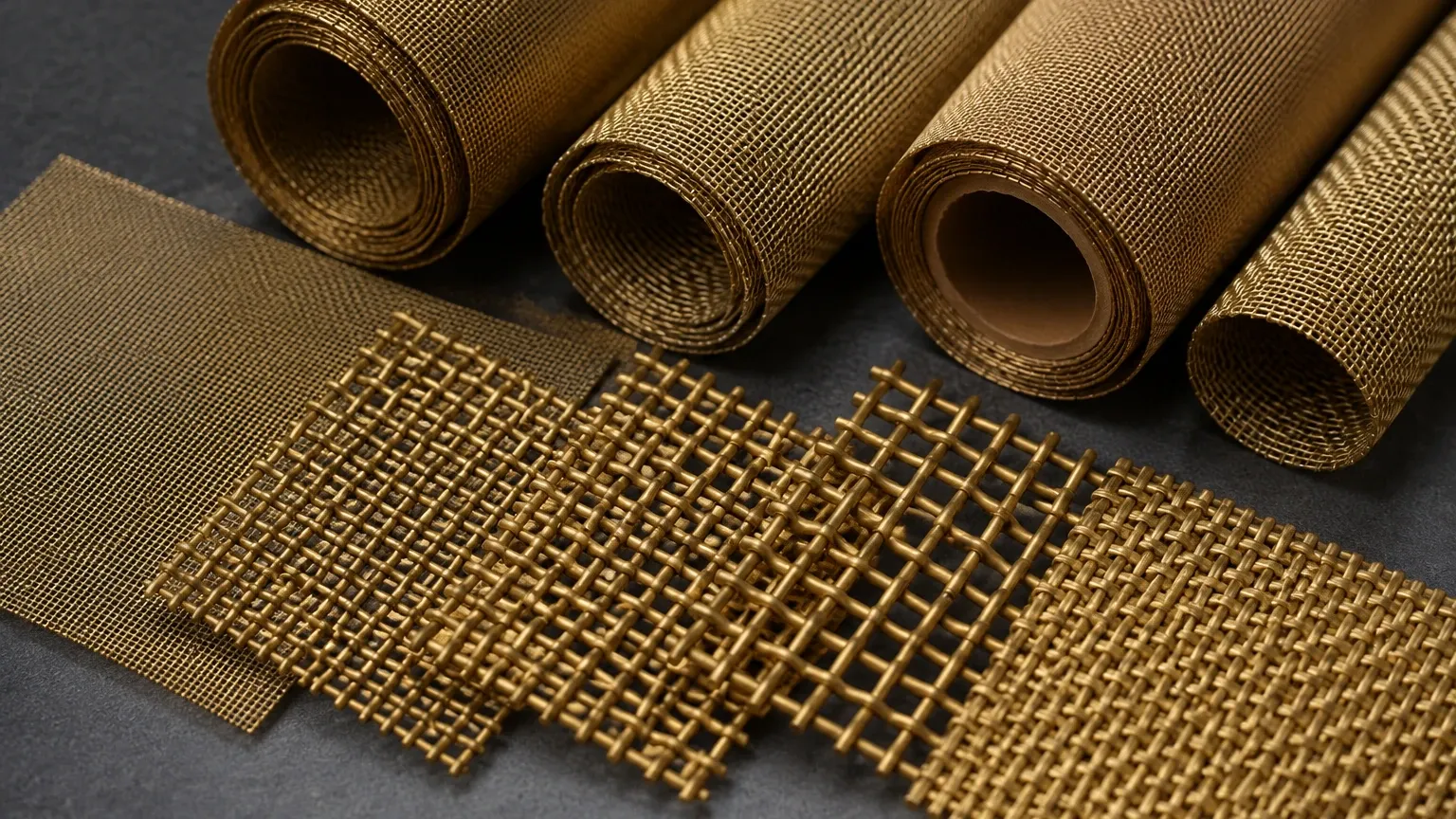
The weave pattern of the woven wire mesh brass determines the shape of the pore and the mechanical strength of the cloth. For most industrial applications, three primary weaves are utilized:
1. Plain Weave: The most common configuration where each warp wire crosses alternately over and under each shute wire. This provides a square opening and is the standard for general-purpose sifting and filtration.
2. Twill Weave: Each shute wire passes alternately over and under two warp wires. This allows for the use of heavier wires in a given mesh count, providing greater strength and the ability to produce finer meshes that would be impossible in a plain weave.
3. Dutch Weave: This utilizes different diameters for the warp and shute wires. The result is a dense, firm mesh with very small, triangular openings. Dutch weave brass is often used in high-pressure filtration where fine particle retention (down to the micron level) is required without sacrificing the structural integrity of the filter element.
Critical Selection Criteria for Engineering Teams
To ensure the selected woven wire mesh brass meets the application requirements, purchasing and engineering teams should confirm several technical parameters before procurement:
Mesh Count vs. Aperture Size
Mesh count is a nominal value, but the aperture (the actual clear opening) is the functional value. The formula for calculating aperture width ($w$) is:
$$w = \frac{1}{M} – d$$
Where $M$ is the mesh count and $d$ is the wire diameter. Even a small change in wire diameter can significantly alter the open area and the pressure drop across the filter. Engineers should always specify the required micron rating alongside the mesh count to avoid ambiguity.
Open Area Percentage
The percentage of open area ($OA$) determines the flow capacity of the mesh. It is calculated as:
$$OA = (w \times M)^2 \times 100$$
A higher open area reduces the initial pressure drop but may result in a mesh that is more prone to deformation under high flow velocities. For brass mesh, which is softer than steel, supporting the mesh with a coarser backup screen or a perforated metal core is often a necessary design consideration.
Chemical Compatibility
Before integrating brass mesh into a system, a thorough chemical compatibility check is mandatory. While brass excels in petroleum-based fluids and many organic solvents, it can degrade rapidly in the presence of strong acids, oxidizing salts, or ammonia-based cleaners. If the process fluid contains these elements, a transition to stainless steel or a specialized bronze alloy may be required.
Industrial Applications: Beyond Standard Filtration
The versatility of woven wire mesh brass extends into specialized sectors that leverage its unique physical profile:
* Aerospace and Automotive: Brass mesh is used in specialized oil and fuel filters where the non-sparking and thermal properties provide a safety margin over synthetic or ferrous alternatives.
* Laboratory Testing: Precision brass sieves are a staple in soil and aggregate testing. The material's resistance to corrosion from environmental moisture ensures that the aperture sizes remain constant over years of use.
* Architectural and Decorative: While primarily a technical guide, it is worth noting that the aesthetic quality of brass—specifically its ability to develop a natural patina—makes it a choice for architectural grilles that also serve as functional air intake filters.
* Gas Diffusion: In certain electrochemical cells and gas processing units, brass mesh acts as a diffusion layer, providing a uniform surface for gas distribution while maintaining electrical contact across the cell.
Maintenance, Durability, and Replacement Cycles
The total cost of ownership for a filtration system is heavily influenced by the durability of the filter media. Brass mesh is generally easier to clean than synthetic media because it can withstand mechanical scrubbing and ultrasonic cleaning. However, because it is softer than stainless steel, it is more susceptible to "blinding" or "peening" if exposed to high-velocity abrasive particles.
Engineers should monitor the pressure differential ($ΔP$) across the brass mesh. A steady increase in $ΔP$ that cannot be reversed by standard cleaning cycles indicates that particles have become permanently wedged in the apertures or that the wire has undergone chemical scaling. Due to the malleability of brass, care must be taken during installation to avoid over-tensioning, which can distort the mesh openings and compromise filtration accuracy.
Customization and Technical Procurement
For many B2B applications, off-the-shelf mesh rolls do not meet the precise requirements of modern industrial equipment. Customization options for woven wire mesh brass include:
* Slitting and Die-Cutting: Precision cutting of mesh into discs, rectangles, or custom shapes for integration into OEM assemblies.
* Edge Treatments: Adding frames, bindings, or ultrasonic welding to prevent fraying and ensure a secure fit within the filter housing.
* Multi-Layer Sintering: Combining brass mesh with other metal layers to create a composite filter media that offers both fine filtration and high structural strength.
When sourcing these components, it is essential to work with a manufacturer that understands the mechanical limits of the material. At Kaifil, we specialize in translating complex filtration requirements into reliable metal components. Whether you are designing a new hydraulic system or optimizing a chemical separation process, our engineering team provides the technical support needed to select the correct mesh count, weave, and alloy.
By focusing on factual performance data and engineering constraints, procurement teams can ensure that their choice of woven wire mesh brass provides the necessary balance of filtration precision, safety, and operational life. For further technical specifications or to request a quote based on your specific micron targets, Review product options and application support to find the ideal solution for your industrial application.
