


Woven Wire Mesh Copper: Engineering Properties and Industrial Applications
In the landscape of industrial filtration and material science, woven wire mesh serves as a critical component for separation, protection, and structural reinforcement. While stainless steel is often the default choice for high-temperature and highly corrosive environments, woven wire mesh copper offers a unique suite of physical and chemical properties that make it indispensable for specific technical applications. From electromagnetic interference (EMI) shielding to specialized chemical catalysis and heat exchange, understanding the engineering nuances of copper mesh is essential for procurement and design teams.
As a precision manufacturer, Kaifil emphasizes the importance of material selection in achieving optimal filtration performance. Whether an application requires the high-tensile strength of steel or the superior conductivity of copper, the fundamental principles of weave precision and structural integrity remain the same. This guide examines the technical specifications, performance advantages, and selection criteria for woven wire mesh copper in a B2B industrial context.
Technical Properties of Copper in Woven Wire Mesh
Copper is distinguished from other metals used in wire weaving by its exceptional thermal and electrical conductivity. In industrial environments, these properties are often the primary drivers for selecting copper over stainless steel or aluminum.
Electrical and Thermal Conductivity
Copper possesses the highest electrical conductivity of any non-precious metal. In the form of a woven mesh, this allows for the creation of highly effective Faraday cages and EMI/RFI shielding solutions. The continuity of the weave ensures that electrical charges are distributed evenly across the surface, preventing penetration by external electromagnetic fields. Thermally, copper mesh is utilized in heat sinks and heat exchangers where rapid heat dissipation is required through a porous medium.
Corrosion Resistance and Antimicrobial Action
While copper oxidizes over time—developing a characteristic green patina (verdigris)—this oxide layer actually provides a level of protection against further atmospheric corrosion. Furthermore, copper is naturally antimicrobial. In water treatment or food processing environments where biofouling or bacterial growth is a concern, copper mesh can inhibit the development of biofilms, although its use must be balanced against chemical compatibility with the process fluid.
Ductility and Formability
Compared to stainless steel, copper is significantly more ductile. This makes woven wire mesh copper easier to form into complex shapes, such as pleated filter elements or deep-drawn components, without the risk of work-hardening or cracking. This formability is a key advantage for OEM manufacturers who require custom-shaped filtration components for specialized machinery.
Weave Patterns and Their Impact on Filtration
The performance of a wire mesh is determined not only by the material but also by the geometry of the weave. The three most common weave types used in industrial copper mesh production are plain, twill, and dutch weaves.
Plain Weave
In a plain weave, each shute (weft) wire passes alternately over and under each warp wire. This is the most common and economical weave pattern. It provides a stable structure with square or rectangular apertures. For copper mesh, plain weaves are typically used in applications requiring high open area percentages and straightforward particle separation.
Twill Weave
A twill weave involves the shute wire passing over and under two warp wires at a time. This creates a more flexible mesh and allows for the use of heavier wire diameters relative to the mesh count. Twill woven copper mesh is often selected when the material needs to withstand higher mechanical loads or when a finer mesh count is required than what is possible with a plain weave.
Dutch Weave
Dutch weaves utilize different wire diameters for the warp and shute. The wires are driven closely together to create a "tortuous path" for the fluid, resulting in a mesh that has no visible light-passing apertures when viewed directly. This weave is ideal for high-pressure filtration. While Kaifil provides extensive options for Plain, twill and dutch woven wire mesh in SS304/316L — rolls, cut mesh and framed panels. Send mesh count or micron target for a technical quote., copper versions of these weaves are specifically sought after for specialized chemical reactors and cryogenic filtration systems.
Industrial Application Scopes for Copper Mesh
The unique profile of copper allows it to serve industries that require more than just mechanical filtration. Below are the primary sectors where woven copper mesh is a critical engineering requirement.
EMI and RFI Shielding
In the electronics and aerospace industries, protecting sensitive components from electromagnetic interference (EMI) and radio frequency interference (RFI) is paramount. Woven copper mesh is integrated into enclosures, windows, and cable shielding. The mesh count is carefully calculated to block specific frequencies while still allowing for airflow or visibility.
Chemical Processing and Catalysis
Copper acts as a catalyst in several chemical reactions, particularly in the production of certain alcohols and the treatment of specific gas streams. Woven mesh provides a high surface-area-to-volume ratio, making it an efficient substrate for these reactions. Additionally, in the petroleum industry, copper mesh is sometimes used in distillation columns to remove sulfur compounds.
Cryogenics and Heat Exchange
Due to its thermal properties, copper mesh is used in cryogenic regenerators and heat exchangers. It can facilitate the rapid transfer of heat between fluids or gases in a compact, porous structure. The ability to maintain ductility at extremely low temperatures is a significant advantage in these applications.
Engineering Specifications: Mesh Count, Wire Diameter, and Aperture
When specifying woven wire mesh copper, engineers must define three primary variables that dictate the mesh's performance: mesh count, wire diameter, and aperture size.
1. Mesh Count: This refers to the number of openings per linear inch. A higher mesh count indicates a finer mesh with smaller openings. For copper, mesh counts can range from coarse (e.g., 2×2 mesh) to extremely fine (e.g., 200×200 mesh or higher).
2. Wire Diameter: The thickness of the wire used in the weave. There is an inverse relationship between mesh count and wire diameter; as the mesh becomes finer, the wire must generally become thinner to maintain a viable open area.
3. Aperture (Opening Size): The clear distance between two adjacent wires. This determines the "micron rating" of the mesh and defines what size particles will be retained or passed.
Calculating the Percentage of Open Area is also vital for flow rate calculations. The formula is:
* *Open Area % = (Aperture / (Aperture + Wire Diameter))² x 100*
For B2B buyers, providing these exact specifications ensures that the manufactured product will meet the pressure drop and filtration efficiency requirements of the system.
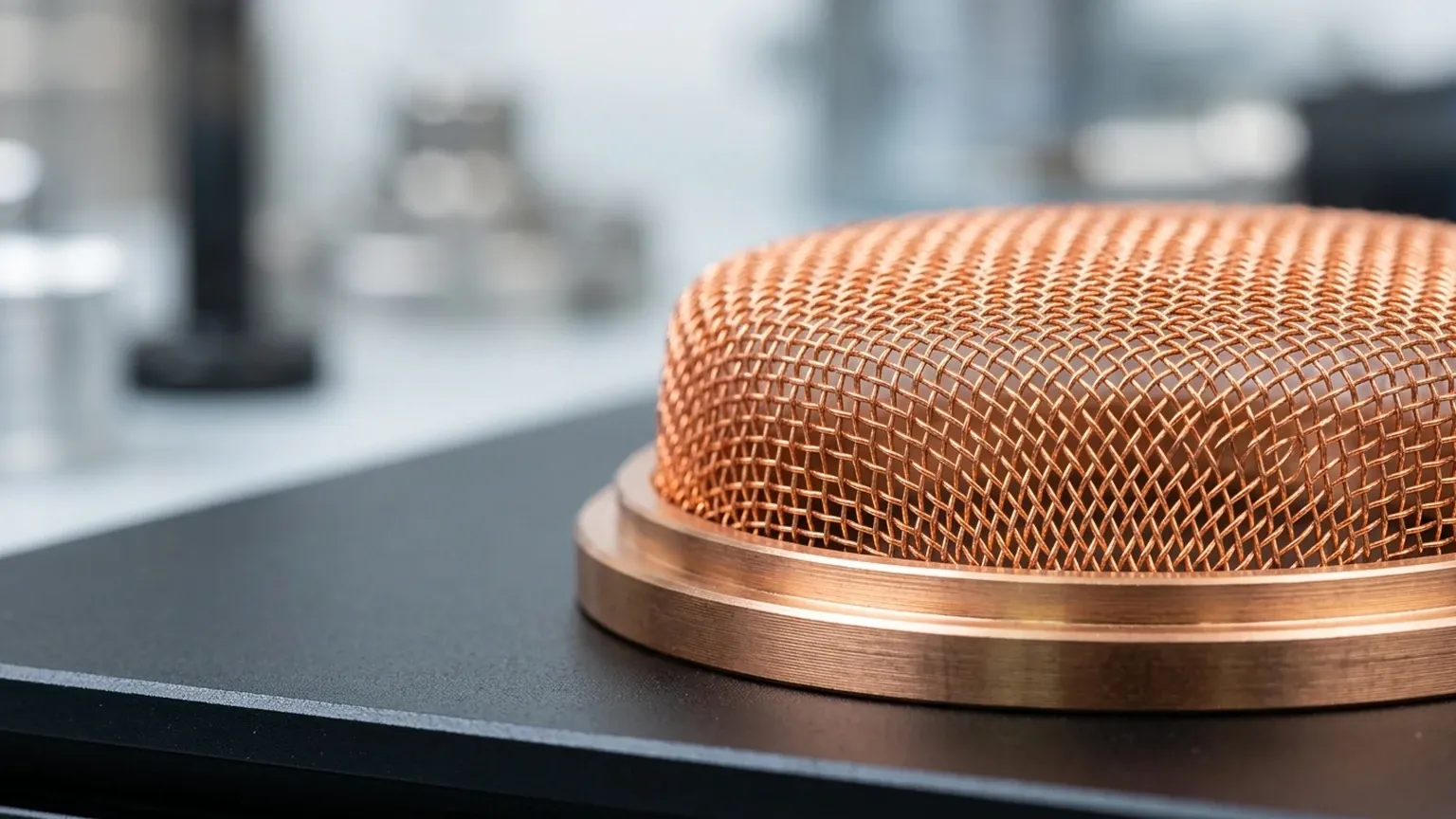
Comparing Copper with Stainless Steel Woven Wire Mesh
While copper has specific advantages, it is often compared against stainless steel alloys like SS304 and SS316L. Choosing the correct material depends on the operating environment and the primary function of the mesh.
| Feature | Woven Wire Mesh Copper | Stainless Steel (SS316L) |
| :— | :— | :— |
| Electrical Conductivity | Excellent (Standard for shielding) | Moderate |
| Thermal Conductivity | Very High | Low |
| Tensile Strength | Moderate | High |
| Corrosion Resistance | Good (Atmospheric/Marine) | Excellent (Acids/Chlorides) |
| Antimicrobial | Yes | No |
| Cost | Fluctuates with commodity market | Generally more stable |
In many industrial filtration scenarios, stainless steel is preferred for its mechanical robustness and resistance to aggressive cleaning chemicals. However, if the application involves electrical grounding or high-speed thermal transfer, copper is the superior choice. Kaifil assists engineers in evaluating these trade-offs to ensure the selected Woven Wire Mesh aligns with the total cost of ownership and performance expectations.
Customization and OEM Manufacturing Considerations
For many industrial applications, off-the-shelf mesh rolls do not meet the precise requirements of complex machinery. Customization is often necessary in terms of dimensions, edge treatments, and assembly.
Cut-to-Size and Framed Panels
Industrial filters often require the mesh to be cut into specific shapes (circles, rectangles, or custom geometries) or mounted into rigid frames. Framing prevents the edges of the copper mesh from fraying and provides a secure sealing surface within the filter housing.
Multi-Layer Sintering and Laminates
To combine the benefits of different materials, copper mesh can sometimes be laminated or sintered with stainless steel layers. This can provide a copper functional surface with the structural backing of a high-strength steel mesh. Such hybrid solutions are common in advanced aerospace and laboratory equipment.
Quality Control and Standards
Manufacturers must adhere to international standards such as ASTM E2016 (Standard Specification for Industrial Woven Wire Cloth) to ensure consistency in wire diameter and weave tightness. For B2B procurement, verifying that the manufacturer uses high-purity copper (typically 99.9% pure) is essential for maintaining the expected conductivity and corrosion resistance.
Maintenance, Oxidation, and Replacement Cycles
Understanding the lifecycle of copper mesh is crucial for calculating maintenance schedules. Unlike stainless steel, which remains relatively inert, copper will react with its environment.
* Patina Formation: In outdoor or humid environments, copper will turn brown and eventually green. For most filtration applications, this does not impair the structural integrity of the mesh, but it may affect the electrical contact resistance in shielding applications.
* Cleaning: Copper is sensitive to certain harsh acids and ammonia-based cleaners, which can cause rapid thinning of the wire. Cleaning protocols should use neutral pH detergents or specialized copper-safe solvents.
* Replacement: Because copper is softer than steel, it may be more susceptible to erosion from high-velocity particles in a fluid stream. Regular inspection of the aperture geometry is recommended to ensure the filtration rating has not drifted due to wire wear.
Conclusion: Making an Informed Selection
Selecting the right woven wire mesh copper requires a balance of material science and mechanical engineering. By focusing on the specific needs of the application—whether it be EMI attenuation, thermal management, or specialized chemical resistance—engineers can leverage copper's unique properties to optimize system performance.
When the requirements shift toward high-pressure durability or aggressive chemical environments, stainless steel solutions often become the more viable path. For technical teams currently evaluating their filtration or shielding needs, reviewing the full range of material options is the first step toward a reliable solution. Explore the engineering possibilities and Review product options and application support to find the precise weave and material configuration for your industrial requirements. Whether you need the high conductivity of copper or the industrial-grade resilience of stainless steel, precise manufacturing ensures that your filtration components perform as designed under the most demanding conditions.
