


Filter Cartridge Tank
In industrial filtration, the filter cartridge tank—commonly referred to as a filter housing—serves as the critical pressure vessel that contains and directs fluid through the filtration media. For engineers and procurement teams, selecting the appropriate tank is as vital as selecting the filter media itself. A well-designed filter cartridge tank ensures that the Filter Cartridges operate at peak efficiency, preventing bypass, managing pressure drops, and maintaining the structural integrity of the entire system under varying thermal and mechanical loads.
This guide examines the technical specifications, engineering considerations, and selection criteria for industrial filter cartridge tanks, focusing on stainless steel constructions used in demanding chemical, pharmaceutical, and food processing environments.
Understanding the Role of the Filter Cartridge Tank in Industrial Systems
The filter cartridge tank is more than a simple container; it is a precision-engineered component designed to manage fluid dynamics. Its primary function is to provide a sealed environment where contaminated fluid is forced through the filter media. The internal geometry of the tank must be optimized to distribute flow evenly across all installed cartridges, minimizing dead zones and preventing localized high-velocity areas that could lead to premature media failure.
In high-purity applications, the tank’s internal finish is paramount. For example, in the pharmaceutical industry, tanks are often electropolished to a specific Ra (Roughness Average) to prevent bacterial growth and ensure complete drainage during Clean-in-Place (CIP) cycles. For industrial water treatment or hydraulic applications, the focus shifts toward structural durability and resistance to pressure surges.
Key Engineering Specifications for Filter Cartridge Tank Design
When specifying a filter cartridge tank, engineers must evaluate several physical and chemical parameters to ensure long-term reliability and safety.
Material Selection and Corrosion Resistance
Stainless steel is the industry standard for high-performance filtration tanks due to its mechanical strength and chemical compatibility.
* SS304: Suitable for general industrial use, water treatment, and mildly corrosive environments. It offers good structural integrity and cost-effectiveness.
* SS316L: The preferred choice for chemical processing, marine environments, and food-grade applications. The "L" denotes low carbon content, which improves weldability and resistance to intergranular corrosion.
* Specialty Alloys: In cases involving high concentrations of chlorides or aggressive acids, alloys like Hastelloy or Duplex stainless steel may be required to prevent pitting and stress corrosion cracking.
Pressure and Temperature Ratings
Every filter cartridge tank must be rated for a maximum allowable working pressure (MAWP) and temperature range. These ratings are determined by the wall thickness of the vessel, the type of closure mechanism used, and the material of the seals. In many jurisdictions, tanks operating above a certain pressure threshold must comply with ASME Section VIII or similar international pressure vessel codes to ensure safety.
Flow Rate and Pipe Sizing
The inlet and outlet ports of the tank must be sized to accommodate the required flow rate without inducing excessive velocity. High fluid velocity at the inlet can cause mechanical erosion of the filter cartridges or create turbulence that disrupts the filtration cake. Typically, fluid velocity within the piping and housing should be kept within 2 to 3 meters per second for liquids.
Integrating High-Performance Filter Cartridges
The performance of a filter cartridge tank is inextricably linked to the Filter Cartridges housed within it. The interface between the cartridge and the tank—the sealing mechanism—is the most common point of failure in industrial filtration.
Sealing Configurations
To prevent bypass (unfiltered fluid leaking into the clean stream), the tank must support specific cartridge end-cap configurations:
* Double Open End (DOE): Cartridges are sealed using flat gaskets at both ends, compressed by a tie rod or a spring-loaded plate within the tank.
* Code 7 (226 O-rings/Fin): Features a locking tab and two O-rings to ensure a high-integrity seal, commonly used in critical pharmaceutical and beverage applications.
* Code 3 (222 O-rings/Flat): Utilizes double O-rings for a secure fit without the locking tabs, suitable for moderate pressure applications.
Support Structures
In multi-round tanks, internal support structures like tube sheets and hold-down plates are essential. These components must be robust enough to withstand the differential pressure (ΔP) that increases as the cartridges become loaded with contaminants. If the support structure flexes or fails, the seal is compromised, leading to immediate downstream contamination.
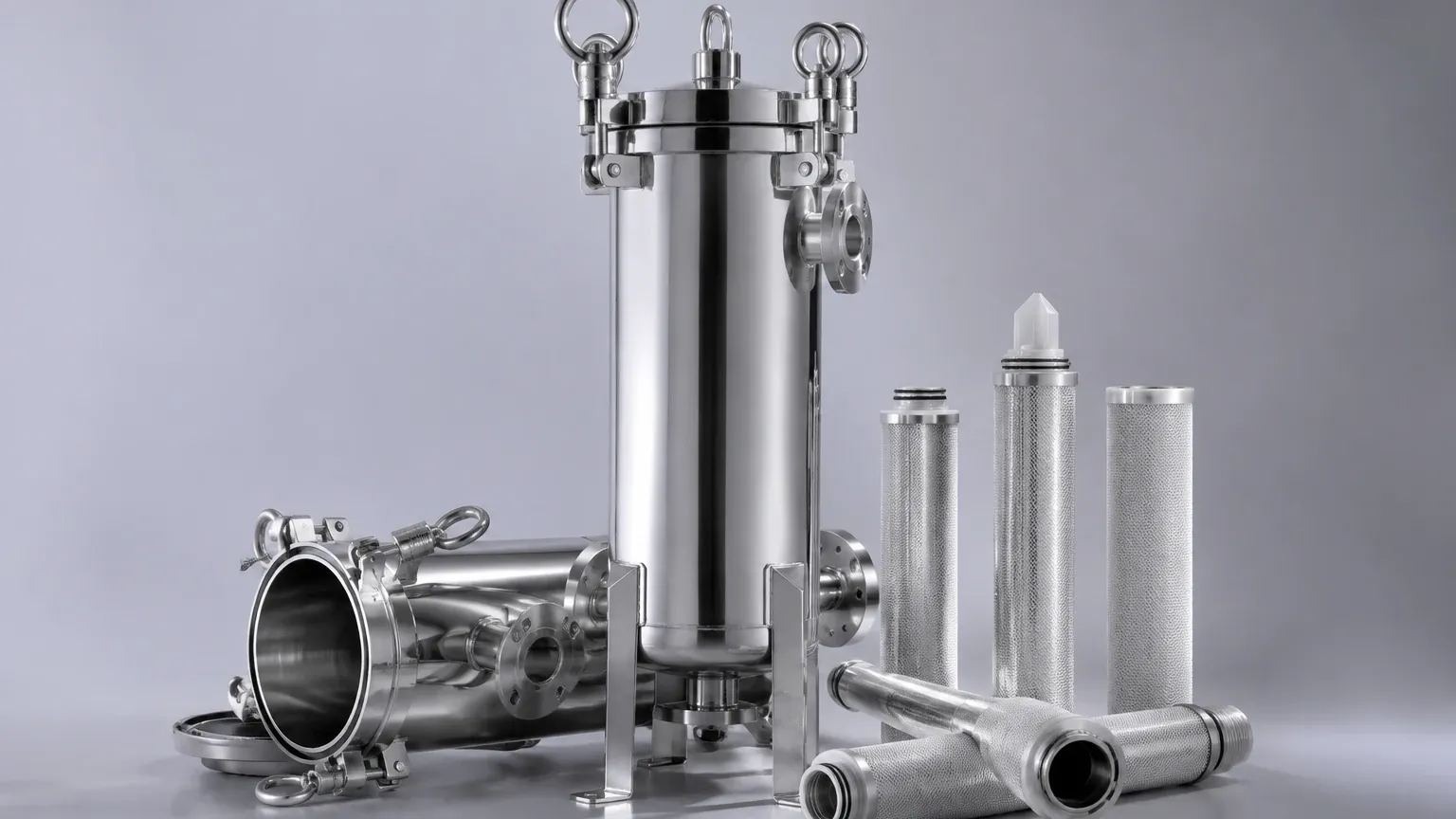
Comparing Single-Round and Multi-Round Tank Configurations
The choice between a single-round and a multi-round filter cartridge tank depends primarily on the required flow volume and the desired service interval.
Single-Round Housings
Single-round tanks house one cartridge and are ideal for low-flow applications, pilot plants, or point-of-use filtration. They are compact, easy to maintain, and often utilize V-clamp closures for quick cartridge changes.
Multi-Round Housings
For large-scale industrial processes, multi-round tanks can hold anywhere from 3 to over 100 cartridges. These vessels are designed for high-capacity throughput and longer intervals between maintenance.
* Swing Bolt Closures: Recommended for high-pressure multi-round tanks, providing a secure, heavy-duty seal that can withstand frequent opening and closing.
* Davit Arms: In very large tanks, the top cover (head) can be extremely heavy. A davit arm or mechanical lifting device is integrated into the tank design to allow a single operator to safely move the cover during cartridge replacement.
Operational Efficiency and Maintenance Protocols
To maintain the efficiency of a filter cartridge tank, operators must adhere to strict monitoring and maintenance schedules. Neglecting these protocols can lead to system downtime or damage to downstream equipment.
Differential Pressure Monitoring
The most effective way to track the performance of the filter is by monitoring the differential pressure between the inlet and outlet of the tank. A clean system will have a baseline ΔP (usually 2-5 psi). As the Filter Cartridges capture particles, the ΔP will rise. Most industrial systems are designed for cartridge replacement when the ΔP reaches 15-25 psi. Operating beyond this limit risks media migration or structural collapse of the cartridge.
Venting and Draining
Air trapped inside a filter cartridge tank can cause flow inconsistencies and reduce the effective surface area of the filtration media. Every tank should be equipped with a high-point vent to bleed off air during startup. Similarly, a low-point drain is necessary to remove residual fluid before opening the tank for maintenance, ensuring operator safety and preventing environmental spills.
Cleaning and Sterilization
For reusable stainless steel filter media, the tank often facilitates backwashing or chemical cleaning. The tank design must allow for the flow reversal or the introduction of cleaning agents without causing stagnant pockets where chemicals could linger. In the food and beverage industry, the tank must also be compatible with steam sterilization (SIP), requiring seals (such as Silicone or EPDM) that can withstand elevated temperatures.
Technical Checklist for Selecting a Filter Cartridge Tank
Before finalizing a purchase or design specification, engineers should confirm the following technical details to ensure the tank is fit for purpose:
1. Fluid Characteristics: Confirm the chemical compatibility of the fluid with the tank material (SS304 vs. SS316L) and the elastomers (O-rings/Gaskets).
2. Viscosity and Flow Rate: Higher viscosity fluids require larger tanks or more cartridges to maintain acceptable flow velocities and pressure drops.
3. Micron Rating and Efficiency: Ensure the tank is compatible with the specific Filter Cartridges required to achieve the target particle retention.
4. Footprint and Orientation: Determine if a vertical or horizontal orientation is better suited for the available floor space and piping layout.
5. Compliance Requirements: Verify if the application requires ASME stamps, FDA-compliant materials, or 3-A Sanitary Standards.
6. Total Cost of Ownership (TCO): Evaluate not just the initial purchase price, but also the cost of replacement cartridges, the ease of maintenance (labor time), and the energy costs associated with pressure drop.
By focusing on these technical parameters, industrial facilities can implement a filter cartridge tank system that provides consistent performance, protects downstream assets, and optimizes the lifespan of their filtration media. Whether for fine chemical processing or large-scale water treatment, the synergy between a high-quality tank and precision-engineered cartridges is the foundation of effective industrial filtration.
