


Gravity Water Filter Cartridges
In the landscape of industrial liquid separation, gravity filtration remains a fundamental process favored for its simplicity, energy efficiency, and reliability. Unlike pressurized systems that require mechanical pumps and complex control valves, gravity-fed systems utilize the natural force of hydrostatic head to drive fluid through a medium. At the heart of these systems are gravity water filter cartridges, which must be engineered to provide precise particle retention while operating under significantly lower differential pressures than their high-pressure counterparts.
For engineers and procurement specialists, selecting the appropriate filtration media for gravity-fed applications requires a deep understanding of fluid dynamics, material science, and structural integrity. Industrial-grade Filter Cartridges used in these settings often transition away from standard consumer-grade materials toward robust, cleanable, and chemically resistant options like stainless steel wire mesh and sintered metal components.
The Engineering Principles of Gravity Filtration
Gravity filtration operates on the principle of potential energy. The height of the fluid column above the filter media—known as the hydrostatic head—determines the pressure available to overcome the resistance of the filter. In industrial environments, this pressure is typically low, often ranging from 0.1 to 0.5 bar depending on the tank height.
Because the driving force is limited, the design of gravity water filter cartridges must prioritize low initial pressure drop. If the filter media is too dense or the pore structure too tortuous, the flow rate will diminish rapidly, leading to system bottlenecks. Engineers must balance the required micron rating with the effective filtration area (EFA). Increasing the surface area through pleating or utilizing high-porosity stainless steel mesh allows for higher throughput without requiring additional head pressure.
Furthermore, the velocity of the fluid passing through the media—the flux—is generally lower in gravity systems. This lower velocity can be advantageous, as it reduces the likelihood of particle "breakthrough," where flexible contaminants are forced through the pores under high pressure. However, it also means that the mechanism of filtration relies more heavily on surface straining rather than depth filtration.
Material Selection: Why Stainless Steel Dominates Industrial Applications
While residential gravity filters often use ceramic or carbon blocks, industrial gravity water filter cartridges frequently demand the durability and precision of stainless steel. Materials such as AISI 304 and 316L are standard for several technical reasons:
Corrosion and Chemical Resistance
In chemical processing or pharmaceutical applications, the fluid being filtered may be acidic, alkaline, or contain solvents that would degrade polymer-based filters. Stainless steel provides the necessary inertness to ensure that the filter media does not leach contaminants into the filtrate or lose structural integrity over time.
Thermal Stability
Gravity systems are often integrated into processes involving hot liquids, such as in the food and beverage industry (e.g., wort filtration in brewing or hot oil recovery). Stainless steel cartridges can operate at temperatures exceeding 300°C, far beyond the limits of polypropylene or polyester media.
Mechanical Strength and Reusability
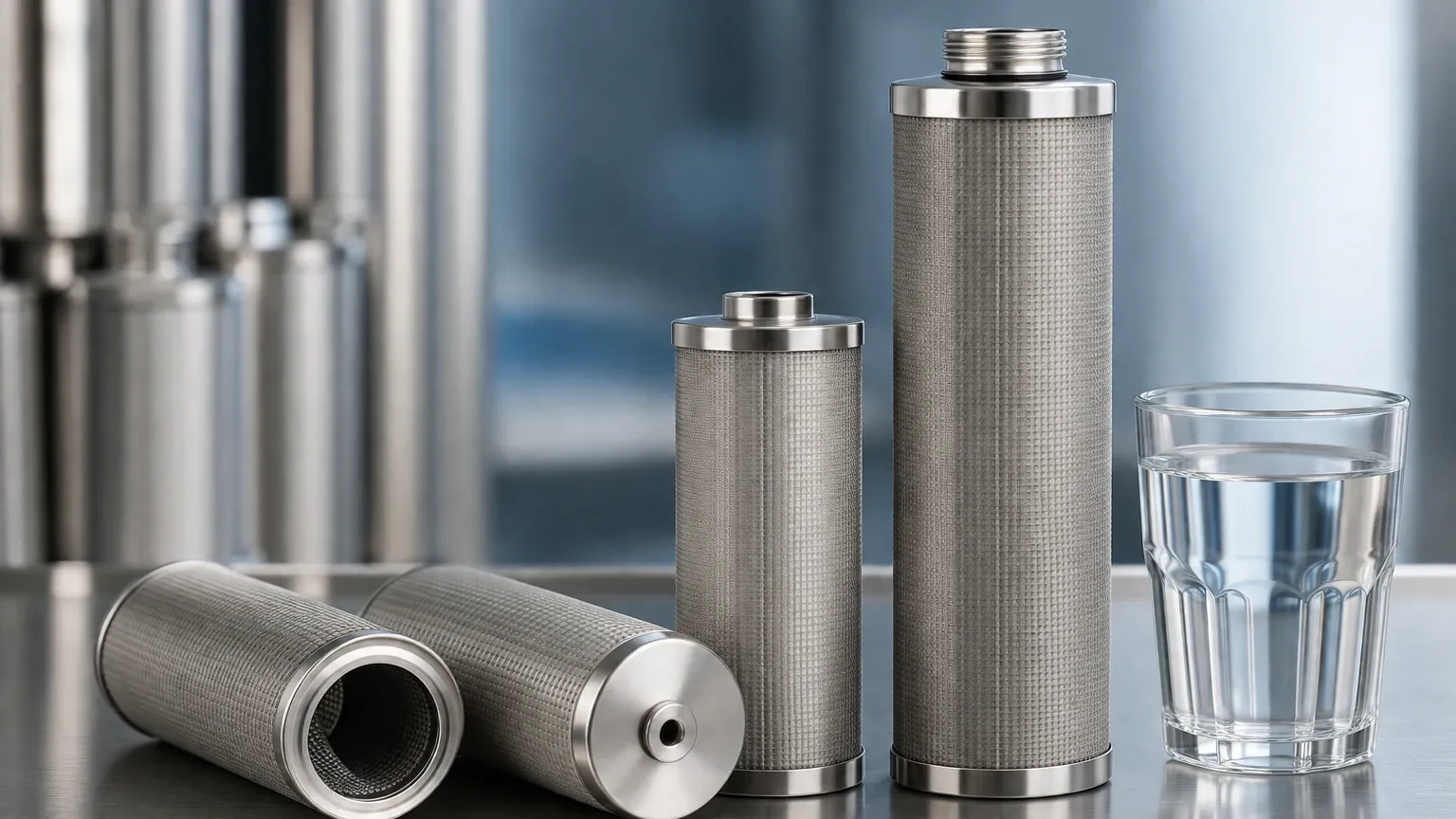
Industrial gravity water filter cartridges are subject to manual handling, high-volume backwashing, and potentially abrasive solids. Sintered wire mesh or wedge wire constructions provide a rigid structure that resists deformation. Unlike disposable cartridges, stainless steel filters can be cleaned via ultrasonic baths, chemical soaking, or backpulsing, significantly reducing the long-term cost of ownership.
Key Performance Metrics for Evaluation
When specifying cartridges for a gravity-fed system, technical teams should evaluate the following parameters to ensure the solution meets the process requirements:
1. Micron Rating (Absolute vs. Nominal): In gravity systems, an absolute micron rating is critical if the goal is to protect downstream equipment or ensure product purity. A nominal rating may allow larger particles to pass if the particle shape is irregular or if the fluid level in the supply tank fluctuates.
2. Permeability: This defines how easily a fluid can pass through the media. For gravity applications, high permeability is essential to maintain a consistent flow rate as the hydrostatic head decreases during tank drainage.
3. Dirt Holding Capacity (DHC): This refers to the amount of contaminant the cartridge can retain before the flow rate drops below the functional threshold. In gravity systems, where the available pressure is fixed, a high DHC is vital to extend the intervals between cleaning cycles.
4. Structural Integrity: Even without high pump pressure, the weight of the fluid column and the resistance of a loaded filter can create stress. The cartridge must have a central core or outer cage (if necessary) to prevent collapse or bypass.
Customization and OEM Considerations
Standard off-the-shelf filters rarely meet the specific needs of specialized industrial gravity systems. Customization is often required to optimize the interface between the filter and the housing. Engineering teams should consider the following customization options:
* End Cap Configurations: Whether the system requires a 222/226 O-ring seal, a flat gasket, or a threaded connection, the seal must be bypass-proof. In gravity systems, even a small leak at the seal can significantly compromise the quality of the filtrate because there is no high-pressure differential to "seat" the gasket more firmly.
* Layered Sintered Mesh: For fine filtration in gravity setups, a multi-layer sintered mesh can be used. This involves a fine filtration layer protected by coarser support layers, providing both precision and the mechanical strength to withstand cleaning.
* Dimensions: Gravity tanks vary widely in depth and diameter. Custom lengths and diameters allow for the maximization of the filtration surface area within the existing footprint of the gravity vessel.
Common Risks and Mitigation Strategies
Operating gravity water filter cartridges involves specific risks that differ from pressurized filtration. One primary concern is air binding. If air becomes trapped within the filter media or the housing, the low pressure of a gravity system may not be sufficient to purge it. This creates an air lock that can completely stop the flow. Designing systems with proper venting and using hydrophilic stainless steel mesh can mitigate this issue.
Another risk is biofilm accumulation. In gravity systems with slow flow rates, there is a higher potential for biological growth if the fluid contains organic matter. Choosing 316L stainless steel with a high-quality surface finish (such as electro-polishing) reduces the ability of bacteria to adhere to the surface and makes the sterilization process more effective.
Finally, media migration is a concern with lower-quality fiber-based filters. In critical B2B applications, using Filter Cartridges constructed from woven wire mesh ensures that no fragments of the filter media enter the process stream, which is a mandatory requirement in food, beverage, and pharmaceutical manufacturing.
Maintenance and Total Cost of Ownership (TCO)
From a procurement perspective, the initial capital expenditure (CAPEX) of stainless steel gravity water filter cartridges is higher than that of disposable polymer filters. However, the Total Cost of Ownership (TCO) is often much lower when analyzed over a 2-to-5-year horizon.
Disposable filters require frequent replacement, leading to high operational expenditure (OPEX), increased waste disposal costs, and potential downtime during change-outs. In contrast, a high-quality stainless steel cartridge can last for years. The ability to clean and reuse the media means that the cost per liter of filtered fluid decreases over time. Furthermore, the durability of metal filters reduces the risk of catastrophic failure, which could lead to expensive product loss or equipment damage downstream.
Conclusion: Selecting the Right Solution
Gravity water filter cartridges are a critical component in many industrial processes where energy conservation and mechanical simplicity are prioritized. However, the success of a gravity-fed system depends entirely on the engineering of the filter media. By focusing on high-permeability materials like stainless steel mesh, optimizing the effective filtration area, and ensuring robust structural design, engineers can achieve reliable and cost-effective separation.
When evaluating suppliers, it is essential to confirm their ability to provide technical documentation, material certifications (such as 3.1b certs), and customization capabilities. A partner that understands the nuances of hydrostatic head and fluid velocity will be better equipped to provide a filtration solution that performs consistently under the unique constraints of gravity-driven flow.
For those seeking to optimize their industrial filtration processes with durable and precise components, exploring specialized Filter Cartridges is the first step toward achieving long-term operational efficiency.
