


Disc Filter Direction
In industrial filtration, the performance of a system is often determined by the precision of its components and the accuracy of their installation. For engineers and procurement specialists working with stainless steel filtration media, understanding the nuances of disc filter direction is critical to ensuring operational efficiency, structural integrity, and the longevity of the equipment. Whether utilizing single-layer mesh or complex multi-layer assemblies, the orientation of the filter media relative to the fluid flow—the disc filter direction—directly impacts pressure drop, particle retention capacity, and mechanical stability.
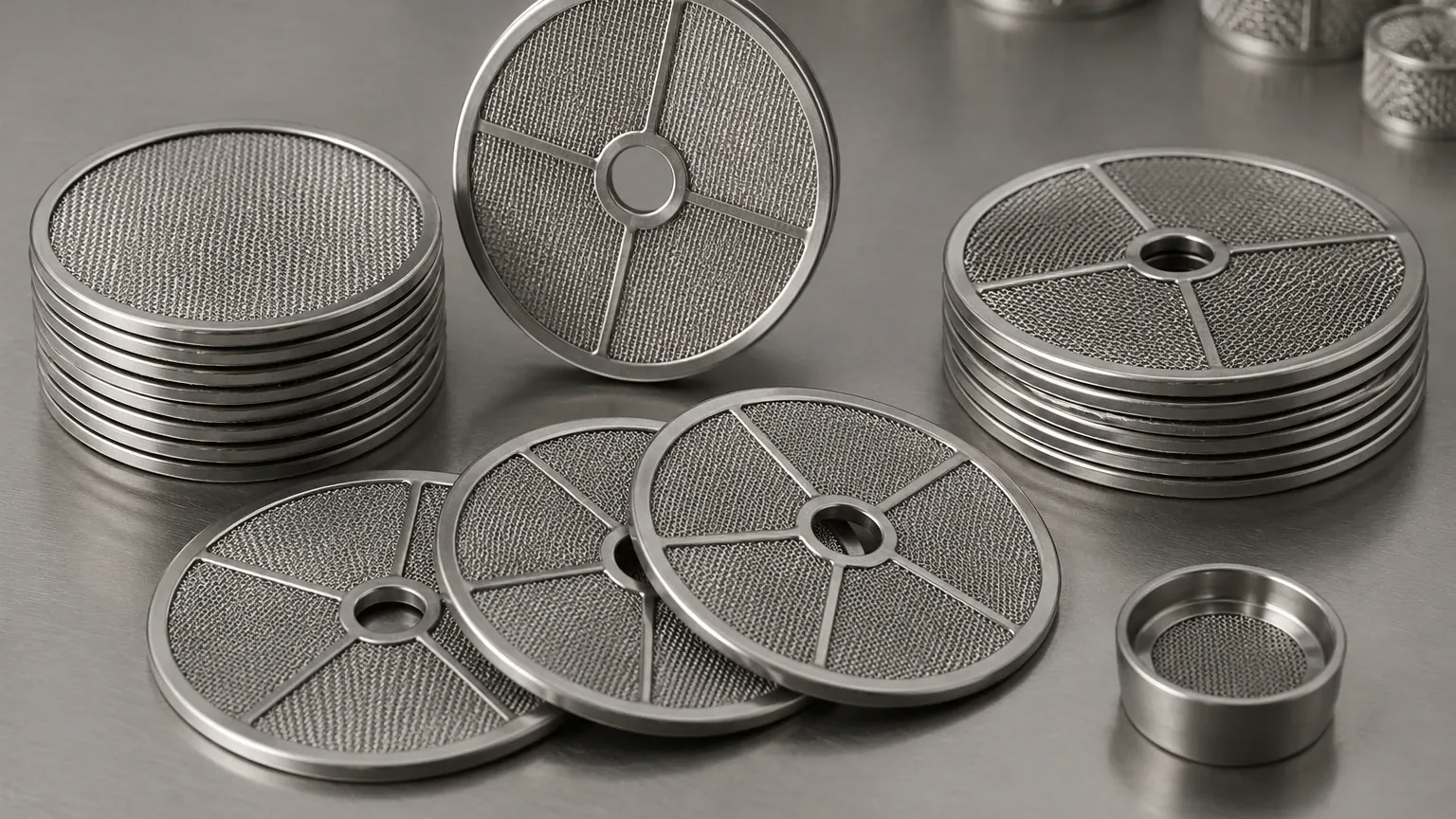
Industrial Filter Discs & Packs are engineered to operate under specific hydraulic conditions. When these components are integrated into chemical processing, hydraulic systems, or polymer melt extruders, the direction in which the fluid passes through the mesh determines how the load is distributed across the wire structure. Misalignment or reversed installation can lead to premature failure, mesh migration, or a significant decrease in filtration accuracy.
The Engineering Principles of Flow Direction
The fundamental principle of disc filter direction revolves around the relationship between the filtration layer and the support structure. In most high-performance stainless steel filter packs, the assembly is not symmetrical in function, even if it appears so to the naked eye.
Upstream vs. Downstream Orientation
In a standard multi-layer configuration, the "upstream" side is designed to encounter the raw influent first. This side may feature a coarser mesh designed for pre-filtration or a protective layer that shields the finer, more delicate filtration mesh from high-velocity particles. The "downstream" side, conversely, is typically supported by a heavier, high-strength mesh or a perforated plate. This support is essential because the pressure differential ($ΔP$) exerts a mechanical force on the filtration media. If the disc filter direction is reversed, the fine mesh lacks the necessary backing to resist this pressure, which can result in the mesh stretching, tearing, or collapsing into the downstream flow path.
Depth vs. Surface Filtration Dynamics
Direction also dictates whether a filter acts primarily as a surface filter or a depth filter. In multi-layer sintered packs, the layers are often arranged in a graded density. If the fluid follows the intended disc filter direction, it moves from a larger pore size to a smaller pore size. This allows for depth filtration, where larger particles are trapped in the outer layers and smaller particles are captured deeper within the pack. If installed backwards, the finest layer faces the full brunt of the particle load immediately, leading to rapid surface blinding and an exponential increase in pressure drop.
Structural Integrity and Support Mechanisms
Stainless steel filter discs are frequently used in high-pressure environments where mechanical failure is a constant risk. The structural design of these discs is optimized for a specific flow vector.
Resistance to Deformation
Wire mesh is inherently flexible. Under the stress of industrial flow rates, the mesh wires tend to bow in the direction of the fluid. Manufacturers like Kaifil engineer Filter Discs & Packs with specific rimming or spot-welding techniques to maintain the flatness of the disc. The disc filter direction ensures that the force of the fluid pushes the filtration media against its internal or external support skeletons. In high-viscosity applications, such as polymer filtration, the wrong direction can cause the entire pack to dislodge from its housing, leading to catastrophic system bypass.
Sintered Mesh Stability
In sintered metal filter discs, multiple layers of wire cloth are bonded together using heat and pressure. While sintering provides excellent structural stability, the sequence of the layers remains vital. The thickest, most robust layer is intended to be the final exit point for the fluid (the downstream side). This layer acts as the foundation for the finer layers. Understanding the disc filter direction allows engineers to ensure that the mechanical load is transferred through the fine mesh into the robust sintered base, preventing delamination of the sintered layers under high-pressure pulses.
Impact on Filtration Efficiency and Particle Retention
Filtration efficiency is not just a result of the micron rating; it is a result of how that micron rating interacts with the fluid dynamics of the system.
1. Particle Distribution: When the disc filter direction is correct, particles are distributed across the various layers of a multi-layer pack. This maximizes the "dirt-holding capacity" of the disc. Correct orientation prevents the "cake" from forming too quickly on the primary filtration layer, which extends the interval between maintenance cycles.
2. Flow Velocity and Turbulence: The weave of the wire mesh (e.g., Plain Weave, Dutch Weave, or Twilled Dutch Weave) is designed to manage fluid velocity. Certain weaves are directional by nature; they are engineered to handle flow more efficiently from one side to minimize turbulence. Excessive turbulence on the downstream side can lead to "particle shedding," where previously captured contaminants are shaken loose and re-introduced into the clean filtrate.
3. Consistency of Micron Rating: The effective pore size of a mesh can change if the wires are displaced. Proper disc filter direction ensures that the tension within the weave remains constant. If the flow direction is reversed, the pressure may cause the wires to shift slightly, enlarging the pores and allowing larger-than-rated particles to pass through.
Customizing Filter Discs & Packs for Directional Accuracy
To mitigate the risk of human error during installation and to optimize performance for specific industrial needs, customization of Filter Discs & Packs is often necessary. Engineering teams must consider several factors when specifying their requirements to a manufacturer.
Identification Markers
Since many stainless steel discs look identical on both sides, manufacturers can include physical markers to indicate the correct disc filter direction. This can include:
* Asymmetrical Rimming: Using a different rim thickness or material on the upstream side.
* Etched Indicators: Laser-etching arrows or part numbers on the downstream support rim.
* Notching: Adding a small notch to the circumference of the disc that corresponds to a keyway in the filter housing, ensuring the disc can only be inserted in the correct orientation.
Material Selection and Compatibility
The choice of material (e.g., 304, 316, or 316L stainless steel) also plays a role in how the disc handles directional stress. In corrosive chemical environments, the downstream support must be just as corrosion-resistant as the filtration layer, as any degradation of the support structure will eventually lead to the failure of the filtration media, regardless of the flow direction.
Common Operational Risks and Mitigation Strategies
Ignoring the importance of disc filter direction leads to several quantifiable risks in a B2B industrial setting. Understanding these risks is the first step toward developing a robust filtration strategy.
Premature Blinding and Pressure Spikes
If a disc is installed with the fine mesh facing upstream without a pre-filter layer, the surface area becomes clogged almost instantly. This results in a rapid pressure spike that can trigger system shutdowns or damage sensitive pumps. By adhering to the correct disc filter direction, the load is partitioned, and the pressure increases linearly rather than exponentially, allowing for predictable maintenance scheduling.
Media Migration
In extreme cases, reversed flow can cause "media migration," where fragments of the wire mesh itself break off and enter the process stream. This is particularly dangerous in the food, beverage, and pharmaceutical industries, where product purity is paramount. Ensuring that the fine mesh is always backed by a downstream support layer is the primary defense against this type of contamination.
Cleaning and Backwashing Challenges
For systems designed for in-situ cleaning or backwashing, the disc filter direction is doubly important. Backwashing involves reversing the flow to dislodge particles. However, the filter must be originally designed to withstand this reverse pressure. If a standard disc is backwashed without being engineered for it, the reverse flow can destroy the mesh. Engineers must specify "backwashable" designs when requesting Filter Discs & Packs to ensure the internal structure is reinforced for flow in both directions.
Selection Criteria for Industrial Applications
When selecting or designing a disc filter, engineers should use a checklist to ensure that the disc filter direction and overall design align with the application requirements:
* Operating Pressure and Differential Pressure: What is the maximum $ΔP$ the disc will encounter? This determines the thickness of the downstream support required.
* Fluid Characteristics: Is the fluid Newtonian or non-Newtonian? High-viscosity fluids exert more shear stress on the mesh, making directional support even more critical.
* Particle Size Distribution: Does the process require a single micron rating or a graded approach? Graded packs are highly directional and require clear installation protocols.
* Housing Design: Does the filter housing provide a mechanical stop for the disc? The disc must be seated so that the flow direction reinforces its seal against the housing walls.
Conclusion
In the complex landscape of industrial filtration, the technical detail of disc filter direction is a small but pivotal factor that determines the success of a process. By ensuring that Filter Discs & Packs are installed and engineered with the correct flow orientation in mind, facilities can achieve higher product purity, protect expensive downstream equipment, and reduce the total cost of ownership through extended filter life. For engineers, the focus should always remain on the structural relationship between the filtration media and its support, ensuring that every disc is positioned to handle the mechanical and hydraulic realities of the system.
