


Filter Discs Chemistry
In industrial chemical processing, filtration is rarely a simple mechanical separation. It is a complex interaction between the physical properties of the media and the chemical characteristics of the process fluid. The term filter discs chemistry refers to the critical evaluation of material compatibility, corrosion resistance, and metallurgical stability when selecting filtration components for demanding environments. For engineers and procurement specialists, understanding these chemical nuances is essential to ensuring system longevity, product purity, and operational safety.
Industrial filters must withstand a variety of stressors, ranging from extreme pH levels and aggressive solvents to high-temperature oxidative atmospheres. When these conditions are not properly accounted for, the result is often premature mesh failure, media migration, or the leaching of metallic ions into the process stream. This guide examines the technical considerations required to align filter disc selection with the rigorous demands of chemical engineering.
The Fundamentals of Chemical Compatibility in Filtration
The primary objective of any filtration system is to remove contaminants without altering the chemical composition of the filtrate. However, the filter media itself is subject to chemical attack. Chemical compatibility is the ability of a material to resist degradation when exposed to specific chemicals under defined conditions of temperature and pressure.
In the context of filter discs chemistry, compatibility is not a binary "yes" or "no" attribute. It is a spectrum of resistance. For instance, a material might be perfectly stable in a specific acid at room temperature but may undergo rapid intergranular corrosion if the temperature rises by only twenty degrees. Engineers must evaluate the concentration of the chemical, the presence of impurities (such as chlorides in water), and the duration of exposure.
Stainless steel remains the gold standard for industrial chemical filtration due to its inherent passivity. The chromium content in the steel reacts with oxygen to form a thin, invisible layer of chromium oxide. This "passive layer" is what protects the underlying metal from chemical attack. If this layer is compromised by aggressive chemicals and cannot reform, the filter disc will fail. Therefore, selecting the correct alloy grade is the first and most critical step in engineering a filtration solution.
Material Science: Selecting Alloys for Corrosive Media
Kaifil utilizes a range of stainless steel and high-alloy materials to meet the diverse needs of the chemical industry. The selection of the alloy directly dictates the performance of the Filter Discs & Packs in a given environment.
AISI 304 and 304L
Grade 304 is the most common stainless steel used in filtration. It offers excellent resistance to many organic chemicals and mildly corrosive inorganic chemicals. However, it is susceptible to chloride-induced pitting and stress corrosion cracking. The "L" designation (304L) indicates a lower carbon content, which is crucial for filter discs that require welding, as it prevents carbide precipitation and maintains corrosion resistance in the heat-affected zones.
AISI 316 and 316L
For more aggressive chemical environments, 316L is the industry standard. The addition of 2-3% molybdenum significantly enhances the material's resistance to pitting and crevice corrosion, particularly in chloride-rich environments. In many pharmaceutical and fine chemical applications, 316L is mandated due to its superior stability and ease of sterilization.
Exotic Alloys and High-Nickel Steels
In cases where standard stainless steels fail—such as in highly concentrated hot acids or alkaline solutions—exotic alloys like 904L, Hastelloy, or Monel are employed. These materials are engineered with high nickel and molybdenum concentrations to provide exceptional resistance to reducing acids and high-temperature oxidation. Understanding the specific filter discs chemistry of these alloys allows for the design of filters that can operate in environments that would disintegrate standard materials in hours.
Structural Engineering of Filter Discs & Packs
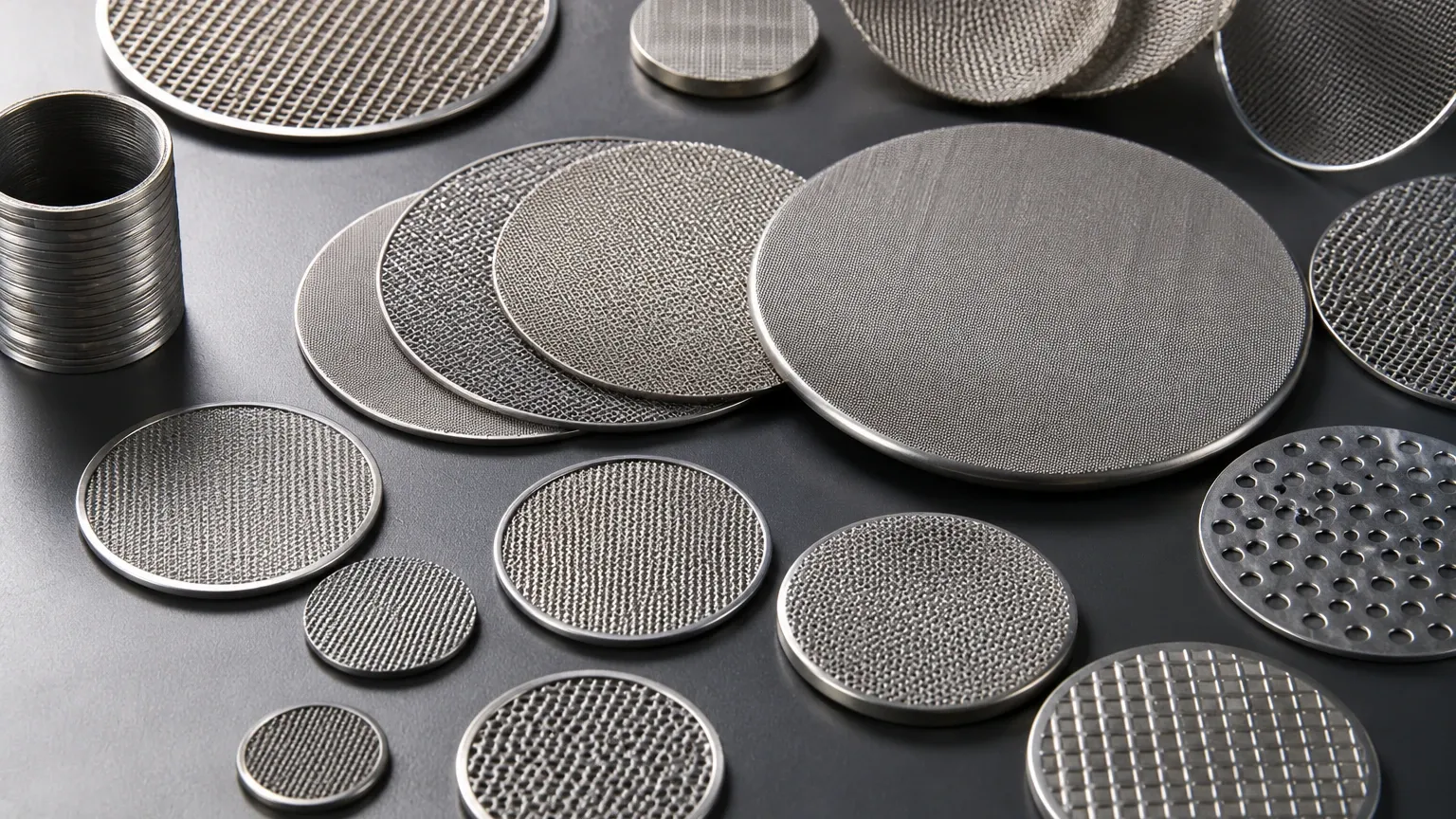
A single layer of wire mesh is often insufficient for high-pressure or high-viscosity chemical applications. To provide both filtration precision and mechanical strength, multiple layers of mesh are combined into integrated units. These components, often referred to as filter packs, are engineered to optimize flow and durability.
Multi-layer designs typically consist of:
1. The Filtration Layer: A fine-mesh layer (often Dutch weave) that determines the micron rating and captures the particles.
2. The Support Layer: A coarser mesh layer that provides structural rigidity to the filtration layer, preventing it from deforming under pressure.
3. The Drainage Layer: An additional coarse layer that ensures the filtrate can flow freely away from the filtration zone, reducing pressure drop across the disc.
These layers can be bound together through various methods. Spot welding is common for simple discs, while rimming (using a metal U-channel) provides a clean, sealed edge that prevents bypass and simplifies installation. The choice of rim material—whether aluminum, copper, or stainless steel—must also be evaluated for chemical compatibility with the process fluid to avoid galvanic corrosion.
Pore Geometry and Micron Ratings in Chemical Applications
The efficiency of a filter disc is defined by its pore geometry and micron rating. In chemical processing, where particle size distribution can be extremely narrow, the precision of the weave is paramount. Wire mesh filters are categorized by their weave type, each offering different advantages:
* Plain Weave: The simplest weave, offering high flow rates and easy cleaning. It is best suited for coarse filtration.
* Twilled Weave: Allows for the use of heavier wires in a given mesh count, increasing the strength and durability of the disc.
* Plain Dutch Weave: Features a high density of wires in the shute direction, creating a tortuous path for particles. This provides excellent filtration accuracy and high pressure resistance.
* Dutch Twilled Weave: Combines the features of twilled and Dutch weaves to achieve the finest filtration levels, often down to 5-10 microns.
When evaluating filter discs chemistry, engineers must also consider the "bubble point" of the mesh. This is a physical test used to verify the largest pore size in a filter. In chemical applications where absolute filtration is required (such as catalyst recovery), ensuring that the pore geometry remains stable under operating pressure is vital. Stainless steel mesh excels here, as its rigid structure prevents pore enlargement, unlike polymer-based filter media.
Mechanical Integrity Under High-Pressure Conditions
Chemical filtration often involves high differential pressures, especially as the filter begins to load with contaminants. The mechanical integrity of the filter disc is a function of both the material's tensile strength and the design of the filter pack.
As the pressure drop increases, the mesh is subjected to significant mechanical stress. If the material has been weakened by chemical corrosion—even slightly—it may suffer from fatigue or sudden rupture. This is why a safety margin is always engineered into the selection process. For high-pressure hydraulic or chemical injection systems, pleated filter discs may be used to increase the surface area, thereby reducing the face velocity and the pressure drop across the media.
Furthermore, the thermal expansion coefficients of the materials must be considered. In processes that cycle between high and low temperatures, the expansion and contraction of the filter disc and its housing can lead to mechanical bypass if the sealing mechanism is not robust. Metal-to-metal seals or specialized gaskets are often required to maintain integrity in these fluctuating chemical environments.
Customization Parameters for OEM Integration
Every chemical process has unique requirements, making customization a necessity rather than an option. When sourcing filtration components, engineers should confirm several parameters to ensure the product meets the specific application needs:
* Dimensional Accuracy: Precise outer and inner diameters are required to ensure a snug fit within the filter housing, preventing fluid bypass.
* Layer Configuration: The number of layers and the specific mesh counts used in a pack can be adjusted to balance filtration efficiency with flow capacity.
* Edging and Sealing: Options include spot-welded edges, bound edges (rims), or even sintered edges for maximum cleanliness and structural unity.
* Surface Treatment: Passivation or electropolishing can be applied to the finished filter discs to further enhance their corrosion resistance and reduce the risk of particle shedding.
By working closely with a manufacturer like Kaifil, purchasing teams can develop OEM filtration components that are tailored to the exact chemical and mechanical profiles of their equipment, ensuring seamless integration and optimized performance.
Operational Lifecycle and Cleaning Protocols
The total cost of ownership for filtration components is heavily influenced by their service life and cleanability. Unlike disposable synthetic filters, stainless steel filter discs are designed for long-term use. Their ability to be cleaned and reused multiple times provides a significant economic advantage in industrial settings.
Cleaning protocols are dictated by the nature of the contaminant and the filter discs chemistry. Common methods include:
* Ultrasonic Cleaning: Uses high-frequency sound waves in a cleaning solution to dislodge particles from deep within the mesh.
* Chemical Cleaning: Involves soaking the discs in solvents or mild acids to dissolve organic or inorganic deposits. The compatibility of the cleaning agent with the filter material must be verified.
* Backwashing: A process where the flow is reversed through the filter to flush out captured solids.
* Thermal Cleaning: Involves heating the filter in a controlled atmosphere to burn off organic contaminants (pyrolysis).
Regular maintenance and proper cleaning not only extend the life of the filter but also ensure that the filtration efficiency remains consistent over many cycles. Engineers should establish a replacement schedule based on the observed pressure drop and the physical condition of the mesh to prevent unexpected failures.
Conclusion: Strategic Selection for Chemical Success
Selecting the right filtration solution requires a deep understanding of the chemical environment and the mechanical demands of the application. By focusing on the principles of filter discs chemistry, engineers can identify the optimal material grades and structural designs to ensure reliable performance.
Whether the goal is to protect downstream equipment, recover expensive catalysts, or ensure the purity of a final chemical product, the choice of Filter Discs & Packs plays a pivotal role. Through precise material selection, advanced manufacturing techniques, and a commitment to quality, Kaifil provides the technical expertise and customized solutions necessary to meet the most challenging filtration requirements in the modern chemical industry. Understanding these factors before procurement helps mitigate risks, reduce long-term costs, and maintain the integrity of the entire production process.
