


Lf Filter
In the landscape of industrial separation technology, the term lf filter—often referring to leaf filter components or specific liquid filtration elements—represents a critical category of equipment used for high-volume, high-precision clarification. These systems rely heavily on the integrity of their internal components to maintain process continuity and product purity. For engineers and procurement specialists, understanding the technical nuances of the filtration media, specifically the Filter Discs & Packs that constitute the heart of these systems, is essential for optimizing operational efficiency and reducing total cost of ownership.
Industrial filtration is rarely a one-size-fits-all endeavor. Whether managing the clarification of edible oils, the recovery of catalysts in chemical processing, or the removal of impurities in pharmaceutical precursors, the choice of an lf filter element dictates the flow rate, pressure tolerance, and filtration accuracy of the entire assembly. This guide examines the engineering considerations, material sciences, and selection criteria necessary for deploying effective stainless steel filtration solutions.
The Role of LF Filter Components in Industrial Processing
Pressure leaf filters, or LF filters, are pressure vessels containing a series of vertical or horizontal leaves. Each leaf serves as a support structure for a fine wire mesh or a combination of mesh layers. The primary function of these components is to facilitate the formation of a "filter cake" or to act as a surface filter for polishing liquids.
In these environments, the lf filter must withstand significant differential pressures while maintaining the geometric stability of the mesh. Unlike disposable fabric filters, stainless steel filter leaves are designed for longevity and repeatability. They must be capable of undergoing multiple cleaning cycles—whether through mechanical vibration, sluicing, or backwashing—without suffering from wire displacement or structural fatigue. The performance of the system is directly tied to the quality of the mesh layers and the precision with which the filter packs are assembled.
Technical Specifications for Filter Discs & Packs
The efficiency of an lf filter system is defined by its media. When selecting Filter Discs & Packs, engineers must evaluate several technical parameters to ensure compatibility with the process fluid and the desired particle retention size.
Mesh Count and Micron Rating
The mesh count refers to the number of openings per linear inch. In LF filter applications, this can range from coarse drainage layers to extremely fine filtration layers. The micron rating (nominal or absolute) determines the smallest particle size the mesh can reliably intercept. For high-precision applications, multi-layer sintered mesh is often preferred because it combines the fine filtration of a high-mesh-count layer with the structural support of coarser layers.
Weave Types
Different weave patterns offer distinct advantages:
* Plain Weave: Provides a simple, straight-through flow path and is easy to clean.
* Dutch Weave: Features a higher wire density, allowing for finer filtration and greater mechanical strength under pressure.
* Twill Weave: Used for heavier wires in finer meshes, offering increased durability for demanding lf filter operations.
Material Science: Selecting Alloys for LF Filter Applications
The chemical environment of the application is the primary driver for material selection. Stainless steel is the industry standard due to its balance of mechanical strength and corrosion resistance. However, the specific grade of steel can significantly impact the lifespan of the lf filter.
304 Stainless Steel
Grade 304 is suitable for general-purpose applications where corrosion risk is moderate. It is commonly used in food and beverage processing where the primary concern is hygiene and basic oxidation resistance. However, in environments with high chloride concentrations, 304 may be susceptible to pitting.
316L Stainless Steel
For chemical processing and pharmaceutical applications, 316L is the preferred choice. The addition of molybdenum provides enhanced resistance to chloride-induced pitting and crevice corrosion. The "L" denotes low carbon content, which is crucial for components that require welding, as it prevents carbide precipitation and ensures the integrity of the joints in complex filter packs.
Exotic Alloys
In extreme cases involving highly acidic or alkaline fluids, materials like Hastelloy, Monel, or Inconel may be required. These alloys are used when standard stainless steel would fail prematurely, ensuring that the lf filter remains operational in the most aggressive industrial environments.
Design Variations: Multi-layer vs. Single-layer Packs
The construction of the filter element is as important as the material itself. An lf filter typically utilizes a multi-layer design to balance flow resistance with structural integrity.
1. Filtration Layer: The finest mesh, positioned on the exterior, which determines the filtration accuracy.
2. Support Layer: A slightly coarser mesh that prevents the filtration layer from deforming under pressure.
3. Drainage Layer: A heavy-duty internal mesh or perforated plate that provides a clear path for the filtrate to exit the leaf and enter the manifold.
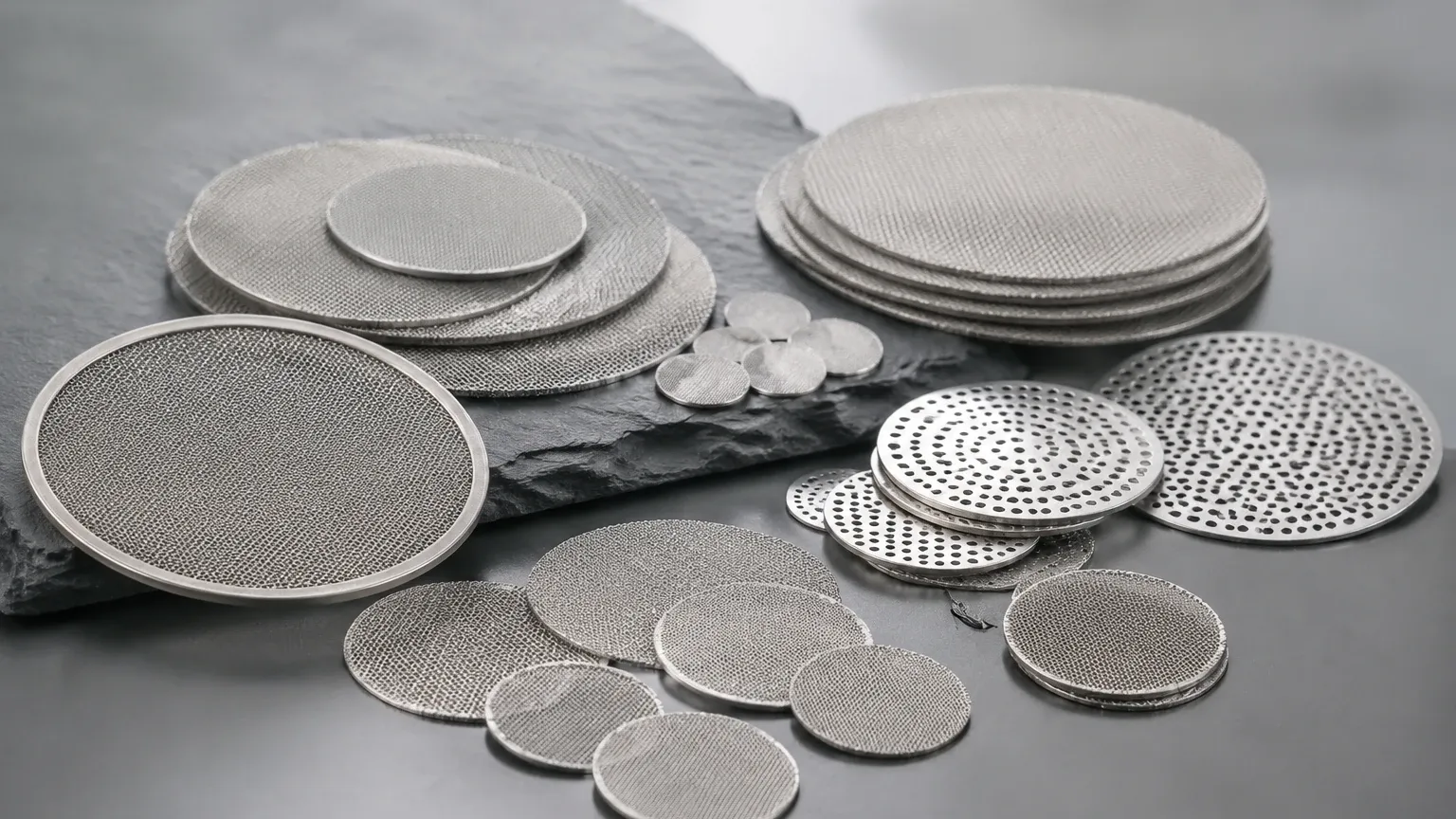
These layers are often bound together using spot welding or a peripheral metal rim. Rimmed Filter Discs & Packs are particularly effective in LF systems because the rim provides a secure sealing surface, preventing bypass—a common failure point where unfiltered liquid leaks around the edges of the filter element.
Performance Metrics: Filtration Precision and Flow Dynamics
When integrating an lf filter into a production line, engineers must calculate the balance between filtration precision and flow dynamics. A mesh that is too fine will provide excellent clarity but will result in a rapid pressure drop and frequent cleaning cycles. Conversely, a mesh that is too coarse will allow contaminants to pass through, potentially damaging downstream equipment or compromising product quality.
Pressure Drop (ΔP)
The initial pressure drop across a clean lf filter should be minimized to allow for maximum cake buildup before the terminal pressure is reached. The geometry of the wire mesh—specifically the open area percentage—is the key factor here. High open-area designs allow for higher flow rates at lower pressures, which is critical for energy efficiency in large-scale industrial pumps.
Dirt Holding Capacity
In many lf filter applications, the goal is to build a uniform filter cake. The surface texture of the wire mesh must be conducive to cake attachment while also allowing for easy cake release during the discharge phase. If the mesh is too smooth, the cake may slip; if it is too rough, residual solids may remain trapped in the mesh, leading to "blinding" or clogging over time.
Application-Specific Engineering Requirements
The requirements for an lf filter vary significantly across different sectors. Understanding these nuances helps in specifying the correct filter pack configuration.
Chemical and Petrochemical
In these industries, filters often handle volatile or hazardous substances at elevated temperatures. The lf filter must maintain its structural integrity up to several hundred degrees Celsius. Stainless steel filter packs are ideal here as they do not off-gas and are not subject to the thermal degradation seen in polymer-based filters.
Food and Beverage
In edible oil filtration (such as palm or soybean oil), the lf filter is used to remove bleaching earth and impurities. The components must be FDA-compliant and easy to sanitize. The use of 316L stainless steel ensures that no metallic contaminants are leached into the product, and the smooth surface of the wire mesh supports rigorous Clean-in-Place (CIP) protocols.
Pharmaceutical and Biotech
Precision is paramount in pharmaceutical clarification. Filter packs used here often require documented micron ratings and high-purity materials. The ability of stainless steel to withstand autoclave sterilization makes it the material of choice for these sensitive applications.
Maintenance and Operational Longevity
The total cost of ownership for an lf filter is determined by its service life and the ease of maintenance. Unlike disposable filters, stainless steel discs and packs are an investment. Proper maintenance can extend their life to several years.
Cleaning Protocols
When an lf filter reaches its terminal pressure, it must be cleaned. Ultrasonic cleaning is one of the most effective methods for stainless steel mesh, as high-frequency sound waves create cavitation bubbles that dislodge deeply embedded particles without damaging the delicate wires. For routine maintenance, backwashing with a compatible solvent or high-pressure water can be sufficient.
Inspection for Wear
Regular inspection of the filter leaves is necessary to identify signs of mechanical stress. Engineers should look for:
* Wire Displacement: Gaps in the mesh that allow larger particles to pass.
* Fatigue Cracks: Often found near weld points or along the rim.
* Blinding: Persistent clogging that cannot be removed by standard cleaning, indicating the need for professional refurbishment or replacement.
Procurement Checklist for Engineering Teams
Before purchasing or custom-ordering Filter Discs & Packs for an lf filter system, technical teams should confirm the following details with their manufacturer:
1. Fluid Characteristics: What is the viscosity, pH level, and temperature of the liquid?
2. Contaminant Profile: What is the particle size distribution and concentration of the solids being removed?
3. Flow Requirements: What is the required flow rate per unit area (flux)?
4. Mechanical Constraints: What are the exact dimensions, including thickness tolerances, required for the filter to fit into the existing housing?
5. Certification Needs: Are there specific industry standards (e.g., ISO, FDA, or ASME) that the components must meet?
By addressing these factors, procurement teams can ensure they receive a filtration solution that is not only compatible with their hardware but also optimized for their specific process conditions. Selecting high-quality stainless steel components reduces the frequency of replacements and ensures that the lf filter performs reliably under the most demanding industrial loads.
In conclusion, the performance of any lf filter system is only as good as the internal media it employs. By focusing on material grade, weave precision, and structural design, industrial operators can achieve superior filtration results while maintaining high throughput and operational safety.
