


Beer Filtration System
In the industrial brewing process, the beer filtration system is a critical stage that determines the final product's clarity, biological stability, and shelf life. While fermentation and conditioning develop the flavor profile, filtration is the engineering process that refines the liquid into a commercially viable product. For engineers and production managers, selecting the right filtration hardware involves balancing flow rates, pressure tolerances, and the specific physical characteristics of the beer being processed.
Industrial beer filtration is not a single-step operation but a multi-stage process designed to remove yeast cells, proteins, tannins, and spoilage microorganisms. Using high-grade stainless steel components, such as those found on our Main Page, ensures that the system meets stringent food safety standards while providing the durability required for continuous industrial cycles.
The Role of Filtration in Modern Brewing
The primary objective of a beer filtration system is to achieve "brilliance"—a technical term for the high degree of clarity expected in lagers and many ales. Beyond aesthetics, filtration plays a vital role in the chemical and biological stabilization of the beverage.
Suspended solids, including residual yeast and hop particles, can continue to interact with the liquid after packaging, leading to off-flavors or unintended secondary fermentation. Furthermore, protein-polyphenol complexes can cause "chill haze," where a beer becomes cloudy when refrigerated. A robust filtration system removes these precursors, ensuring the beer remains clear and flavor-stable throughout its intended shelf life. From a technical perspective, this requires a deep understanding of micron ratings and the mechanical strength of filter media to withstand the differential pressures generated during high-volume production.
Key Stages of a Professional Beer Filtration System
To achieve optimal results without clogging delicate membranes, industrial brewing typically employs a graduated approach to filtration. Each stage utilizes different filter architectures to target specific particle sizes.
Primary Filtration (Coarse Filtration)
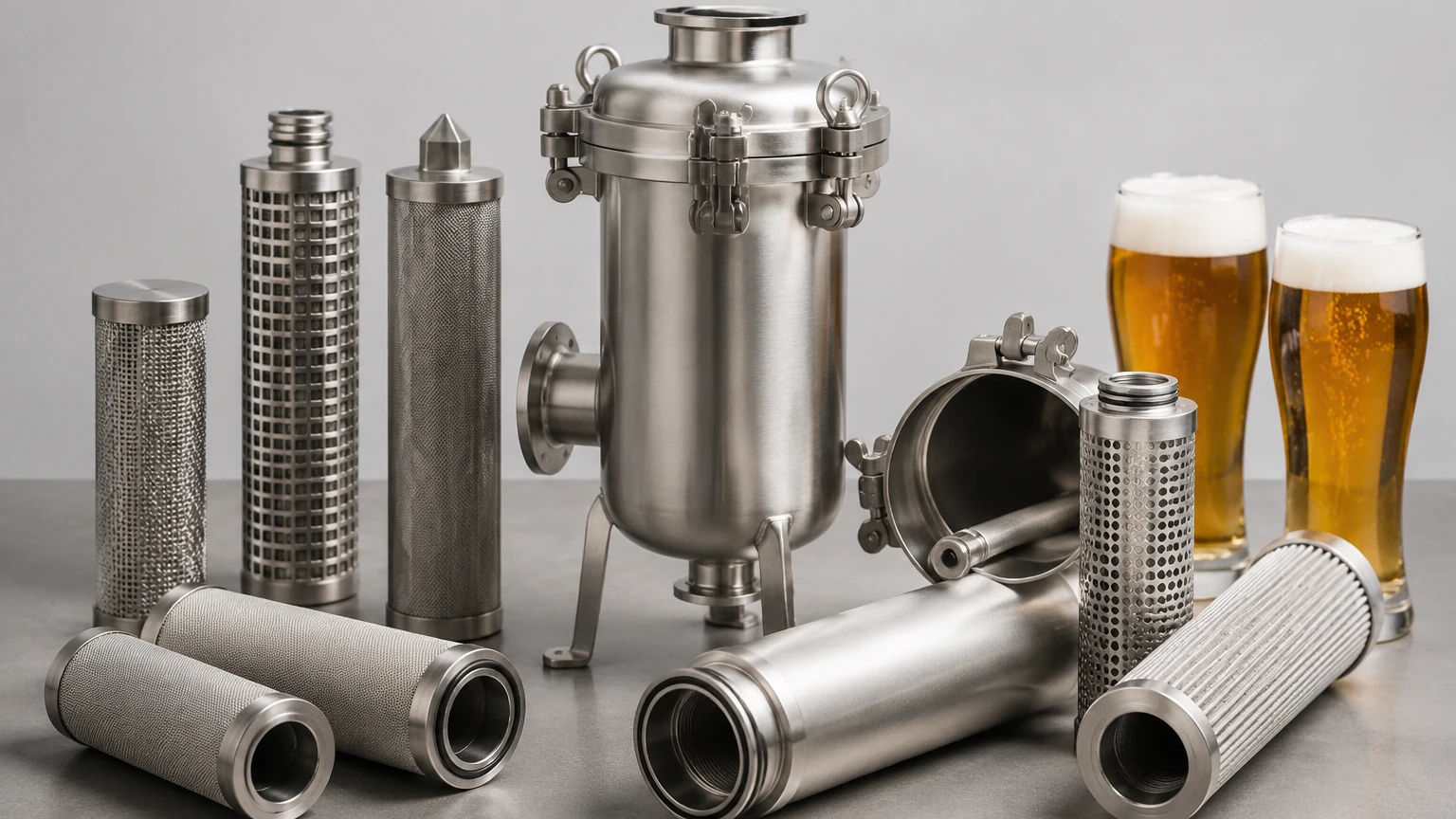
This initial stage focuses on the removal of the bulk of the yeast and large suspended solids following fermentation and maturation. In many industrial setups, this involves the use of stainless steel wire mesh or wedge wire screens. These components are designed to handle high solids loading. By removing the majority of the particulate matter here, the system protects more expensive, finer filters downstream from premature blinding.
Secondary Filtration (Polishing)
Once the bulk solids are removed, the beer undergoes polishing. This stage targets smaller particles, typically in the 1 to 5-micron range. Sintered metal mesh and pleated stainless steel cartridges are frequently used here. The goal is to achieve the desired level of clarity. Engineers must carefully monitor the flow velocity during this stage, as excessive speed can force deformable particles through the filter media, compromising the final clarity.
Cold Stabilization (Final/Sterile Filtration)
For beers that will not be pasteurized, the final filtration stage must be capable of removing spoilage bacteria and any remaining yeast cells. This usually requires a sub-micron rating (often 0.45 to 0.65 microns). At this level, the integrity of the filter housing and the precision of the filter element are paramount. Any bypass or mechanical failure at this stage can lead to batch contamination.
Engineering Specifications for Stainless Steel Filter Components
When designing or upgrading a beer filtration system, the material science behind the filter elements is as important as the system's layout. Stainless steel, specifically grades 304 and 316L, is the industry standard due to its corrosion resistance and ability to withstand rigorous cleaning protocols.
Material Selection: 304 vs. 316L
While 304 stainless steel is suitable for many structural components, 316L is preferred for parts in direct contact with the beer and cleaning chemicals. The addition of molybdenum in 316L provides superior resistance to pitting and crevice corrosion, which is essential when dealing with the acidic nature of beer and the chlorine-based or caustic cleaning agents used in breweries.
Micron Ratings and Filtration Efficiency
The "micron rating" indicates the size of the particles the filter is designed to trap. In a beer filtration system, engineers must distinguish between nominal and absolute ratings. A nominal rating refers to a filter that can trap a large percentage of particles of a certain size, whereas an absolute rating indicates that 99.9% or more of particles at that size are retained. For final stabilization, absolute-rated cartridges are mandatory to ensure biological safety.
Pressure and Flow Dynamics
Every filter element introduces a pressure drop (Delta P) into the system. As the filter collects debris, this pressure drop increases. Engineering a system requires calculating the maximum allowable differential pressure before the filter element risks structural deformation or "blow-through." High-quality stainless steel mesh filters are favored in industrial settings because they offer high mechanical strength, allowing them to operate under higher pressure differentials than polymer-based alternatives.
Comparing Filter Media: Sintered Mesh vs. Wedge Wire
Different sections of a beer filtration system require different mechanical structures. Two of the most common are sintered wire mesh and wedge wire.
Sintered Wire Mesh
Sintered mesh is created by layering multiple sheets of stainless steel wire cloth and bonding them together through a high-temperature diffusion-bonding process. This creates a porous material that is incredibly strong and has a fixed pore size. In beer filtration, multi-layer sintered mesh is excellent for polishing stages because it provides deep filtration and can be backwashed effectively. Its rigid structure prevents pore migration, ensuring consistent filtration performance even under fluctuating pressures.
Wedge Wire Screens
Wedge wire is constructed from V-shaped profiles resistance-welded onto support rods. This creates a non-clogging surface that is ideal for the primary stages of beer filtration or for use in lauter tuns. The V-shape allows only two-point contact with particles, making it much easier to clean during backwashing compared to traditional woven wire. For large-scale breweries, wedge wire provides the necessary surface area and mechanical durability to handle high flow rates with minimal maintenance.
Operational Efficiency and Maintenance: CIP and Durability
In a B2B environment, the total cost of ownership (TCO) of a beer filtration system is heavily influenced by maintenance requirements and the lifespan of the filter elements. Stainless steel filters offer a significant advantage over disposable depth filters due to their cleanability.
Clean-in-Place (CIP) Compatibility
Modern industrial breweries rely on Clean-in-Place (CIP) systems to sanitize equipment without disassembly. A stainless steel beer filtration system must be designed to withstand high-temperature caustic washes (often up to 85°C or 185°F) and acidic neutralizers. Unlike synthetic filters that may degrade or leach chemicals when exposed to heat and harsh pH levels, stainless steel components maintain their structural integrity and hygienic properties over hundreds of cleaning cycles.
Regeneration and Backwashing
One of the primary benefits of using metal filter elements in a beer filtration system is the ability to regenerate the media. Through backwashing—reversing the flow of filtered liquid or using compressed air—trapped particles can be dislodged from the surface of the mesh. This extends the time between full cleaning cycles and reduces the frequency of filter replacements, leading to lower operational costs and less production downtime.
Selecting the Right Filtration Solution for Industrial Scale
Choosing the appropriate filtration hardware requires a comprehensive evaluation of the production environment. Engineers should confirm several factors before finalizing a system design:
1. Desired Clarity (Turbidity): Define the target EBC (European Brewery Convention) or ASBC units for the finished beer. This dictates the required micron rating for the polishing and final stages.
2. Batch Volume and Flow Rate: The system must be sized to handle peak production volumes without causing bottlenecks. This involves calculating the total surface area of the filter media required to maintain a laminar flow.
3. Yeast Strain Characteristics: Some yeast strains are more "powdery" and difficult to filter than flocculent strains. The filter media must be selected to handle the specific morphology of the yeast used in the brewery.
4. Chemical Compatibility: Ensure that all seals, gaskets, and metal alloys are compatible with both the beer and the specific cleaning chemicals used in the facility.
For organizations looking to optimize their production line, exploring the technical specifications of various filter architectures is essential. You can review product options and application support on our Main Page to see how custom-engineered stainless steel solutions can be integrated into your specific brewing workflow.
Conclusion
A well-engineered beer filtration system is an investment in product quality and brand reputation. By utilizing high-performance stainless steel components, breweries can achieve the precise balance of clarity and flavor stability required by the global market. Whether it is through the use of durable wedge wire for primary separation or precision sintered mesh for final polishing, the focus remains on technical reliability and operational efficiency. Choosing the right partner for custom filtration components ensures that the system not only meets today’s production needs but is also durable enough to handle the rigors of long-term industrial use.
