


Bioreactor Sparger
In industrial bioprocessing, the efficiency of gas-to-liquid mass transfer is a primary determinant of productivity. The bioreactor sparger serves as the critical interface where process gases—typically oxygen, air, carbon dioxide, or nitrogen—are introduced into the liquid medium. For engineers and facility managers, selecting the appropriate sparging technology is not merely a matter of hardware procurement; it is a complex engineering decision that impacts cell viability, nutrient uptake, and the overall scalability of the fermentation or cell culture process.
As a specialized manufacturer of stainless steel filtration and fluid control components, Kaifil provides precision-engineered sparging solutions designed to meet the rigorous demands of the pharmaceutical, chemical, and food processing industries. Understanding the technical nuances of sparger design, material selection, and bubble dynamics is essential for optimizing the performance of any bioreactor system.
The Role of Sparging in Mass Transfer Dynamics
The fundamental objective of a bioreactor sparger is to maximize the Oxygen Transfer Rate (OTR) while minimizing the potential for cellular damage caused by shear stress or gas toxicity. This is quantified through the mass transfer coefficient ($k_La$). The efficiency of gas transfer is governed by the total surface area of the gas bubbles relative to the volume of the liquid. Smaller bubbles provide a significantly higher surface-area-to-volume ratio, which facilitates more rapid gas dissolution.
However, bubble size must be balanced against the physical requirements of the system. While micro-bubbles (typically generated by sintered metal spargers) excel at oxygenation, they can also lead to increased foaming and higher shear stress upon bubble rupture at the liquid surface. Conversely, larger bubbles generated by drilled pipe spargers may be less efficient for oxygenation but are often used for stripping carbon dioxide from the media. Engineering a balanced system often requires a combination of sparger types or highly specific pore size configurations to maintain the optimal dissolved oxygen (DO) levels and pH balance.
Sintered Metal vs. Traditional Sparger Designs
When evaluating sparging hardware, engineers generally choose between two primary categories: sintered porous metal spargers and macroscopic orifice designs (such as drilled pipes or rings).
Sintered Porous Metal Spargers
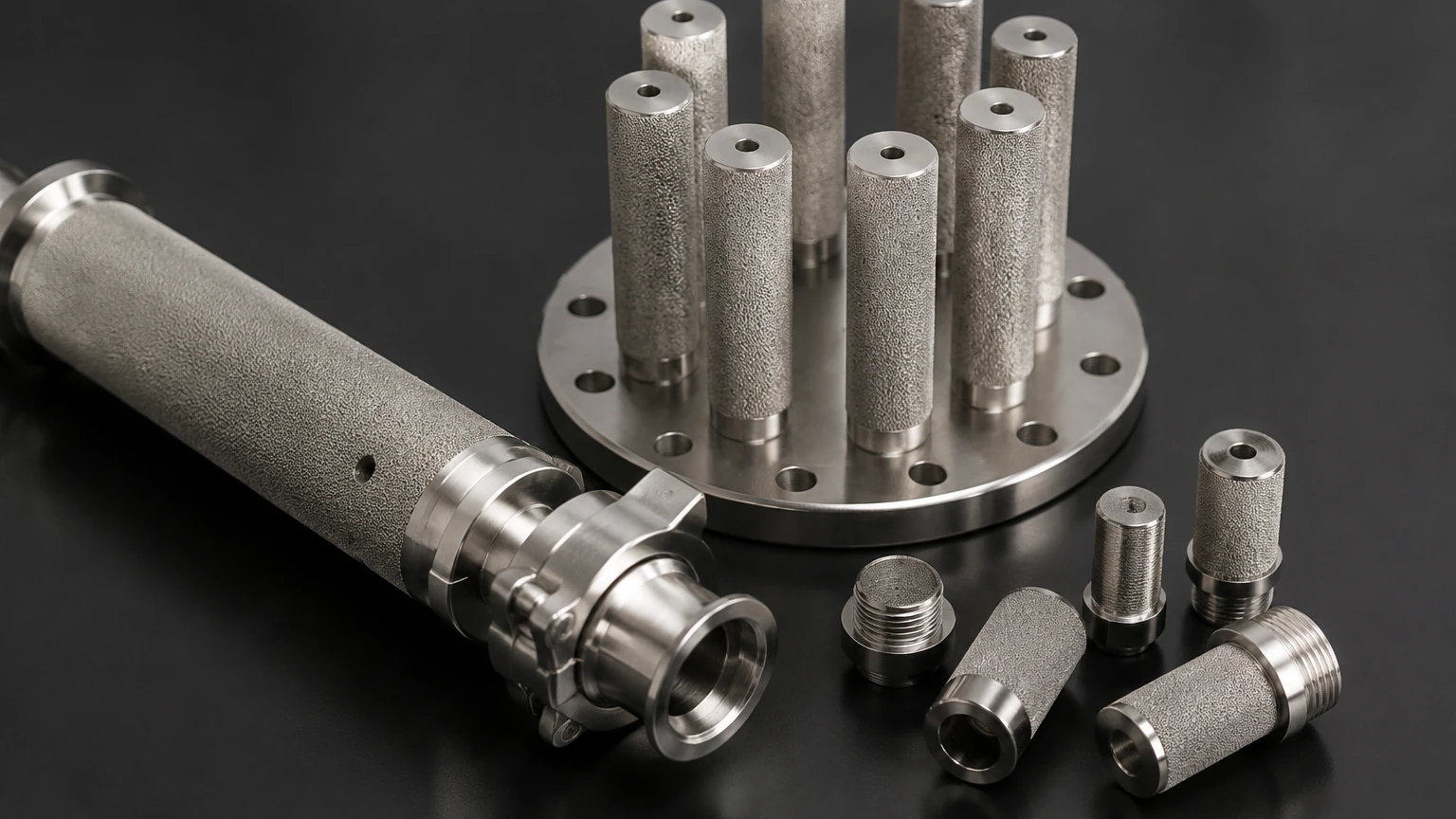
Sintered metal spargers, often referred to as micro-spargers, are manufactured by compressing and heat-treating stainless steel powder to create a porous structure with controlled pore sizes. These components are the industry standard for high-performance bioreactors due to their ability to produce millions of tiny bubbles.
Key advantages include:
* High Surface Area: The microscopic pores (ranging from 0.5 µm to 100 µm) create a massive interface for gas exchange.
* Uniform Distribution: Unlike drilled holes, the porous matrix ensures gas is distributed evenly across the entire surface of the sparger element.
* Durability: Stainless steel construction provides the structural integrity needed to withstand high-pressure steam sterilization and aggressive cleaning cycles.
Drilled Pipe and Ring Spargers
These designs utilize larger, mechanically drilled holes. While they are simpler to manufacture and less prone to clogging, they produce significantly larger bubbles. These are frequently used in large-scale fermenters where the primary goal is bulk gas movement or where the biological culture is highly sensitive to the foam generated by micro-bubbles.
For many advanced applications, a hybrid approach is used. A micro-sparger provides the primary oxygenation, while a larger ring sparger is utilized for CO2 stripping or supplemental aeration during peak growth phases. You can Review product options and application support on the Kaifil Main Page to determine which configuration suits your specific vessel geometry.
Engineering Considerations: Pore Size and Gas Velocity
Selecting the correct pore size for a bioreactor sparger is a critical engineering step. The "nominal pore size" of a sintered element indicates the average diameter of the openings, but the actual bubble size produced is also influenced by the surface tension of the media, the gas flow rate, and the agitation speed of the bioreactor impellers.
Pressure Drop and Flow Rates
Every sparger introduces a degree of resistance to gas flow, known as pressure drop ($ΔP$). A sparger with very fine pores (e.g., 0.5 µm) will require a higher inlet pressure to overcome the surface tension and resistance of the metal matrix. Engineers must ensure that the facility's gas delivery system can provide sufficient pressure to achieve the required flow rates at the end of the batch, when the liquid head pressure and potential fouling may increase resistance.
Exit Velocity
The velocity at which gas exits the sparger pores can impact cell health. High-velocity gas jets can create localized zones of high shear, which may lyse sensitive mammalian cells. By utilizing larger surface area sintered elements, the same volume of gas can be delivered at a lower exit velocity, protecting the biological payload while maintaining high OTR.
Material Integrity and Regulatory Compliance
In the B2B biopharmaceutical environment, material selection is non-negotiable. Bioreactor components must be chemically inert, non-leaching, and capable of withstanding repeated sterilization cycles.
316L Stainless Steel
Kaifil utilizes 316L stainless steel as the primary material for its filtration and sparging components. The "L" denotes low carbon content, which is essential for preventing sensitization and intergranular corrosion during welding. This material offers excellent resistance to the organic acids and salts commonly found in fermentation broths.
Surface Finish and Cleanability
The external surface of the sparger must be finished to high standards (often measured in Ra, or roughness average) to prevent microbial attachment. Electropolishing is frequently employed to create a mirror-like finish that enhances the effectiveness of Clean-in-Place (CIP) protocols. For sintered elements, the internal porosity must be maintained through specialized cleaning procedures, such as ultrasonic baths or chemical back-flushing, to ensure that the component does not become a site for bio-burden accumulation.
Integration and Customization in Bioreactor Design
No two bioreactors are identical. Factors such as vessel height, diameter, impeller type, and the specific metabolic requirements of the organism dictate the sparger's physical configuration.
Custom Geometries
Standard sparger shapes include probes, rings, and discs. However, custom OEM solutions are often required for retrofitting existing vessels or optimizing new designs.
* Sparger Probes: These are often inserted through side ports or bottom ports and can be easily removed for maintenance.
* Ring Spargers: These are mounted beneath the lowest impeller to ensure that bubbles are immediately sheared and dispersed by the turbine blades.
* Fritted Discs: Often used in bench-top or lab-scale glass bioreactors where space is limited.
When designing a custom bioreactor sparger, engineers should confirm the connection type (e.g., Tri-Clamp, NPT, or flange), the total submerged length, and the required gas flow range (SLPM). These specifications ensure that the sparger integrates seamlessly with the vessel's control system and piping.
Maintenance, Fouling, and Total Cost of Ownership
While sintered metal spargers offer superior performance, they are more susceptible to fouling than macroscopic designs. Fouling occurs when media components, proteins, or cellular debris penetrate the porous structure. If not addressed, this leads to increased pressure drop and non-uniform gas distribution.
Cleaning Protocols
To maintain long-term performance, a robust maintenance schedule is required. This typically includes:
1. In-situ Sterilization (SIP): Using saturated steam to ensure sterility before and after batches.
2. Chemical Cleaning: Circulating caustic or acidic solutions to dissolve organic and inorganic deposits.
3. Ultrasonic Cleaning: For heavily fouled elements, removing the sparger and placing it in an ultrasonic bath can dislodge particles trapped deep within the sintered matrix.
Replacement Cycles
Despite their durability, spargers are considered critical consumables or semi-permanent components. Over years of use and repeated cleaning, the pore structure may eventually degrade or become permanently occluded. Monitoring the pressure-to-flow ratio during operation is the most effective way to determine when a sparger has reached the end of its functional life. Investing in high-quality sintered components from a reliable manufacturer like Kaifil reduces the frequency of replacements and prevents costly mid-batch failures.
Conclusion: Selecting the Right Partner for Sparging Solutions
The bioreactor sparger is a small component with a massive impact on the success of a bioprocess. From the initial engineering of bubble size and $k_La$ to the long-term considerations of material durability and CIP effectiveness, every detail matters. By focusing on precision manufacturing and technical expertise, Kaifil supports engineers in achieving the precise gas transfer rates required for modern industrial applications.
For technical professionals seeking to optimize their filtration and aeration systems, understanding the interplay between material science and fluid dynamics is the first step. Whether you are scaling up a pilot plant or refining a high-volume production line, selecting a sparger that meets exact engineering specifications is vital for operational efficiency. For more information on custom stainless steel filtration and sparging components, visit the Main Page to explore technical specifications and manufacturing capabilities.
