


Coalesher
In industrial fluid processing, the separation of immiscible liquids or the removal of liquid aerosols from gas streams is a critical challenge. A coalesher (commonly referred to as a coalescer) is a specialized engineering device designed to facilitate the merging of small droplets into larger ones, allowing for efficient separation through gravity or secondary filtration stages. For engineers and procurement professionals, selecting the right coalescing technology is essential for protecting downstream equipment, ensuring product purity, and maintaining environmental compliance.
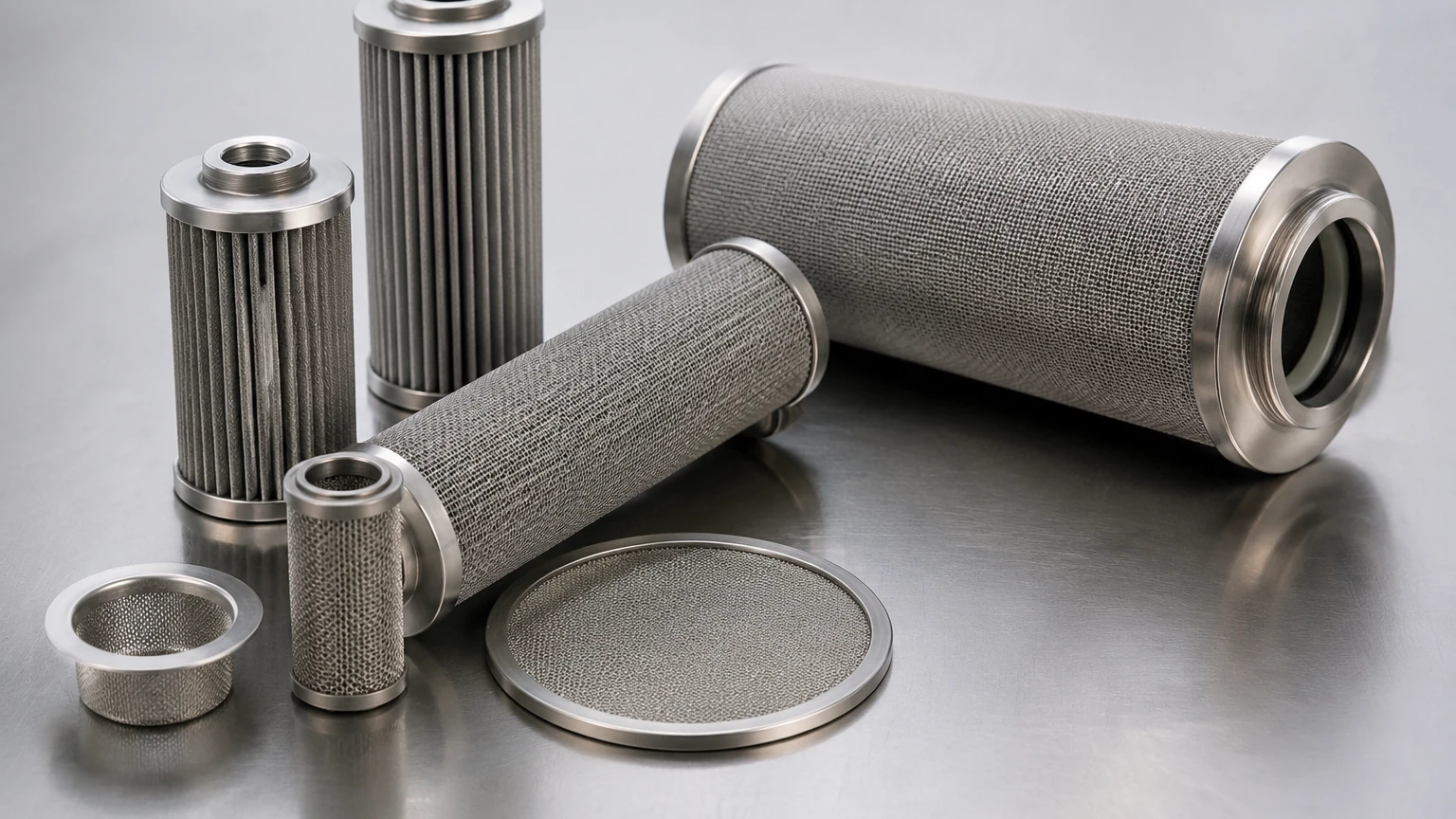
At Kaifil, we specialize in high-performance stainless steel filtration solutions that support these complex separation processes. By utilizing advanced wire mesh and sintered metal technologies, a coalesher can achieve high efficiency even in demanding environments where synthetic media might fail. This guide explores the technical principles, material considerations, and engineering criteria necessary for selecting and implementing industrial coalescing systems.
The Fundamental Principles of Coalescence
The operation of a coalesher relies on the physical principle of coalescence: the process by which two or more droplets, bubbles, or particles merge during contact to form a single daughter droplet. In industrial applications, this is typically used to separate a "discontinuous phase" (the droplets) from a "continuous phase" (the carrier fluid, which can be gas or liquid).
The Three-Stage Process
An effective coalesher operates through three distinct mechanical stages:
1. Capture and Interception: As the fluid passes through the coalescing media—often a dense matrix of stainless steel wire mesh or fibers—the small micro-droplets are intercepted by the media fibers. This capture is driven by Brownian motion, inertial impaction, and direct interception.
2. Coalescence (Merging): Once captured, the droplets adhere to the surface of the media. As more droplets are trapped, they move along the fibers and collide with one another. Due to the surface tension and the affinity of the media for the liquid phase, these small droplets merge into larger ones.
3. Separation and Drainage: Once the merged droplets reach a sufficient size, the drag force of the flowing fluid or the force of gravity overcomes the adhesive forces holding the droplet to the media. The larger droplets then detach and either sink (in liquid-liquid separation where the droplet is denser) or rise (where the droplet is less dense), allowing for easy removal at a collection point.
Liquid-Liquid vs. Gas-Liquid Coalescence
A coalesher is categorized based on the phases it is designed to separate. In gas-liquid applications, the goal is to remove mist or fine oil droplets from a compressed air or gas stream. In liquid-liquid applications, such as removing water from fuel or oil from wastewater, the coalesher must account for the specific gravity differences and interfacial tension between the two liquids.
Engineering Considerations for Media Selection
The efficiency of a coalesher is heavily dependent on the media's material properties and structural design. While synthetic fibers like fiberglass or polymers are common, stainless steel is the preferred choice for industrial applications involving high temperatures, corrosive chemicals, or high-pressure differentials.
Surface Energy and Wettability
For a coalesher to function, the media must have a specific affinity for the dispersed phase. This is known as "wettability." If the media is "preferentially wetted" by the droplets, they will spread across the surface, increasing the likelihood of collisions with other droplets. Stainless steel can be mechanically or chemically treated to optimize its surface energy for specific fluids, ensuring that the coalesher maintains high separation efficiency over long service cycles.
Structural Integrity of Stainless Steel Mesh
Unlike disposable cartridges, stainless steel wire mesh provides a rigid and stable matrix. In high-flow environments, synthetic media can compress or "channel," allowing untreated fluid to bypass the coalescing zone. A stainless steel coalesher maintains its pore structure under pressure, ensuring consistent performance. Engineers often specify 304 or 316L stainless steel for these components to prevent oxidation and chemical degradation, which could otherwise contaminate the process fluid.
Porosity and Surface Area
The balance between porosity and surface area is a critical design trade-off. High surface area (achieved through fine wire diameters) increases the capture rate of micro-droplets but can also increase the pressure drop across the system. Precision-manufactured mesh from Kaifil allows for optimized geometry that maximizes droplet contact while maintaining a manageable Clean Pressure Drop (CPD).
Performance Evaluation and Sizing
When specifying a coalesher, engineers must evaluate several performance metrics to ensure the system meets the required effluent quality. Failure to correctly size a unit often leads to "carryover," where the dispersed phase is not fully removed.
Flux and Face Velocity
The velocity at which the fluid enters the coalesher media (face velocity) is a primary determinant of efficiency. If the velocity is too high, the drag forces will strip droplets from the media before they have grown large enough to separate by gravity. Conversely, if the velocity is too low, the system may be unnecessarily large and expensive. Sizing calculations must account for the maximum anticipated flow rate and the viscosity of the continuous phase.
Interfacial Tension (IFT)
Interfacial tension is the "glue" that holds a droplet together. In systems with very low IFT (often caused by the presence of surfactants or chemicals), droplets become extremely stable and difficult to coalesce. In such cases, a specialized coalesher with multi-stage media or specific surface treatments is required to break the emulsion.
Droplet Size Distribution
Knowing the initial droplet size distribution (measured in microns) is vital. A standard coalesher might be rated to remove 99.9% of droplets larger than 10 microns. If the process generates a significant volume of sub-micron aerosols, a high-efficiency depth-style media or a sintered metal structure may be necessary to achieve the desired clarity.
Common Risks and Mitigation in Coalescing Systems
While a coalesher is a robust separation tool, certain operational factors can compromise its performance. Understanding these risks allows for better system design and maintenance planning.
Solids Contamination (Plugging)
A coalesher is not a primary particle filter. If the process fluid contains significant solid contaminants (scale, rust, or sand), these particles will lodge in the coalescing matrix, leading to a rapid increase in differential pressure and potential media damage. To mitigate this, engineers should always install a pre-filter upstream of the coalesher to remove solids down to at least the micron rating of the coalescing media.
Surfactant Poisoning
Surfactants (surface-active agents) reduce the interfacial tension between liquids. In a coalesher, surfactants can coat the media, changing its wettability and preventing droplets from adhering and merging. If surfactants are present in the process, the media selection must be adjusted, or the surfactants must be removed upstream via carbon adsorption or other chemical means.
Media Migration
In low-quality disposable filters, fibers can break loose and enter the downstream flow. This is a significant risk in pharmaceutical or food and beverage applications. Using a stainless steel coalesher eliminates the risk of media migration, as the wire mesh is woven or sintered into a permanent, monolithic structure.
Maintenance and Total Cost of Ownership
From a procurement perspective, the initial cost of a stainless steel coalesher is often higher than that of a disposable fiberglass unit. However, the Total Cost of Ownership (TCO) is frequently lower when considering the following factors:
* Longevity: Stainless steel units can often be cleaned and reused. Depending on the contaminant, ultrasonic cleaning or chemical backflushing can restore the media to near-original condition.
* Reduced Downtime: Because metal media is more resistant to pressure spikes and temperature fluctuations, the frequency of unplanned failures is significantly reduced.
* Environmental Impact: Reusable filters reduce the waste stream associated with disposing of oil-soaked synthetic cartridges.
For technical professionals looking to optimize their filtration systems, visiting the Main Page provides access to detailed specifications on material grades and custom design capabilities. Confirming the chemical compatibility of the seals and the housing material is a critical final step before finalizing a coalesher purchase.
Customization and OEM Solutions
Every industrial process has unique requirements. A standard off-the-shelf coalesher may not provide the optimal balance of flow rate and separation efficiency for specialized chemical reactors or high-pressure hydraulic systems. Customization options include:
* Layered Media Gradients: Combining different mesh counts to create a depth-loading effect.
* Custom End Fittings: Ensuring the coalesher fits perfectly into existing housings (NPT, Flanged, or O-ring seals).
* Reinforced Cores: Adding internal support structures for high-differential pressure applications to prevent housing collapse.
By working closely with a manufacturer like Kaifil, engineers can develop a coalesher solution that is tailored to their specific fluid dynamics and environmental constraints. Whether you are dealing with water-in-fuel separation or complex chemical mist elimination, the right engineering approach ensures a reliable and cost-effective outcome.
In conclusion, the coalesher is a vital component in modern industrial filtration. By focusing on high-quality materials like stainless steel and adhering to rigorous engineering standards for sizing and media selection, facilities can achieve superior separation performance. For more information on custom metal filtration components and to explore our full range of industrial solutions, please refer to our Main Page.
