


Demisters
In industrial process engineering, the separation of entrained liquid droplets from gas or vapor streams is a critical operation. Demisters, also known as mist eliminators, serve as specialized filtration components designed to remove these liquid particles, ensuring process efficiency, protecting downstream equipment from corrosion or erosion, and meeting environmental emission standards. For engineers and technical procurement teams, selecting the appropriate demister involves a deep understanding of fluid dynamics, material science, and the specific mechanical requirements of the application.
As a manufacturer specializing in stainless steel filtration solutions, Kaifil provides precision-engineered components that address the complexities of gas-liquid separation. Navigating the technical specifications of these systems requires an evaluation of droplet size distribution, gas velocity, and chemical compatibility. To explore the full range of available filtration technologies, technical professionals can visit the Main Page for detailed product specifications and engineering support.
Fundamental Principles of Mist Elimination
The operation of demisters relies on several physical mechanisms to capture liquid droplets from a moving gas stream. The effectiveness of a demister is largely determined by the droplet size it is intended to capture, which can range from large splashes (greater than 100 microns) to sub-micron aerosols.
Inertial Impingement
Inertial impingement is the primary mechanism for capturing droplets larger than 3 to 5 microns. As the gas stream carries liquid droplets through the tortuous path of a wire mesh or vane structure, the gas can easily navigate around the obstacles. However, the liquid droplets, possessing greater momentum and higher density, cannot change direction as quickly as the gas. They collide with the surface of the filter media, coalesce into larger drops, and eventually drain away due to gravity.
Direct Interception
Direct interception occurs when a droplet follows a gas streamline but comes within one-half of its diameter of the filter fiber or wire. The droplet touches the surface and is captured. This mechanism is most relevant for droplets in the mid-range size, typically between 1 and 3 microns.
Brownian Diffusion
For extremely fine sub-micron mists (less than 1 micron), Brownian diffusion becomes the dominant capture mechanism. These tiny particles exhibit random, zig-zag motion caused by collisions with gas molecules. This increased movement increases the probability that the particles will come into contact with the filter surface. Capturing these particles usually requires specialized high-density fiber bed demisters rather than standard wire mesh types.
Wire Mesh Demisters: Engineering and Construction
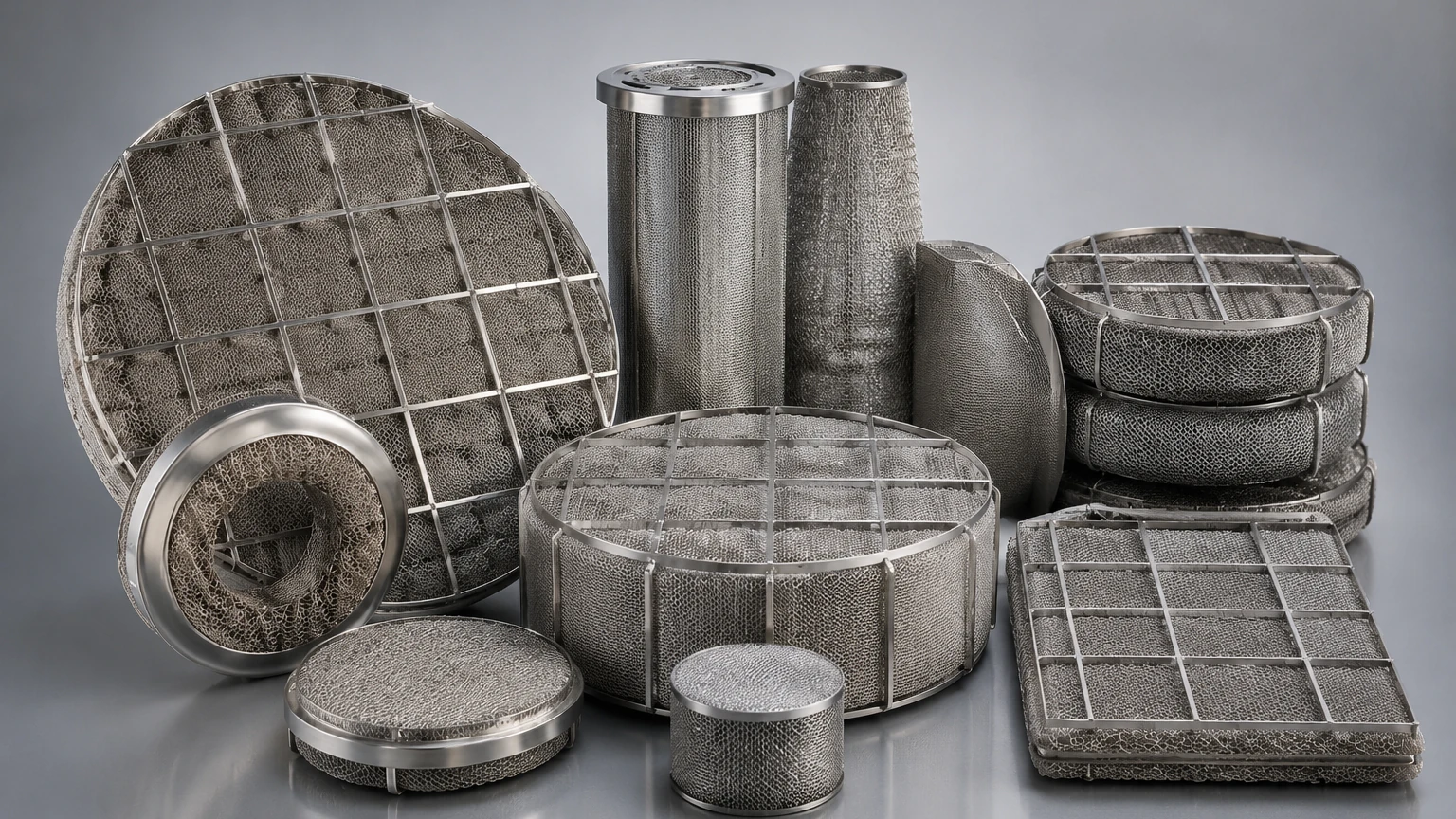
Wire mesh demisters are among the most versatile and widely used mist eliminators in the industry. They consist of a knitted wire structure that creates a high-void-volume pad. Kaifil’s manufacturing process focuses on the precision of this knitted structure to ensure consistent performance across demanding industrial environments.
Knitted Structure and Void Volume
A standard wire mesh demister typically features a void volume between 97% and 99%. This high porosity ensures an exceptionally low pressure drop across the filter, which is critical for maintaining the energy efficiency of the overall system. The wires are knitted into a tubular form and then flattened and crimped to provide the necessary surface area and structural integrity. The crimping process is vital as it prevents the layers of mesh from nesting together, which would otherwise reduce the effective surface area and increase the pressure drop.
Density and Surface Area
The performance of a wire mesh demister is influenced by its bulk density (expressed in kg/m³ or lb/ft³) and its specific surface area (m²/m³). High-efficiency mesh designs use smaller wire diameters and denser knits to increase the surface area available for impingement. Conversely, high-throughput designs may use larger wire diameters and more open knits to handle higher gas velocities without flooding.
Support Grids and Housing
To maintain structural stability under the force of gas flow, the mesh pads are typically supported by heavy-duty grids. These grids are often constructed from flat bars and round rods, welded into a rigid frame. In many industrial applications, the demister is provided in sections to allow for installation through vessel manways. Proper fitment within the vessel housing is essential to prevent "gas bypass," where the gas stream flows around the edges of the demister rather than through the mesh.
Material Selection for Demanding Industrial Environments
Material selection is one of the most critical decisions in demister engineering. The chosen material must withstand the chemical environment of the process stream, the operating temperature, and the mechanical stresses of the flow.
Stainless Steel Alloys
Stainless steel is the industry standard for most filtration applications due to its balance of strength and corrosion resistance.
- SS304/304L: Suitable for general-purpose applications with low corrosion risks.
- SS316/316L: Contains molybdenum, providing superior resistance to chlorides and organic acids. This is the most common choice for chemical processing and marine environments.
- Specialty Alloys: For highly corrosive environments involving concentrated acids or high temperatures, materials such as Monel 400, Inconel 625, or Hastelloy C-276 may be required.
Synthetic and Hybrid Options
In applications where metallic components are susceptible to rapid corrosion, or where specific surface tension properties are needed to aid coalescence, synthetic materials are utilized. Polypropylene (PP) is common for lower-temperature aqueous applications, while PTFE (Teflon) is used for extreme chemical resistance at higher temperatures. Hybrid demisters, which combine metallic wires with synthetic fibers (such as PFA or ETFE), are often used to capture very fine mists that standard wire mesh cannot efficiently handle.
Key Performance Indicators in Demister Selection
When evaluating demisters for a specific project, engineers must consider several interrelated performance factors. Failure to account for these variables can lead to poor separation efficiency or premature equipment failure.
The Souders-Brown Equation
The design of a demister is often governed by the Souders-Brown equation, which determines the maximum allowable gas velocity ($V$) to prevent re-entrainment (the process where captured liquid is picked back up by the gas stream):
$$V = K \sqrt{\frac{\rho_l – ρ_g}{ρ_g}}$$
Where:
- $V$ is the design gas velocity.
- $K$ is a capacity factor (dependent on mesh design and operating pressure).
- $ρ_l$ is the liquid density.
- $ρ_g$ is the gas density.
Selecting the correct K-factor is essential. If the velocity is too high, the liquid will be stripped off the wires; if it is too low, the droplets will not have enough momentum for effective impingement.
Pressure Drop Considerations
Pressure drop is the loss of gas pressure as it passes through the demister. In many processes, particularly vacuum distillation or low-pressure gas scrubbing, minimizing pressure drop is a primary design goal. A typical clean pressure drop for a wire mesh demister ranges from 10 to 25 mm of water column. However, as the mesh becomes fouled with solids or as liquid loading increases, this pressure drop will rise, potentially impacting upstream process pressure.
Separation Efficiency
Efficiency is usually defined by the percentage of droplets of a certain size that the demister can remove. Standard wire mesh demisters are typically 99.9% efficient for droplets 5 microns and larger. For applications requiring the removal of smaller sub-micron particles, engineers must specify higher-density pads or multi-stage separation systems.
Industrial Applications and Process Optimization
Demisters are utilized across a vast array of industries, each with unique challenges regarding flow rates and chemical compositions.
Chemical and Petrochemical Processing
In distillation columns and absorption towers, demisters prevent the carryover of liquid phase into the overhead gas stream. This protects downstream compressors from liquid slugging and prevents the loss of valuable chemical products. In sulfuric acid plants, specialized demisters are used to capture acid mist, protecting the environment and preventing corrosion in downstream ducting.
Oil and Gas Production
In knock-out drums and three-phase separators, demisters are used to ensure that the gas leaving the vessel is dry. This is particularly important before the gas enters a pipeline or a turbine, where liquid droplets could cause significant mechanical damage or lead to the formation of hydrates.
Desalination and Water Treatment
In Multi-Stage Flash (MSF) desalination plants, demisters are used to separate pure water vapor from the brine. The efficiency of the demister directly impacts the purity of the produced fresh water. Given the high chloride content, materials like SS316L or specialized plastics are mandatory to ensure a long service life.
Power Generation
Steam drums in boilers use demisters to ensure that the steam delivered to the turbines is "dry." Any liquid carryover in the steam can lead to turbine blade erosion and mineral scaling, which significantly reduces the efficiency and lifespan of the power generation equipment.
Installation, Maintenance, and Lifecycle Management
The long-term performance of a demister depends as much on proper installation and maintenance as it does on the initial design. Engineers should confirm several factors before the final procurement and installation phase.
Orientation and Flow Direction
Demisters can be designed for vertical flow (gas moving upward) or horizontal flow (gas moving sideways). In vertical flow, the liquid must drain counter-currently to the gas flow. In horizontal flow, the liquid drains perpendicular to the gas flow, which often allows for higher gas velocities without re-entrainment. It is vital that the demister is installed in the orientation for which it was designed.
Monitoring and Fouling
In processes where the gas stream contains solids or polymers, demisters can become fouled over time. This leads to an increase in pressure drop and a decrease in separation efficiency. Installing differential pressure gauges across the demister allows operators to monitor the health of the unit. If the pressure drop exceeds a pre-determined threshold, the unit may require cleaning or replacement.
Cleaning Protocols
Many stainless steel demisters can be cleaned using high-pressure water jets, steam, or chemical solvents, depending on the nature of the fouling. However, care must be taken not to deform the knitted wire structure, as this will create bypass paths or areas of high local velocity. In some high-fouling applications, "wash headers" are installed permanently above the demister to provide intermittent or continuous cleaning during operation.
Total Cost of Ownership (TCO)
When purchasing industrial filtration components, the initial capital expenditure is only one part of the equation. Engineers must also consider the operational costs associated with pressure drop (energy consumption) and the potential costs of downtime if a demister fails or requires frequent cleaning. Custom-engineered solutions from experienced manufacturers like Kaifil often provide a lower TCO by optimizing the balance between efficiency, durability, and pressure drop.
For technical teams looking to optimize their filtration processes, understanding these engineering boundaries is the first step toward achieving reliable performance. Whether for a new installation or a retrofit of an existing vessel, detailed technical consultation ensures that the selected demister meets the specific demands of the industrial environment. To review product options and application support, please visit the Main Page for comprehensive technical resources.
