


Oil Purification
In industrial operations, the integrity of lubricating, hydraulic, and process oils is a primary determinant of equipment longevity and operational efficiency. Oil purification is the systematic process of removing contaminants—including solid particulates, water, and gaseous impurities—from oil to restore its original performance characteristics or extend its service life. For engineers and maintenance professionals, selecting the appropriate filtration technology is not merely a maintenance task but a critical engineering decision that impacts the total cost of ownership (TCO) of high-value machinery.
As a specialized manufacturer of stainless steel filtration solutions, Kaifil provides the technical components necessary to achieve high-precision oil purification across demanding sectors such as chemical processing, power generation, and hydraulic systems. Understanding the technical nuances of filtration media, structural design, and contaminant dynamics is essential for optimizing these systems.
The Engineering Necessity of Oil Purification
Industrial oils serve multiple functions: they reduce friction, dissipate heat, inhibit corrosion, and transfer power. However, as oil circulates, it inevitably becomes contaminated. Contaminants generally fall into three categories: solid particles (wear debris, dust, and soot), liquid contaminants (water and coolant), and gaseous contaminants (air).
Solid particulates are particularly damaging. Hard particles can cause abrasive wear, leading to component fatigue and eventual system failure. According to industry studies, up to 80% of hydraulic system failures are attributed to fluid contamination. Effective oil purification utilizing robust stainless steel wire mesh or sintered metal filters ensures that particulate levels remain within the limits defined by standards such as ISO 4406.
By maintaining fluid cleanliness, facilities can significantly reduce the frequency of oil changes, decrease downtime for component repairs, and improve the energy efficiency of pumps and motors. For those seeking specific component specifications for their systems, it is advisable to Review product options and application support to ensure the hardware matches the fluid's rheological properties.
Technical Criteria for Selecting Filtration Media
When designing or upgrading an oil purification system, the selection of the filter element is the most critical technical variable. Stainless steel is often the material of choice for industrial oil applications due to its thermal stability and chemical resistance.
Micron Rating: Absolute vs. Nominal
In the context of oil purification, the micron rating defines the size of particles the filter can remove.
- Nominal Rating: An indicated filtration efficiency (often 50% to 90%) for a specific particle size. This is often insufficient for critical hydraulic or high-pressure systems.
- Absolute Rating: The diameter of the largest hard spherical particle that will pass through the filter under specified test conditions. For precision oil purification, absolute-rated stainless steel wire mesh is preferred to ensure consistent protection of sensitive valves and bearings.
Material Compatibility
The chemical composition of the oil and its additives must be compatible with the filter material. Standard 304 stainless steel is suitable for many general-purpose lubricating oils. However, in chemical processing or environments where the oil may contain acidic combustion byproducts or corrosive additives, 316L stainless steel provides superior resistance to pitting and crevice corrosion.
Structural Integrity and Collapse Pressure
Oil purification systems often operate under high pressure or experience significant pressure spikes during cold starts when oil viscosity is high. Stainless steel filter cartridges are engineered to withstand high differential pressures (ΔP) without collapsing. This structural rigidity is a significant advantage over cellulose or fiberglass elements, which may deform or shed fibers into the clean oil stream (media migration).
Mechanisms of Particulate Removal in Oil Systems
Effective oil purification relies on several physical mechanisms within the filter media to capture contaminants. Understanding these helps engineers select the right mesh weave or sintered structure.
1. Direct Interception: Occurs when a particle is larger than the pore size of the filter media and is physically blocked. This is the primary mechanism for stainless steel square weave mesh.
2. Inertial Impaction: Heavy particles traveling in the oil stream may fail to follow the fluid streamlines as they curve around the filter fibers, instead striking and adhering to the fibers.
3. Diffusion (Brownian Motion): Extremely small particles move erratically within the fluid flow and eventually contact the filter media surface. While less common in high-viscosity oil than in gas filtration, it remains a factor in fine purification stages.
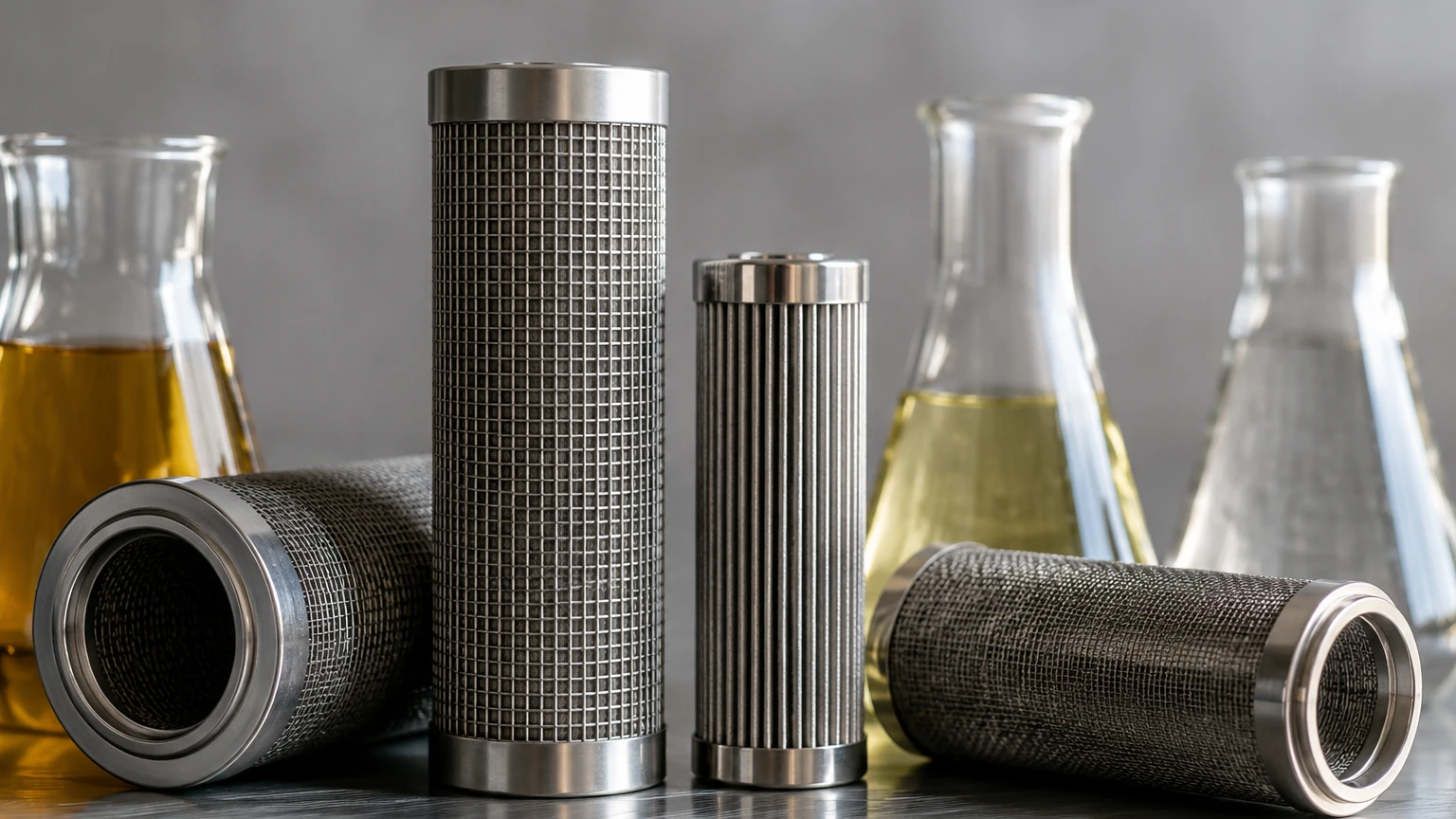
For high-flow applications, pleated stainless steel designs are often utilized. Pleating increases the effective surface area of the filter within the same footprint, which reduces the flux (flow per unit area), lowers the initial pressure drop, and extends the dirt-holding capacity of the element.
Managing Water and Gaseous Contamination
While particulate filtration is the focus of stainless steel mesh components, comprehensive oil purification must also address moisture. Water in oil promotes oxidation, reduces lubricating film strength, and can lead to the formation of acids and sludge.
In many purification systems, stainless steel filters serve as the primary stage to remove solids before the oil passes through vacuum dehydration units or coalescing stages. In some specialized configurations, fine-mesh stainless steel elements can assist in the coalescing process, where small water droplets are encouraged to gather into larger drops that can be easily separated by gravity.
Maintaining low moisture levels is critical for transformer oils (to maintain dielectric strength) and turbine oils (to prevent bearing corrosion). Engineers must ensure that the filtration housing and elements are designed to handle the specific flow rates required for these multi-stage purification processes.
Operational Risks and Maintenance Considerations
Implementing an oil purification strategy involves managing several operational risks. Failure to monitor the system correctly can lead to "bypass" events where contaminated oil avoids the filter entirely.
The Risk of Filter Bypass
Most industrial filter housings include a bypass valve designed to open if the filter becomes completely clogged, preventing the system from being starved of oil. However, running in bypass mode means the oil purification process has ceased. Utilizing stainless steel elements with high dirt-holding capacity and integrated differential pressure sensors allows maintenance teams to replace or clean elements before bypass occurs.
Cleaning vs. Replacement
One of the primary economic advantages of stainless steel filters in oil purification is their cleanability. Unlike disposable synthetic filters, stainless steel wire mesh and sintered cartridges can often be cleaned using ultrasonic baths, backflushing, or chemical cleaning.
- Pros: Lower long-term waste, reduced replacement costs, and consistent performance in high-temperature environments.
- Cons: Requires a standardized cleaning protocol to ensure the media is not damaged and that all trapped particulates are removed.
Engineers should evaluate the total cost of ownership, including the labor and equipment required for cleaning, against the cost of frequent replacements of disposable media.
Customization in Industrial Oil Purification
Every industrial environment presents unique challenges. A standard off-the-shelf filter may not accommodate the specific viscosity of a heavy gear oil or the space constraints of a compact hydraulic power unit. Customization is often required in the following areas:
- End Cap Configurations: Ensuring a leak-proof seal with various housing designs (e.g., DOE, 222, 226 O-rings).
- Reinforcement Layers: Adding perforated metal cores or outer shrouds to handle extreme flow velocities or pulsating pressures.
- Multi-Layer Sintering: Combining different grades of mesh to create a depth-filtration effect within a single robust metal element.
By working with a manufacturer capable of custom fabrication, engineering teams can specify the exact parameters needed for their specific oil purification hardware. For detailed technical specifications and engineering support regarding custom metal filters, professionals can visit the Main Page to explore available configurations.
Conclusion: Achieving Optimal Fluid Cleanliness
Oil purification is a continuous requirement for the health of industrial machinery. The transition from disposable, low-durability filtration to high-performance stainless steel solutions represents a shift toward greater reliability and sustainability. By focusing on absolute micron ratings, material compatibility, and structural integrity, engineers can ensure that their oil purification systems provide maximum protection against the hidden costs of contamination.
When selecting components, always verify the operating temperature, maximum flow rate, and the specific nature of the contaminants involved. A well-designed filtration system, anchored by precision-engineered metal elements, remains the most effective defense against equipment wear and unexpected operational failure.
