


Filter Separator Natural Gas
In the midstream and downstream sectors of the energy industry, the integrity of natural gas processing depends heavily on the removal of both solid and liquid contaminants. A filter separator natural gas system is a critical piece of pressure vessel equipment designed to protect high-value downstream assets, such as compressors, turbines, and metering stations. Unlike simple dry gas filters or liquid knock-out drums, a filter separator is engineered to handle a complex mix of contaminants, including fine particulates, liquid aerosols, and slugs of water or hydrocarbons.
For engineers and procurement professionals, selecting the right filtration components for these systems requires a deep understanding of fluid dynamics, material science, and the specific challenges of gas-liquid separation. This guide examines the technical principles of filter separators, the role of stainless steel filtration media, and the engineering considerations necessary to optimize performance in demanding industrial environments.
The Role of Filter Separators in Natural Gas Infrastructure
Natural gas, as it travels from the wellhead through gathering lines and transmission pipelines, is rarely pure. It often carries "black powder" (a mix of iron sulfides and oxides), sand, and various liquids such as compressor oil, glycol, and water. If these contaminants are not removed, they cause erosion in high-speed rotating equipment, foul heat exchangers, and lead to inaccurate readings in custody transfer meters.
A filter separator natural gas system performs a dual function. It first removes solid particles that could cause mechanical wear and then coalesces fine liquid mists into larger droplets that can be drained from the gas stream. This multi-stage approach is essential because liquid droplets in gas streams often exist in the sub-micron range, making them impossible to remove through gravity alone within a standard vessel size.
By implementing high-efficiency filtration, operators can significantly reduce the Total Cost of Ownership (TCO) of their infrastructure. Effective separation prevents unplanned shutdowns and extends the maintenance intervals of downstream components. When evaluating these systems, engineers must look beyond the initial capital expenditure and focus on the filtration efficiency and the durability of the internal components.
Engineering Principles of Two-Stage Separation
Most industrial filter separators utilize a two-stage design to achieve high efficiency across a wide range of flow conditions. Understanding these stages is vital for specifying the correct internal components.
Stage One: Pre-Separation and Coalescing
In the first stage, the gas enters the vessel and typically encounters a set of filter cartridges or coalescing elements. As the gas passes through the depth-loading media of these elements, solid particles are trapped. Simultaneously, the fine liquid aerosols collide with the fibers of the filter media. Through the process of impingement and interception, these tiny droplets merge to form larger drops. This process, known as coalescence, is critical because larger drops have a higher mass-to-surface-area ratio, allowing them to be more easily separated from the gas flow in the second stage.
Stage Two: Final Separation and Mist Elimination
The second stage is designed to remove the coalesced droplets that have been carried forward by the gas stream. This is usually achieved using a mist extractor, such as a vane pack or a stainless steel wire mesh pad. These components rely on the principle of inertial impaction. As the gas is forced to change direction rapidly through the tortuous path of the mesh or vanes, the heavier liquid droplets cannot follow the streamlines and instead strike the metal surfaces. The liquid then films out and drains into a collection sump at the bottom of the vessel.
For those seeking technical specifications on the components used in these stages, visiting the Main Page provides a comprehensive overview of the engineering capabilities required to manufacture these precision metal parts.
Key Components and Material Selection
The performance of a filter separator natural gas unit is largely determined by the materials used in its internal filtration elements. In the natural gas industry, stainless steel is the preferred material due to its resistance to corrosion, high temperatures, and mechanical stress.
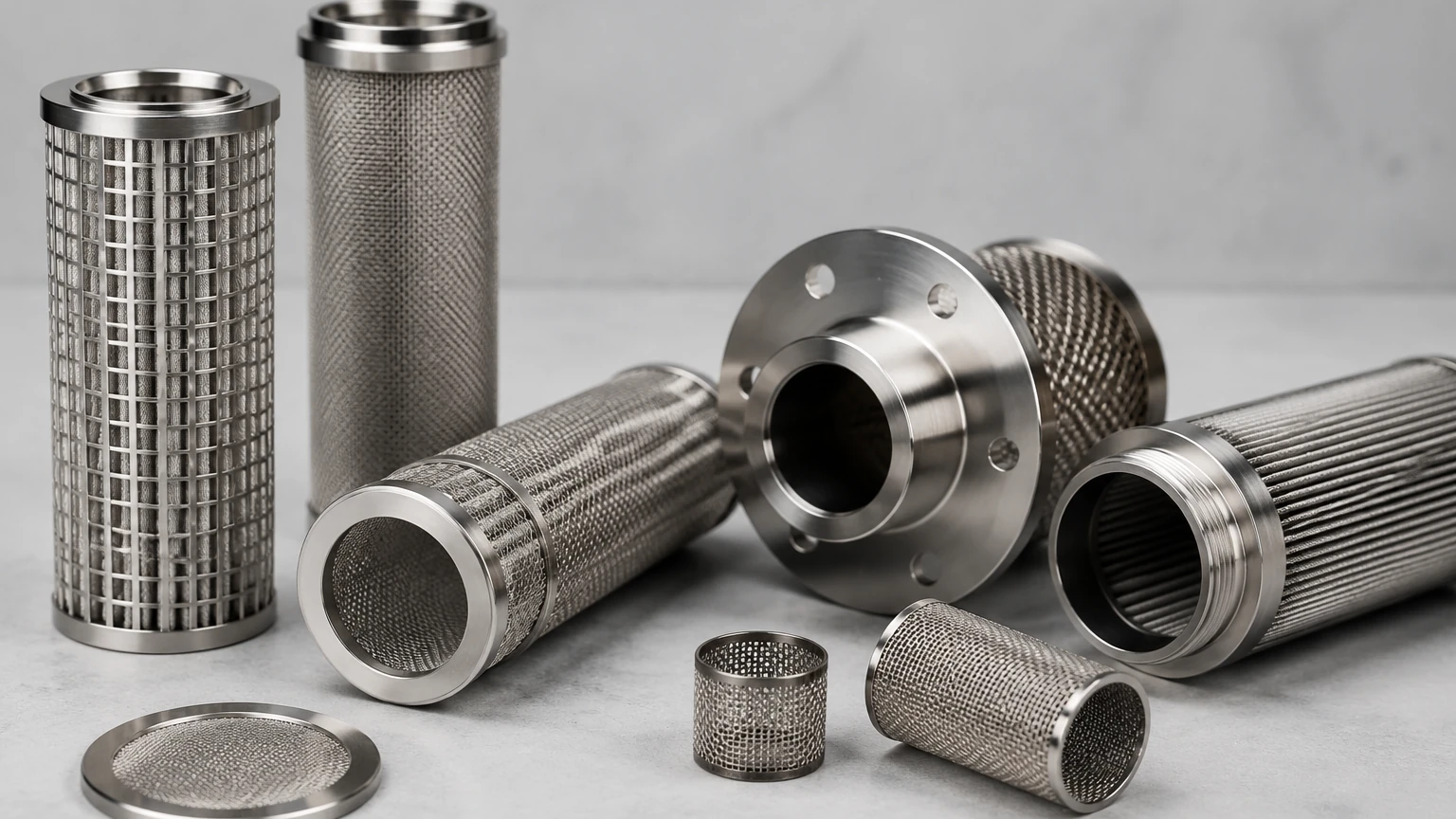
Stainless Steel Wire Mesh
Stainless steel wire mesh is a foundational material for both coalescing stages and mist elimination. It offers a high surface area and controlled porosity. In sour gas applications, where hydrogen sulfide (H2S) is present, using high-grade alloys like 316L stainless steel is mandatory to prevent stress corrosion cracking and ensure the long-term structural integrity of the filter.
Sintered Metal Filter Elements
In applications involving high pressures or abrasive solids, sintered metal filter cartridges are often used. Sintering involves bonding multiple layers of wire mesh or metal fibers through a heat-treatment process without the use of binders. This results in a robust, fixed-pore structure that can withstand high differential pressures without the risk of media migration. These elements are particularly effective in protecting downstream turbines where even minor particulate bypass can lead to catastrophic blade failure.
Customization of Filter Geometry
No two gas streams are identical. Customization of the filter element geometry—such as pleat density, length, and diameter—allows engineers to balance filtration surface area with the available space inside the pressure vessel. Increasing the surface area through pleating reduces the "face velocity" of the gas, which improves coalescing efficiency and lowers the initial pressure drop.
Performance Evaluation and Selection Criteria
When specifying a filter separator, engineers must confirm several technical parameters to ensure the equipment meets the application requirements. Generic marketing claims should be replaced with data-driven evaluations.
1. Filtration Rating (Micron Rating): It is important to distinguish between nominal and absolute ratings. For natural gas separators, an absolute rating (often 0.3 to 1 micron for liquid aerosols) is necessary to protect sensitive equipment.
2. Beta Ratio: This is a measure of the filter's efficiency at a specific particle size. A higher Beta ratio indicates a more efficient filter. For critical gas processing, a Beta ratio of 1000 (99.9% efficiency) is a common benchmark.
3. Maximum Allowable Differential Pressure (MAWP): The filter elements must be designed to withstand the maximum pressure drop they will encounter before replacement. If an element collapses due to high differential pressure, it can send a wave of contaminants and metal debris downstream.
4. Flow Capacity and Velocity: If the gas velocity is too high, liquid droplets can be "re-entrained" or stripped off the mist eliminator and carried back into the gas stream. Sizing the vessel and the internal elements correctly is the only way to prevent this phenomenon.
Maintenance, Replacement Cycles, and Operational Risks
The operational success of a filter separator natural gas system depends on a proactive maintenance strategy. The primary indicator of filter health is the differential pressure (ΔP) across the vessel.
Managing Differential Pressure
As solid contaminants accumulate on the filter elements, the resistance to flow increases. Most systems are equipped with differential pressure gauges and transmitters. A typical "clean" pressure drop might be 2-5 psi, while the "change-out" pressure drop is often set between 10-15 psi. Exceeding the recommended change-out pressure not only risks element failure but also increases the energy consumption of the upstream compressors, as they must work harder to push gas through the fouled filters.
Cleaning vs. Replacing
While some stainless steel wire mesh filters can be cleaned using ultrasonic baths or backwashing, many high-efficiency coalescing cartridges are designed for single use. Engineers must decide during the design phase whether they prioritize the lower operational cost of cleanable elements or the higher efficiency of disposable depth-media cartridges. In many natural gas transmission scenarios, the risk of improper cleaning makes high-quality replacement cartridges the safer choice for maintaining gas quality.
Risks of Bypass
One of the most common failures in filter separators is bypass, where gas flows around the filter media rather than through it. This usually occurs due to poor sealing at the element end-caps or damaged gaskets. Ensuring that the filter housing and the elements are manufactured to tight tolerances is the only way to guarantee that 100% of the gas is treated.
Customization and Engineering Considerations
Industrial filtration is rarely a one-size-fits-all solution. Customization is often required to address specific environmental or chemical challenges. For instance, in offshore environments, the external components of the filter separator must be resistant to salt spray, while the internals must handle potential surges of salt water from the wellhead.
Furthermore, the chemical composition of the gas—such as the presence of CO2, H2S, or heavy hydrocarbons—influences the selection of elastomers for seals and the specific grade of stainless steel for the filter media. Working with a manufacturer that understands these engineering nuances is critical for developing a reliable solution. From initial material selection to the final testing of filtration accuracy, every step must be documented and verified against industry standards like ASME Section VIII.
For purchasing teams, the focus should be on finding a partner capable of providing OEM-quality components that match the original design specifications of the separator vessel. This ensures that replacement parts fit perfectly and perform as expected under actual operating conditions.
Conclusion
A filter separator natural gas system is an essential component for any facility handling raw or processed gas. By understanding the mechanics of two-stage separation, the importance of high-grade stainless steel materials, and the technical criteria for performance evaluation, engineers can ensure their systems operate at peak efficiency.
Whether you are designing a new processing plant or maintaining an existing pipeline, the quality of the filtration elements will directly impact the reliability of your entire operation. Prioritizing precision-engineered components and adhering to strict maintenance protocols will safeguard downstream equipment and optimize the overall productivity of the gas stream. For further technical details on custom filtration solutions and engineering support, explore the resources available on the Main Page.
