


Foam Filter Material
In the landscape of industrial filtration, foam filter material represents a specialized category of porous media designed to handle complex separation tasks that traditional surface filters may struggle to manage. Characterized by a three-dimensional, reticulated structure, these materials offer a unique combination of high porosity, low pressure drop, and significant internal surface area. For engineers and procurement professionals, understanding the technical nuances of foam filter material—ranging from polymer-based options to high-performance metal foams—is essential for optimizing system longevity and filtration efficiency.
Industrial filtration requirements often exceed the capabilities of simple screens. When deep-bed filtration or high-velocity gas streams are involved, the geometry of the filter media becomes the primary driver of performance. Foam filter material provides a tortuous path for fluids and gases, ensuring that particulates are trapped throughout the depth of the media rather than just on the surface.
The Fundamentals of Foam Filter Material
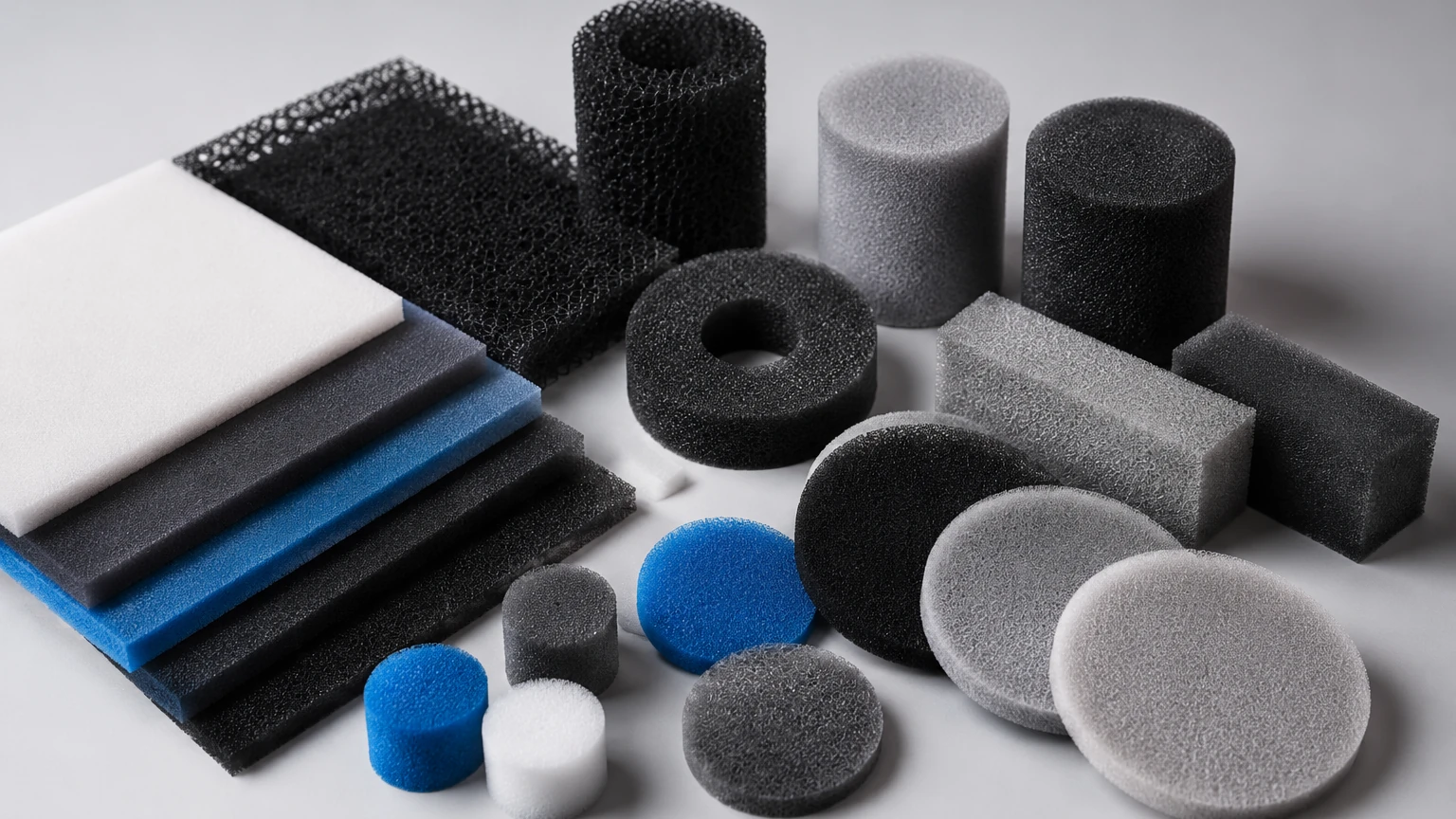
At its core, foam filter material is an open-cell porous structure. Unlike closed-cell foams used for insulation or buoyancy, filtration-grade foam undergoes a process called reticulation. This process removes the thin membranes (or windows) between the individual cells, leaving behind only the structural ribs (struts). The result is a highly permeable, skeletal framework that allows fluids to pass through with minimal resistance while providing a vast network of surfaces for particulate impingement.
The performance of these materials is largely dictated by their cellular geometry. The "openness" of the foam ensures that the fluid can move in three dimensions, which is particularly beneficial in preventing premature clogging. In applications where a high dirt-holding capacity is required, the depth-loading characteristics of foam filter material offer a distinct advantage over two-dimensional wire meshes.
Classifying Foam Filter Materials by Composition
The choice of material is the most critical factor in determining the filter's compatibility with the operating environment. Depending on the chemical exposure, temperature, and mechanical stress, different base materials are utilized.
Polyurethane and Polymer Foams
Reticulated polyurethane is perhaps the most common form of foam filter material for low-temperature applications. It is frequently used in air intake systems, HVAC units, and small-scale fluid processing. These foams are categorized as either polyether or polyester. Polyether foams offer better resistance to moisture and hydrolysis, making them suitable for water-based applications, while polyester foams provide superior resistance to hydrocarbons and chemicals.
Ceramic Foam Filters
In extreme thermal environments, such as molten metal filtration in foundries or high-temperature exhaust gas treatment, ceramic foam filter materials are the standard. These materials can withstand temperatures exceeding 1,000°C and are resistant to thermal shock. Their primary role is to remove inclusions from molten aluminum, steel, or iron, ensuring the structural integrity of the final cast parts.
Metal Foam Filter Material
For demanding industrial and chemical processing sectors, metal foam—specifically stainless steel, nickel, or copper foam—provides the highest level of durability. These materials combine the structural benefits of foam geometry with the mechanical strength and corrosion resistance of metal. Stainless steel foam filter material is often preferred in high-pressure hydraulic systems, chemical reactors, and aerospace applications where polymer foams would degrade and ceramic foams would be too brittle. For those seeking specialized metal filtration components, the Main Page of professional manufacturers provides detailed insights into how these materials are integrated into industrial systems.
Technical Specifications: PPI, Porosity, and Tortuosity
When specifying foam filter material, engineers must look beyond simple dimensions. Several key metrics define the filtration capability of the media:
* Pores Per Inch (PPI): This is the standard unit of measurement for foam density. A lower PPI (e.g., 10 to 20 PPI) indicates large pores and high permeability, suitable for coarse pre-filtration. A higher PPI (e.g., 60 to 100 PPI) indicates much smaller pores, providing finer filtration but at the cost of a higher pressure drop.
* Porosity (Void Volume): Most industrial foam filter materials boast a porosity between 90% and 97%. This extremely high void volume is what allows for high flow rates and low initial pressure drops compared to sintered metal powder or dense fiber felts.
* Tortuosity: This refers to the complexity of the path a fluid must take through the filter. Foam materials have high tortuosity, which increases the likelihood that a particle will collide with and adhere to a strut, even if the particle is smaller than the nominal pore size.
* Surface Area: Because of the skeletal structure, the internal surface area available for filtration is massive. This is critical for applications involving catalysts or coalescing, where the fluid must interact with the material surface as much as possible.
Engineering Advantages of Metal Foam in Industrial Filtration
While polymer foams are cost-effective, metal foam filter materials offer specific engineering advantages that justify their use in critical B2B applications.
1. Thermal Stability: Metal foams can operate in environments ranging from cryogenic temperatures to several hundred degrees Celsius without losing structural integrity or off-gassing.
2. Chemical Resistance: By utilizing alloys like 316L stainless steel, these filters can withstand aggressive solvents, acids, and alkaline solutions common in chemical processing and pharmaceutical manufacturing.
3. Mechanical Rigidity: Unlike soft polymer foams, metal foams do not compress under high differential pressures. This ensures that the pore structure remains consistent throughout the filtration cycle, preventing "channeling" where fluid bypasses the media.
4. Cleanability: Metal foam filter material is often permanent or semi-permanent. It can be cleaned via backpulsing, ultrasonic baths, or chemical cleaning, significantly reducing the total cost of ownership compared to disposable polymer cartridges.
Selection Considerations for High-Performance Applications
Selecting the right foam filter material requires a balance of several competing factors. Engineers should evaluate the following before finalizing a specification:
Fluid Characteristics
The viscosity of the fluid and its flow rate will determine the required PPI. High-viscosity fluids generally require lower PPI foams to prevent excessive backpressure. Additionally, the chemical nature of the fluid must be compatible with the foam's base material to prevent swelling, embrittlement, or dissolution.
Particle Loading and Efficiency
What is the target micron rating? While foam is excellent for depth filtration, it is often used as a pre-filter or a secondary filter. If absolute filtration of very fine particles (sub-5 micron) is required, a foam filter might be used in conjunction with a finer wire mesh or a sintered metal fiber felt.
Environmental Conditions
Will the filter be exposed to vibration, high-pressure pulses, or extreme temperatures? In hydraulic applications, for instance, the filter must withstand rapid pressure fluctuations. In such cases, a rigid metal foam or a reinforced polymer foam is necessary to prevent the material from shedding fibers or collapsing.
Maintenance, Cleaning, and Replacement Cycles
The longevity of foam filter material is a major factor in industrial procurement. Polymer foams are typically treated as consumables. Once the pressure drop across the filter reaches a predetermined limit, the material is replaced.
In contrast, metal and ceramic foam filter materials are designed for extended service. Maintenance cycles for these materials involve monitoring the differential pressure (ΔP). When ΔP increases by a factor of two or three over the clean pressure drop, cleaning is required.
* Ultrasonic Cleaning: Effective for removing fine particulates lodged deep within the reticulated structure of metal foams.
* Chemical Cleaning: Used when the contaminant is a polymer, resin, or organic substance that can be dissolved without damaging the metal substrate.
* Burn-off/Pyrolysis: For metal and ceramic foams, organic contaminants can sometimes be baked off in a controlled furnace.
Customization and OEM Integration Strategies
Most industrial applications require more than just a raw sheet of foam filter material. Integration into a system usually involves housing the material in a cartridge, frame, or custom-machined component.
Customization options often include:
* Layering: Combining different PPI foams (gradient density) to maximize dirt-holding capacity. A coarse outer layer traps large debris, while a fine inner layer performs the final polish.
* Structural Reinforcement: Adding a stainless steel wire mesh backing to the foam to provide additional mechanical support in high-flow environments.
* Shape and Form: Foam materials can be die-cut, CNC machined, or even molded into complex geometries to fit specific housing requirements.
For purchasing teams and engineers, working with a manufacturer that understands the transition from raw foam material to a finished filtration component is vital. Reliable providers offer guidance on material selection and can produce prototypes that meet the specific tolerances required for industrial machinery. To explore various configurations and technical support for these components, professionals can Review product options and application support to ensure their filtration systems are built for long-term reliability.
Conclusion
Foam filter material is a versatile and high-performance solution for a wide array of industrial challenges. Whether it is the cost-effective air filtration provided by reticulated polymers or the robust, high-temperature capabilities of stainless steel foams, the material's unique open-cell structure provides benefits that surface filters cannot match. By focusing on key specifications like PPI, material compatibility, and cleanability, engineering teams can select a filtration media that not only protects sensitive equipment but also optimizes operational efficiency and reduces long-term maintenance costs.
