


How Do Oil Water Separators Work
In industrial environments, the separation of oil from water is a critical process for environmental compliance, equipment protection, and resource recovery. From chemical processing plants to hydraulic systems and food production facilities, managing oily wastewater or contaminated lubricants is a daily operational challenge. Understanding the engineering principles behind this process is essential for selecting the right filtration and separation equipment. This article explores the technical mechanics of how do oil water separators work, the role of advanced filter media, and the engineering considerations necessary for optimal performance.
The Fundamental Physics of Oil-Water Separation
To understand how do oil water separators work, one must first look at the physical properties of the fluids involved. Most industrial oil-water separation relies on the principle of specific gravity—the difference in density between oil and water. Since most oils are less dense than water, they possess a natural tendency to float to the surface.
The Three States of Oil in Water
Before a separator can be designed, engineers must identify the state of the oil in the mixture:
1. Free Oil: Large droplets that rise immediately to the surface when the fluid is at rest. These are typically larger than 150 microns.
2. Dispersed Oil: Smaller droplets (ranging from 20 to 150 microns) that stay suspended in the water column for longer periods due to molecular forces and turbulence.
3. Emulsified Oil: Microscopic droplets (less than 20 microns) that are chemically or mechanically stabilized. These often require specialized treatment, such as chemical flocculation or ultra-fine membrane filtration, as they do not separate through gravity alone.
Stokes' Law and Rise Velocity
The efficiency of a gravity-based separator is governed by Stokes' Law. This mathematical formula determines the terminal rise velocity of an oil droplet in a water column. The velocity is influenced by the droplet diameter, the difference in density between the two liquids, and the viscosity of the water.
In engineering terms, increasing the size of the oil droplet significantly increases the speed at which it rises. This is why many industrial separators incorporate components designed to encourage "coalescence"—the process where small droplets collide and merge into larger ones.
Mechanical Mechanisms: How Do Oil Water Separators Work?
Industrial separators use various mechanical designs to accelerate the natural separation process. While the goal is always the same, the method varies based on flow rate, space constraints, and the required purity of the effluent.
Gravity Separators (API Separators)
The most basic design is the API (American Petroleum Institute) separator. These are typically large tanks where the fluid velocity is slowed down to allow for laminar flow. As the mixture moves slowly through the tank, free oil rises to the surface where it is skimmed off, while heavier solids sink to the bottom. While effective for large-scale free oil removal, they are often insufficient for dispersed oil and require a large physical footprint.
Coalescing Plate Separators
To improve efficiency without increasing the size of the tank, engineers use coalescing plates. These plates are stacked closely together, often at an angle. As the oily water flows through the narrow gaps between the plates, the oil droplets only have to rise a few millimeters before hitting the underside of a plate. Once they contact the plate surface, they join with other droplets, grow in size, and eventually slide up the plate to the surface. This design significantly reduces the "residence time" required for separation.
Centrifugal Separators
In applications where space is at a premium or the density difference between the oil and water is very slight, centrifugal force is used. By spinning the mixture at high speeds, the heavier water is pushed to the outer walls of the vessel, while the lighter oil is forced toward the center. This method is highly effective for dispersed oil but involves higher energy costs and mechanical complexity.
The Role of Stainless Steel Filter Media in Coalescence
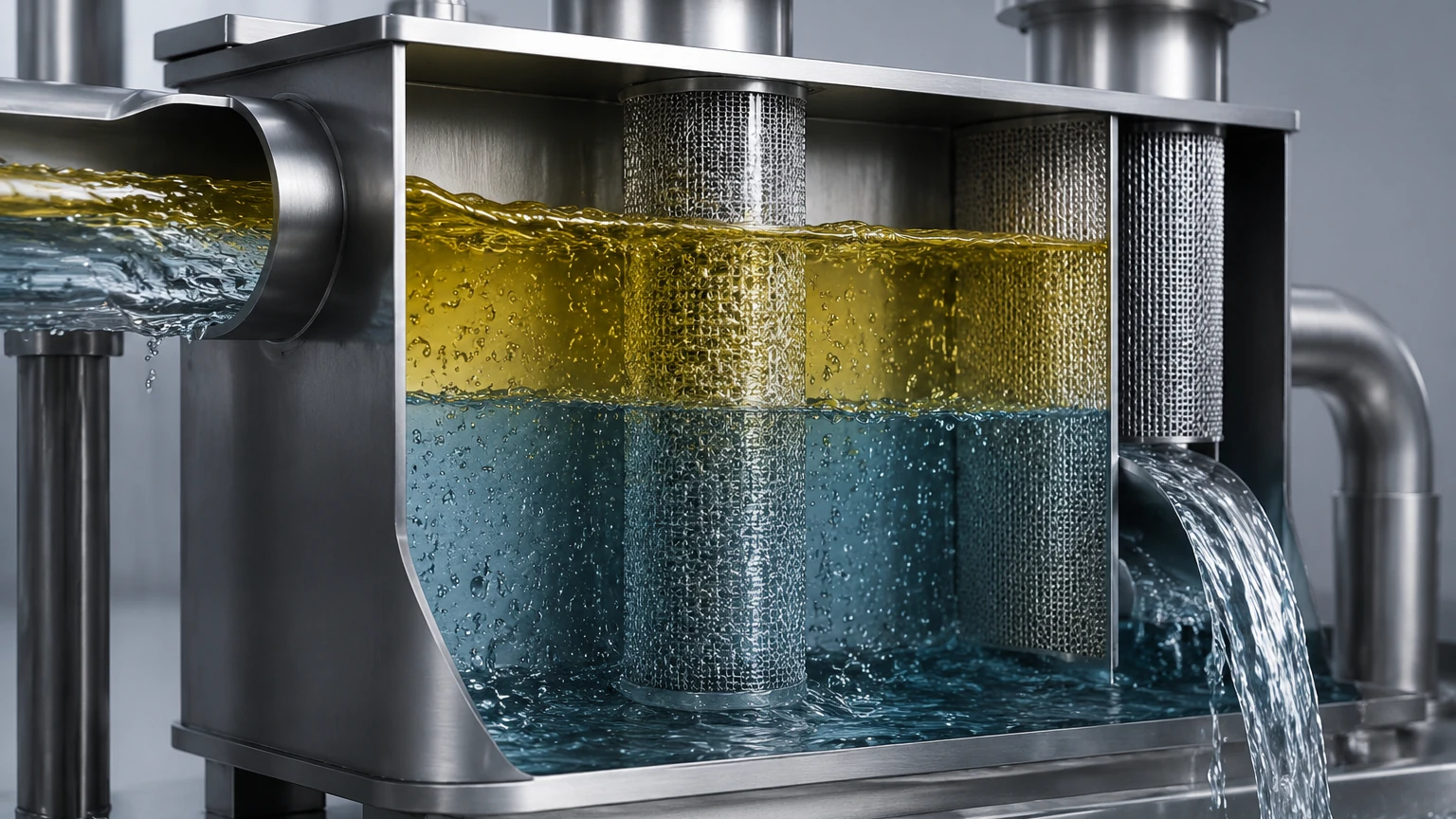
One of the most effective ways to enhance the performance of a separator is through the use of high-precision metal filter media. In many advanced systems, stainless steel wire mesh or sintered metal cartridges act as the coalescing medium.
Surface Science and Material Selection
Stainless steel is often preferred in industrial filtration due to its durability and specific surface energy properties. When dispersed oil droplets pass through a multi-layered stainless steel wire mesh, the physical structure of the mesh forces the droplets to take a tortuous path. This increases the probability of droplets colliding with the mesh surface and with each other.
Because stainless steel is oleophilic (oil-attracting) under certain conditions or can be treated to enhance this property, the oil droplets cling to the wire strands. As more oil accumulates, the droplets grow until they are large enough for the buoyant force to overcome the attachment to the mesh, at which point they rise rapidly to the surface.
Advantages of Stainless Steel Components
Using stainless steel filter cartridges within a separator provides several technical advantages:
* Thermal Stability: Unlike plastic media, stainless steel can operate in high-temperature chemical processes without deforming.
* Corrosion Resistance: In saltwater or acidic environments, 316L stainless steel provides the longevity required for industrial service.
* Cleanability: Metal filters can be backwashed or ultrasonically cleaned, extending the service life of the separator and reducing the total cost of ownership.
For engineers looking to integrate these components into their systems, reviewing technical specifications on a manufacturer's Main Page can provide insights into micron ratings and flow capacities.
Engineering Considerations for System Selection
When designing or purchasing an oil-water separator, engineers must look beyond the basic question of how do oil water separators work and focus on specific application variables.
Flow Dynamics and Reynolds Number
For a separator to function correctly, the flow must remain laminar. If the fluid is moving too fast or with too much turbulence (a high Reynolds number), the oil droplets will be broken down into smaller sizes rather than coalescing. Engineers must calculate the maximum flow rate that the separator can handle while maintaining a quiescent environment for separation.
Droplet Size Distribution
Knowing the "cut-off" size is vital. If a system is designed to remove droplets down to 50 microns, but the process generates a high volume of 10-micron droplets, the separator will fail to meet environmental standards. Technical professionals often use laser diffraction analysis to determine the droplet size distribution of their process fluid before selecting a separator.
Temperature and Viscosity
Temperature has a profound impact on oil-water separation. As temperature increases, the viscosity of the water decreases, which according to Stokes' Law, allows oil droplets to rise faster. However, higher temperatures can also lead to the formation of more stable emulsions. Therefore, the operating temperature must be factored into the material selection for the filter media and the overall vessel design.
Maintenance and Performance Monitoring
No matter how well-designed, an oil-water separator requires consistent maintenance to remain effective. In systems utilizing stainless steel mesh or cartridges, monitoring the pressure differential ($ΔP$) is the standard method for determining when the media requires cleaning.
Common Operational Risks
1. Biofouling: In water-heavy applications, bacteria can grow on the separator media, creating a biofilm that blocks flow and reduces coalescing efficiency.
2. Solids Loading: If the influent contains high levels of suspended solids (sand, grit, or metal shavings), these can clog the coalescing plates or filter mesh. Pre-filtration is often necessary to protect the oil-water separator.
3. Surfactants: The presence of soaps or detergents can chemically emulsify the oil, making mechanical separation nearly impossible. It is critical to confirm that no surfactants are introduced upstream of the separator.
Industry Applications of Oil-Water Separators
The practical implementation of these systems varies across sectors:
* Marine and Shipping: Separators are used to treat bilge water, ensuring that oil concentrations are below 15 ppm before discharge into the ocean, as per MARPOL regulations.
* Hydraulic Systems: In large-scale industrial machinery, water ingress can ruin hydraulic oil. Separators equipped with stainless steel cartridges remove water to prevent pump cavitation and component corrosion.
* Food and Beverage: Processing plants use separators to recover fats and oils from wash water, reducing the load on municipal wastewater systems.
* Petrochemical: Refineries use massive API and coalescing separators to manage process water and prevent environmental contamination.
Conclusion
Understanding how do oil water separators work requires a grasp of fluid dynamics, material science, and mechanical engineering. By leveraging the principles of gravity and enhancing them with high-performance coalescing media like stainless steel wire mesh, industries can achieve high levels of purity in their fluid streams. Selecting the right system involves a careful analysis of flow rates, droplet sizes, and the chemical environment of the application. For those seeking customized filtration components and technical support for industrial separation, visiting the Main Page of a specialized manufacturer like Kaifil can provide the necessary engineering data to optimize your filtration process.
