


Industrial Basket Strainer
In industrial fluid handling systems, the protection of downstream equipment—such as pumps, valves, flow meters, and spray nozzles—is critical for operational continuity. The industrial basket strainer serves as a primary line of defense, designed to remove large particles, debris, and contaminants from liquids. Unlike simpler Y-strainers, basket strainers offer a larger surface area for filtration, allowing for higher dirt-holding capacity and longer intervals between cleaning cycles.
For engineers and procurement teams, selecting an industrial basket strainer involves more than matching pipe sizes. It requires a deep understanding of fluid dynamics, material compatibility, and the specific filtration requirements of the application. This guide explores the technical parameters, design variations, and engineering considerations essential for optimizing filtration performance.
Understanding the Role of an Industrial Basket Strainer in Process Systems
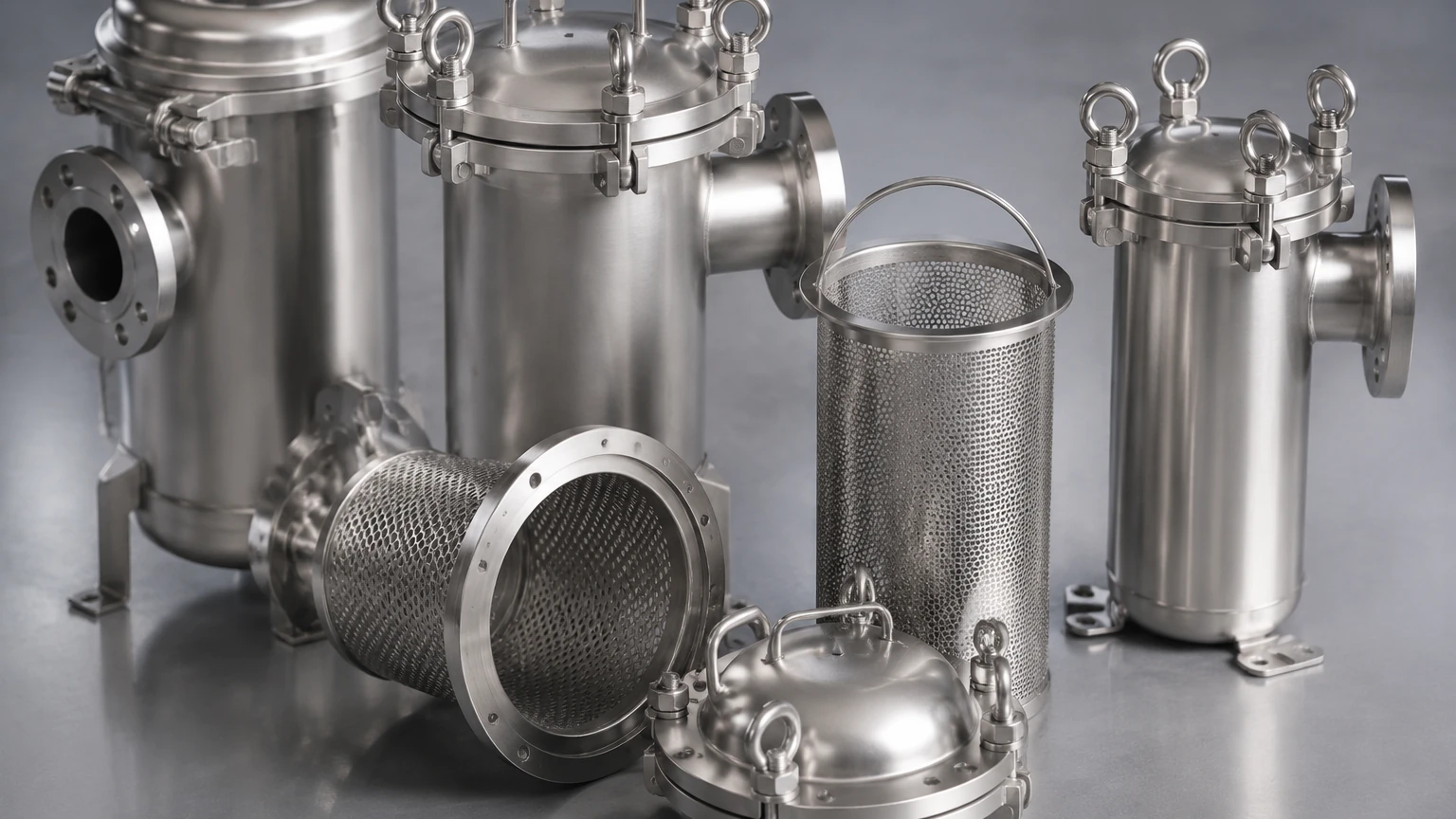
An industrial basket strainer is a closed vessel with a removable screen or basket that captures solids from a flowing liquid. As the fluid enters the strainer housing, it is directed into the basket. The mesh or perforated metal of the basket allows the liquid to pass through while trapping any particles larger than the opening size.
Protection of Capital Equipment
The primary function is the protection of expensive mechanical components. For instance, in a hydraulic system, even small metallic shavings can cause catastrophic pump failure. In food and beverage processing, a basket strainer ensures that no foreign matter enters the final packaging stages. By removing these solids, the strainer prevents abrasion, clogging, and mechanical damage, thereby extending the service life of the entire system.
Strainers vs. Filters
While the terms are often used interchangeably, there is a technical distinction. Strainers are generally used to remove larger particles (typically 40 microns and above) and are designed to be cleaned and reused. Filters, particularly cartridge or membrane filters, are used for finer filtration and often involve disposable media. An industrial basket strainer is frequently used as a pre-filter to protect finer filtration stages, reducing the frequency and cost of replacing expensive filter cartridges.
Key Engineering Specifications for Selection
When specifying an industrial basket strainer, several technical factors must be evaluated to ensure the component can withstand the operating environment while maintaining the required flow rates.
Flow Rate and Pressure Drop
The most critical performance metric is the pressure drop (ΔP) across the strainer. Every strainer introduces some resistance to flow. The "clean pressure drop" is the resistance when the basket is empty. As debris accumulates, the pressure drop increases. Engineers must calculate the flow coefficient (Cv), which represents the volume of water at 60°F that will flow through the strainer with a pressure drop of 1 psi.
High-viscosity fluids, such as oils or syrups, will experience a much higher pressure drop than water. If the pressure drop is too high, it can lead to cavitation in pumps or reduced system efficiency.
Material Compatibility and Durability
The housing and the internal basket must be compatible with the process fluid. Stainless steel is the industry standard for most demanding applications due to its corrosion resistance and structural integrity.
- SS304: Suitable for general industrial use and water treatment.
- SS316/316L: Preferred for chemical processing, pharmaceutical, and marine environments where high resistance to pitting and chloride corrosion is required.
Filtration Rating: Mesh vs. Micron
Filtration accuracy is defined by the size of the openings in the basket.
- Perforated Plate: Used for coarse straining (e.g., 1/16" to 1/4" holes).
- Wire Mesh: Used for finer straining. Mesh count refers to the number of openings per linear inch. A higher mesh count indicates finer filtration.
- Micron Rating: A more precise measurement of the largest particle that can pass through the screen.
Structural Variations: Simplex vs. Duplex Designs
The choice between a simplex and a duplex industrial basket strainer depends on whether the process can afford downtime for maintenance.
Simplex Basket Strainers
A simplex strainer is used in systems where the flow can be shut down periodically. When the basket becomes full, the system is depressurized, the cover is removed, and the basket is cleaned. These are cost-effective and compact, making them ideal for batch processes or systems with redundant lines.
Duplex Basket Strainers
In continuous-flow applications—such as oil refineries, power plants, or large-scale chemical processing—shutting down the system for cleaning is not an option. A duplex strainer consists of two separate strainer chambers connected by a diverter valve. When one basket is full, the valve redirects the flow to the clean chamber, allowing the operator to service the dirty basket without interrupting the process. This ensures 24/7 operation and prevents system-wide pressure spikes during maintenance.
Evaluating Filtration Performance and Efficiency
To maximize the efficiency of an industrial basket strainer, engineers look at the Open Area Ratio (OAR). The OAR is the relationship between the total area of the openings in the basket and the cross-sectional area of the inlet pipe.
A well-designed strainer should have an OAR of at least 6:1 or 8:1. A higher OAR means the strainer can hold more debris before the pressure drop becomes significant, leading to longer service intervals. If the OAR is too low, the strainer will clog quickly, necessitating frequent manual intervention.
Dirt Holding Capacity
This refers to the volume of solids the basket can retain before the pressure drop reaches a critical limit. In applications with high solids loading, deeper baskets or multi-layered mesh designs are employed to increase the effective surface area without increasing the footprint of the housing.
Common Operational Risks and Mitigation Strategies
Even a high-quality industrial basket strainer can fail if not properly integrated or maintained. Understanding these risks is essential for system reliability.
1. Pressure Spikes and Water Hammer: Sudden changes in fluid velocity can create pressure waves that may rupture the mesh basket or damage the housing seals. Installing air release valves and ensuring slow valve actuation can mitigate these risks.
2. Bypass Leakage: If the basket is not seated correctly within the housing, fluid can bypass the filtration media. High-quality strainers use precision-machined seats and O-ring seals to ensure that 100% of the fluid passes through the basket.
3. Corrosion and Erosion: In high-velocity systems, abrasive particles can erode the mesh over time. Regular inspection of the basket for thinning or broken wires is necessary to prevent downstream contamination.
4. Gasket Failure: The seals on the strainer cover are subject to wear every time the unit is opened for cleaning. Using the correct gasket material (EPDM, Viton, or PTFE) for the specific chemical and temperature profile of the fluid is vital.
Maintenance Protocols and Service Life
Effective maintenance of an industrial basket strainer is driven by data rather than guesswork. The most effective method is monitoring the differential pressure.
Differential Pressure Monitoring
Installing pressure gauges on both the inlet and outlet of the strainer allows operators to see the exact pressure drop. A common industry standard is to clean the basket when the differential pressure reaches 5-10 psi above the clean pressure drop. Waiting too long can cause the basket to collapse under the weight of the debris and the force of the fluid.
Cleaning Procedures
For stainless steel baskets, cleaning usually involves rinsing with a high-pressure hose or using ultrasonic cleaning for fine mesh. In the food and pharmaceutical industries, Clean-in-Place (CIP) compatibility may be required, where the strainer is cleaned with chemical agents without disassembly.
Customization and OEM Integration for Specific Applications
Standard off-the-shelf strainers often fail to meet the rigorous demands of specialized industrial processes. This is where customization becomes essential. Manufacturers like Kaifil specialize in engineering bespoke filtration components that fit specific spatial constraints or unique fluid profiles.
Customization options include:
- Specialized Mesh Weaves: Dutch weave or twilled weave for higher strength and finer filtration.
- Reinforced Baskets: Adding perforated metal backing to fine wire mesh to handle high-pressure differentials.
- Magnetic Inserts: Adding magnetic rods inside the basket to capture fine ferrous particles that might otherwise pass through the mesh.
- Custom Housing Geometries: Adjusting inlet/outlet positions to fit existing piping layouts.
For those seeking technical guidance on material selection or custom designs, visiting the Main Page provides access to comprehensive resources on stainless steel filtration solutions and engineering support.
Procurement Checklist: Questions to Ask Before Purchase
Before finalizing a purchase order for an industrial basket strainer, the engineering and purchasing teams should confirm the following details with the manufacturer:
* Fluid Characteristics: What is the viscosity, density, and chemical composition? Is the fluid corrosive or abrasive?
* Operating Conditions: What are the maximum operating pressure and temperature? Are there likely to be pressure surges?
* Filtration Target: What is the smallest particle size that must be removed? What is the allowable pressure drop at the required flow rate?
* Installation Constraints: Is there enough clearance to remove the basket for cleaning? Does the piping require flanged, threaded, or socket-weld connections?
* Compliance Standards: Does the strainer need to meet specific industry certifications, such as ASME Section VIII, FDA, or 3A sanitary standards?
Total Cost of Ownership (TCO) in Filtration
While the initial purchase price of an industrial basket strainer is an important factor, the Total Cost of Ownership (TCO) provides a more accurate picture of value. TCO includes the cost of energy (lost due to pressure drop), the labor cost for cleaning and maintenance, the cost of replacement parts (gaskets and baskets), and the potential cost of system downtime.
Investing in a high-quality stainless steel strainer with a high Open Area Ratio may have a higher upfront cost but often results in significantly lower TCO over the life of the system. By reducing the frequency of cleaning and protecting downstream equipment more effectively, a well-engineered strainer pays for itself through improved process efficiency and reduced maintenance requirements.
In conclusion, the industrial basket strainer is a vital component in modern manufacturing and processing. By focusing on technical specifications, material integrity, and proper maintenance, engineers can ensure their systems operate reliably and efficiently. For more information on custom stainless steel filtration components and industrial solutions, please visit the Kaifil Main Page.
