


Industrial Cartridge Dust Collectors
Industrial cartridge dust collectors are essential components in modern manufacturing environments, designed to maintain air quality, ensure worker safety, and protect sensitive machinery from particulate contamination. Unlike traditional baghouses, these systems utilize pleated filter media housed within compact cartridges to provide a high filtration surface area in a relatively small footprint. For engineers and facility managers, understanding the technical nuances of these systems—from media selection to airflow dynamics—is critical for optimizing operational efficiency and ensuring regulatory compliance.
At the core of any dust collection system is the filtration element. As a specialized manufacturer of stainless steel filtration solutions, Kaifil provides the precision-engineered components required to handle demanding industrial environments where standard cellulose or polyester media may fail. By visiting the Main Page, technical teams can explore how custom metal filter components integrate into broader industrial air quality strategies.
Principles of Operation in Industrial Dust Collection
Industrial cartridge dust collectors operate on the principle of surface filtration. Contaminated air enters the collector housing, where it is directed through the filter cartridges. As the air passes through the media, dust particles are trapped on the exterior surface, while cleaned air is exhausted back into the facility or out through a stack.
To prevent the filters from clogging, most modern systems employ a pulse-jet cleaning mechanism. This process involves a high-pressure blast of compressed air directed down the center of the cartridge in the opposite direction of the normal airflow. This pulse causes the pleated media to expand rapidly, dislodging the accumulated "dust cake," which then falls into a collection hopper. The efficiency of this cleaning cycle is heavily dependent on the structural integrity of the cartridge and the quality of the filter media.
Selecting Filter Media for Industrial Cartridge Dust Collectors
The performance of industrial cartridge dust collectors is primarily dictated by the choice of filter media. While standard applications often use cellulose or spun-bond polyester, specialized industrial processes require more robust materials.
Synthetic and Natural Fibers
Cellulose is the most common and cost-effective media, suitable for dry, ambient-temperature dust. However, for applications involving moisture or oils, synthetic fibers like polyester are preferred due to their better resistance to blinding. For high-temperature environments, specialized fibers such as Aramid or PPS (Polyphenylene Sulfide) are utilized.
Stainless Steel and Metal Mesh
In extreme environments—such as chemical processing, high-temperature exhaust, or applications involving corrosive vapors—traditional fabric media may degrade rapidly. This is where stainless steel wire mesh and sintered metal filters become indispensable. These materials offer exceptional durability, chemical compatibility, and the ability to be cleaned and reused multiple times. Engineering teams must evaluate the chemical composition of the dust and the carrier gas to determine if a metal-based filtration solution is required to prevent premature cartridge failure.
Critical Engineering Parameters: Air-to-Cloth Ratio and Velocity
When specifying or troubleshooting industrial cartridge dust collectors, two metrics are paramount: the Air-to-Cloth (A/C) ratio and the interstitial velocity.
Air-to-Cloth Ratio
The A/C ratio represents the volume of air (in Cubic Feet per Minute, or CFM) passing through one square foot of filter media. A lower A/C ratio generally leads to higher filtration efficiency and longer filter life, as it reduces the force at which particles strike the media. For fine, abrasive, or light dust, an A/C ratio between 1.5:1 and 2.5:1 is typical. If the ratio is too high, the dust is driven deep into the media fibers, making the pulse-jet cleaning ineffective and leading to a rapid increase in differential pressure.
Interstitial Velocity
Interstitial velocity refers to the speed of the air moving between the cartridges within the collector housing. If this velocity is too high, the dust dislodged during the pulse-jet cleaning cycle will be re-entrained onto the neighboring filters instead of falling into the hopper. Proper spacing between cartridges and the use of internal baffles are essential design considerations to mitigate this risk.
The Role of Stainless Steel Components in High-Performance Filtration
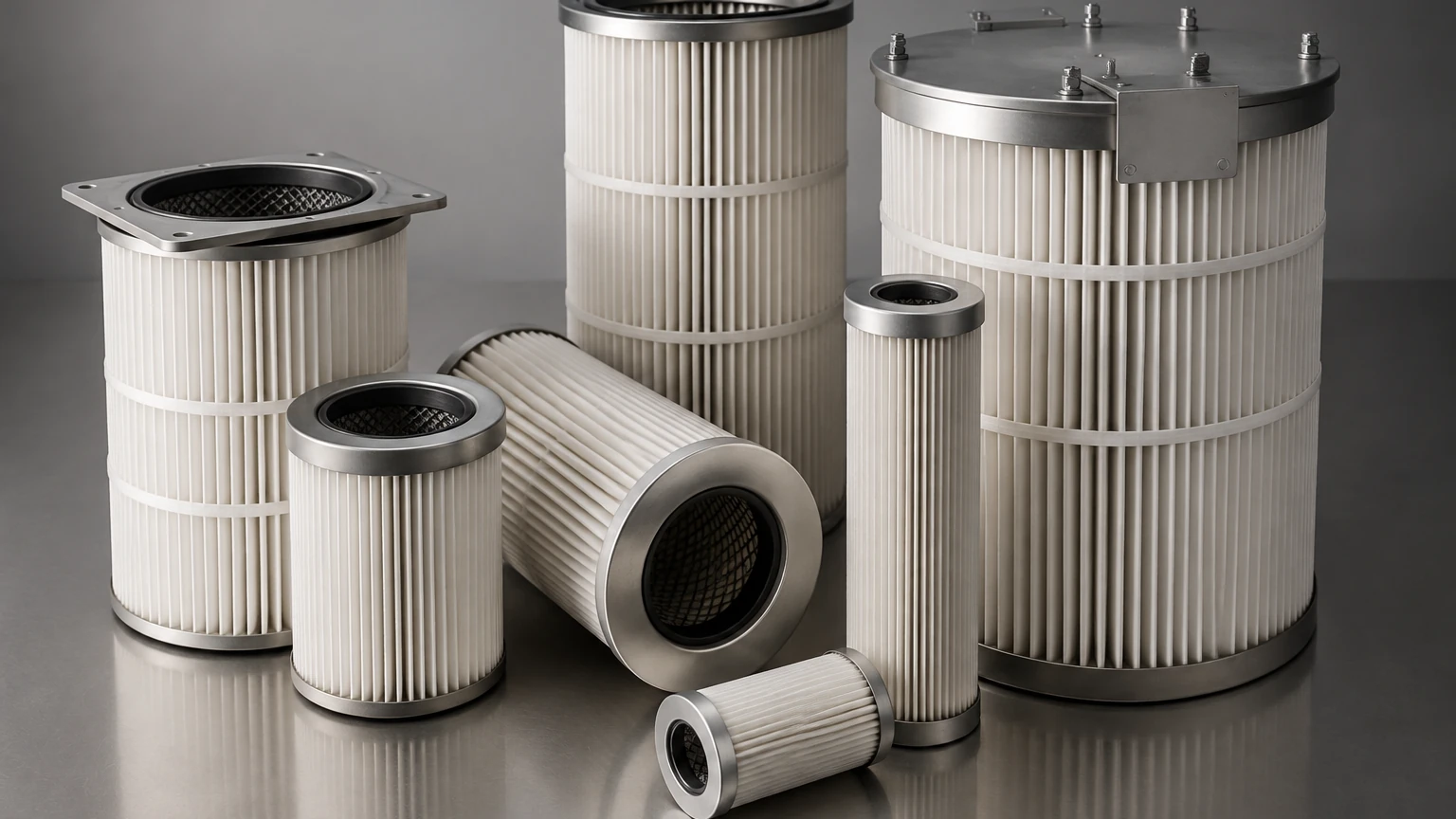
In many heavy-duty industrial applications, the structural components of the filter cartridge are just as important as the media itself. End caps, inner cores, and outer cages must withstand significant pressure differentials and mechanical stress during the pulse-cleaning process.
Kaifil specializes in manufacturing these precision metal components. Utilizing high-grade stainless steel (such as 304 or 316L) ensures that the cartridge remains dimensionally stable under high temperatures and resists oxidation in humid or chemically aggressive environments. For industries like food and beverage or pharmaceuticals, where hygiene is paramount, stainless steel components provide a non-leaching, easy-to-sanitize framework for high-efficiency filtration media.
Maintenance Strategies and Troubleshooting Performance Issues
Effective maintenance of industrial cartridge dust collectors shifts the focus from reactive repairs to predictive performance monitoring. The most reliable indicator of system health is the differential pressure (DP) gauge, which measures the pressure drop across the filters.
Monitoring Differential Pressure
A steady DP indicates a stable dust cake and effective cleaning. A sudden spike in DP often suggests "blinding," where the media pores are blocked by moisture, oils, or over-loading. Conversely, a sudden drop in DP may indicate a ruptured filter or a failed seal. Engineers should establish a baseline DP for new filters and set alarm thresholds to trigger inspection before system performance degrades.
Pulse-Jet System Audit
The cleaning system requires regular inspection. Common points of failure include:
* Diaphragm Valves: Leaking or stuck valves result in weak pulses and poor cleaning.
* Compressed Air Quality: Moisture or oil in the compressed air line can contaminate the filter media, leading to permanent blinding.
* Solenoid Functionality: Electrical failures can prevent specific rows of filters from being cleaned, leading to uneven loading.
Customization and OEM Integration for Specialized Applications
Not every industrial process fits a standard off-the-shelf dust collector configuration. Customization is often necessary to handle unique particle sizes, hazardous materials, or space constraints. OEM manufacturers frequently require bespoke filtration components that match specific housing geometries or interface with proprietary cleaning systems.
Customization options include:
* Specialized Gasket Materials: Ensuring a leak-proof seal in high-temperature or chemically volatile environments.
* Variable Pleat Spacing: Optimizing the surface area for heavy dust loads to prevent "bridging" between pleats.
* Reinforced Cores: Preventing cartridge collapse in high-vacuum or high-pressure systems.
By collaborating with a manufacturer like Kaifil, engineers can develop tailored filtration elements that meet the exact demands of their application, ensuring long-term reliability and lower total cost of ownership.
Safety and Compliance Considerations
Industrial dust collection is not merely an operational concern; it is a safety mandate. Many types of industrial dust, including wood, grain, sugar, and certain metals, are combustible. The National Fire Protection Association (NFPA) and OSHA have strict guidelines regarding the design and operation of dust collectors in these environments.
Key safety features often include:
* Explosion Venting: Pressure relief panels that direct the force of an internal explosion to a safe area.
* Fire Suppression Systems: Integrated sensors and extinguishers to quench sparks or flames within the collector.
* Grounding and Bonding: Ensuring that all metal components, including the filter cartridges, are properly grounded to prevent static discharge.
When selecting cartridges for potentially explosive environments, it is vital to confirm that the media and the metal components are conductive or dissipative to prevent the buildup of static electricity.
Conclusion: Optimizing the Filtration Lifecycle
Investing in high-quality industrial cartridge dust collectors and their associated filtration components is a strategic decision that impacts energy consumption, maintenance costs, and workplace safety. By focusing on the technical details—such as the air-to-cloth ratio, media compatibility, and the structural integrity of the filter elements—organizations can achieve superior air quality and operational uptime.
For those seeking specialized advice on custom stainless steel filtration components or looking to optimize their current system's performance, reviewing the technical resources available on the Main Page provides a foundation for informed decision-making. Whether the application involves chemical processing or high-temperature industrial exhaust, the right engineering partner ensures that the filtration system performs reliably under the most demanding conditions.
