


Industrial Wastewater Filtration Systems
Industrial wastewater treatment is a complex process that requires a multi-stage approach to remove contaminants effectively while maintaining operational efficiency. Central to this process are industrial wastewater filtration systems, which serve as the primary defense against suspended solids, particulate matter, and chemical precipitates. For engineers and facility managers, selecting the appropriate filtration technology is not merely a matter of compliance; it is a critical decision that impacts equipment longevity, processing costs, and the overall environmental footprint of the facility.
Effective filtration ensures that downstream processes, such as membrane bioreactors (MBR), reverse osmosis (RO) units, or chemical treatment tanks, are protected from fouling and mechanical damage. By implementing robust mechanical filtration solutions, industries can achieve significant reductions in Total Suspended Solids (TSS) and protect high-value infrastructure. To explore the full range of custom filtration components available for these applications, professionals often consult the Main Page of specialist manufacturers to understand the intersection of material science and fluid dynamics.
Fundamentals of Industrial Wastewater Filtration Systems
Industrial wastewater filtration systems are designed to separate solids from liquids through a physical barrier. Unlike municipal systems, industrial applications often deal with highly variable influent characteristics, including extreme pH levels, high temperatures, and abrasive particles. The primary objective is to achieve a specific effluent quality that meets either discharge regulations or internal reuse standards.
Mechanical filtration remains the most reliable method for primary and secondary wastewater treatment. It operates on principles such as surface filtration, where particles are trapped on the face of the media, and depth filtration, where particles are captured within the tortuous paths of the filter material. In industrial settings, the choice between these methods depends on the particle size distribution (PSD) and the concentration of the solids in the waste stream.
Engineering Criteria for Selecting Filtration Media
When designing or upgrading industrial wastewater filtration systems, several technical parameters must be evaluated to ensure the system performs under peak load conditions without excessive downtime.
Micron Rating and Filtration Efficiency
The micron rating defines the size of the particles the filter is intended to remove. In industrial wastewater, this typically ranges from coarse screening (1000+ microns) to fine polishing (under 5 microns). Engineers must distinguish between nominal ratings—which indicate the filter's ability to retain a majority of particles of a certain size—and absolute ratings, which guarantee the retention of all particles above the specified threshold. For critical applications where downstream sensitive equipment is involved, absolute-rated stainless steel mesh is often preferred.
Flow Rate and Flux
The flux, or the rate of flow per unit area of the filter media, determines the size of the filtration vessel. High flux rates can lead to rapid pressure build-up and premature blinding of the filter surface. Conversely, an oversized system may lead to stagnant zones and bacterial growth. Calculating the optimal flux requires an understanding of the fluid viscosity and the nature of the solids (e.g., compressible vs. non-compressible).
Differential Pressure (Delta P)
Differential pressure is the difference in pressure between the upstream and downstream sides of the filter. It serves as the primary indicator of filter loading. Industrial wastewater filtration systems must be designed with a clear understanding of the maximum allowable Delta P before the structural integrity of the filter element is compromised. High-strength stainless steel cartridges are often utilized in high-pressure environments where polymer-based filters would collapse.
The Role of Stainless Steel in Wastewater Applications
Material selection is perhaps the most critical factor in the durability of industrial wastewater filtration systems. While plastic or fabric media may be suitable for mild conditions, industrial waste often requires the resilience of metal.
Corrosion Resistance
Stainless steel 304 and 316L are the industry standards for wastewater filtration. 316L, containing molybdenum, offers superior resistance to chlorides and acidic environments, which are common in chemical processing and pharmaceutical waste. This prevents pitting and crevice corrosion, ensuring that the filtration accuracy remains consistent over years of service.
Thermal Stability
Many industrial processes discharge wastewater at elevated temperatures. Synthetic filters often lose structural rigidity or melt at temperatures exceeding 80°C. Stainless steel wire mesh and sintered metal components can operate at temperatures exceeding 500°C, making them indispensable for steam-cleaning processes and high-temperature industrial outflows.
Structural Integrity
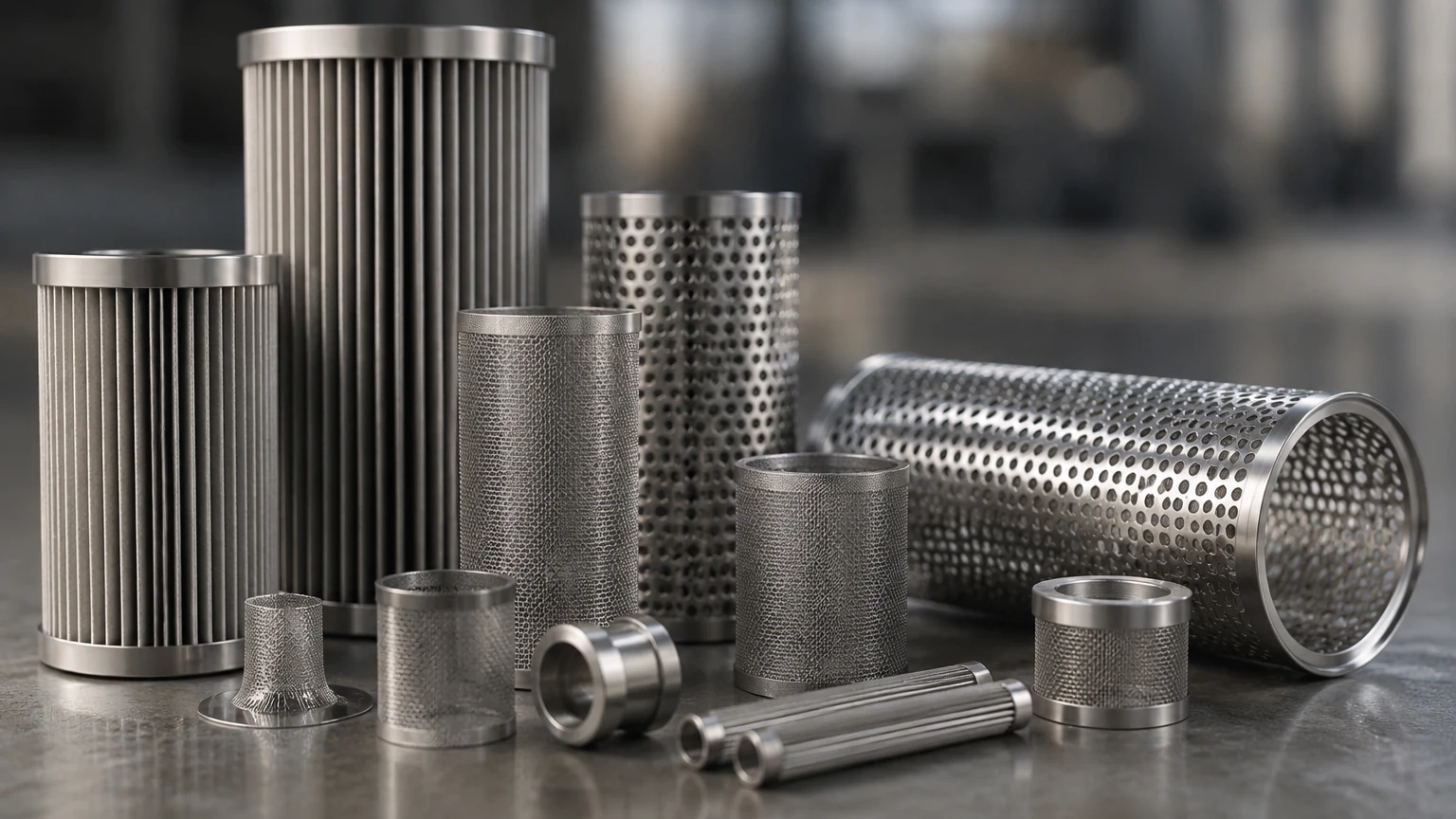
In high-flow industrial wastewater filtration systems, the filter media is subjected to significant mechanical stress. Stainless steel wire mesh can be pleated to increase surface area or sintered to bond multiple layers together, creating a rigid structure that resists deformation under hydraulic shock or high differential pressure.
Comparison of Filtration Technologies
Different industrial contexts demand different filtration architectures. Understanding the strengths of each helps in optimizing the system for specific waste streams.
1. Wire Mesh Filters: These provide precise surface filtration. They are highly effective for removing hard, granular particles and are easily cleaned via backwashing or ultrasonic methods. Their predictable pore size makes them ideal for protecting precision nozzles and sensitive valves.
2. Sintered Metal Cartridges: Created by fusing layers of metal mesh or powder, these elements offer high mechanical strength and excellent depth filtration capabilities. They are often used in applications requiring high-pressure resistance and fine filtration (down to 1 micron).
3. Wedge Wire Screens: Known for their non-clogging characteristics, wedge wire is frequently used in the initial stages of industrial wastewater filtration systems to remove large debris and fibrous materials. The V-shaped profile of the wire ensures that only two-point contact is made with particles, facilitating easy release during cleaning.
Maintenance, Cleaning, and Total Cost of Ownership (TCO)
A common mistake in procurement is focusing solely on the initial capital expenditure (CAPEX) while overlooking the operational expenditure (OPEX). Industrial wastewater filtration systems that utilize disposable cartridges may seem cheaper initially but often result in higher TCO due to frequent replacement costs, labor, and disposal fees for contaminated media.
Cleanability and Reuse
Permanent stainless steel filter elements are designed for longevity. In many industrial wastewater setups, these filters are integrated into automated backwash systems. When the differential pressure reaches a set point, the flow is reversed, or a cleaning arm is activated to dislodge the filter cake. For stubborn contaminants, such as oils or biological films, the elements can be removed and cleaned using chemical baths or ultrasonic cleaners, restoring them to near-original permeability.
Replacement Cycles
While stainless steel filters have a higher upfront cost, their replacement cycle is measured in years rather than weeks. This reliability is crucial for 24/7 industrial operations where unplanned downtime can cost thousands of dollars per hour. Engineers should evaluate the "clean pressure drop" vs. the "terminal pressure drop" to establish a predictable maintenance schedule.
Industry-Specific Applications
The requirements for industrial wastewater filtration systems vary significantly across different sectors:
* Chemical Processing: Focuses on chemical compatibility and the removal of catalysts or hazardous precipitates. Systems must handle aggressive solvents and varying pH levels.
* Food and Beverage: Requires hygienic designs (often 316L stainless steel) to prevent bacterial growth. Filtration is used to remove organic solids and fats from wash water before discharge.
* Pharmaceutical: Demands high-precision filtration to ensure that trace active pharmaceutical ingredients (APIs) are captured and that the water meets stringent environmental discharge limits.
* Hydraulic and Power Generation: Filtration is used to remove fine metal particulates and carbon from cooling water and process fluids to prevent wear on turbines and pumps.
Pre-Purchase Considerations for Engineers
Before finalizing the design of industrial wastewater filtration systems, purchasing teams and engineers should confirm the following technical details with their manufacturer:
* Fluid Characterization: What is the chemical composition, temperature, and viscosity of the wastewater?
* Solids Loading: What is the concentration of solids (ppm or mg/L), and what is the particle size distribution?
* Integration Requirements: Does the filter need to fit into an existing housing, or is a custom OEM solution required?
* Cleaning Compatibility: Is the facility equipped for backwashing, or is manual cleaning preferred?
* Regulatory Compliance: What are the specific local or industry-mandated effluent standards that must be met?
By addressing these factors, organizations can implement industrial wastewater filtration systems that provide reliable, long-term performance while minimizing environmental impact and operational costs. For those seeking technical guidance on material selection or custom filter design, visiting the Main Page of a dedicated manufacturer provides the necessary engineering resources to move from specification to implementation.
