


Polymer Filter
In industrial polymer processing, the removal of contaminants from molten resins is a critical step that directly influences the quality of the final product. Whether in plastic extrusion, fiber spinning, or film production, a high-performance polymer filter is essential for protecting downstream equipment and ensuring structural integrity. Contaminants such as degraded polymer (gels), metal particles, and environmental debris can cause fiber breakage, film pinholes, and surface defects if not effectively managed.
As a specialized manufacturer of stainless steel filtration solutions, Kaifil provides precision-engineered components designed to withstand the extreme temperatures and pressures inherent in polymer melt filtration. This guide explores the technical considerations, material selection, and engineering principles involved in selecting and maintaining effective filtration systems for polymer applications.
The Critical Role of Filtration in Polymer Melt Processing
Polymer melt filtration occurs under demanding conditions where temperatures often exceed 300°C and pressures can reach several hundred bar. The primary objective of a polymer filter is to remove particulate matter while maintaining a consistent flow rate and minimizing pressure drop.
In synthetic fiber production, such as polyester or nylon spinning, even microscopic particles can lead to "spinneret" clogging or filament breakage. In film extrusion, contaminants can cause optical defects or weaken the barrier properties of the material. Beyond product quality, effective filtration protects expensive machinery, such as gear pumps and extrusion dies, from abrasive wear and catastrophic failure.
Engineers must balance filtration efficiency with the economic realities of production. A filter with excessively fine pores may provide superior cleanliness but will likely result in a high pressure drop and shorter service life, increasing the frequency of filter changes and downtime. Conversely, a filter that is too coarse will fail to protect the final product quality.
Engineering Considerations for Polymer Filter Media
Selecting the appropriate media is the most significant decision in designing a polymer filter system. Stainless steel is the material of choice due to its thermal stability, mechanical strength, and corrosion resistance. Within the category of metal filtration, several structures are commonly employed:
Sintered Metal Fiber Felt
Sintered metal fiber felt is a non-woven medium composed of stainless steel fibers that are randomly laid and then sintered together. This structure offers a high porosity (up to 80%), which translates to a high dirt-holding capacity and a low initial pressure drop. For polymer applications involving high-viscosity melts, the depth filtration characteristics of fiber felt are particularly effective at capturing "gels"—soft, deformable particles of degraded polymer that might otherwise squeeze through a standard wire mesh.
Stainless Steel Wire Mesh
Stainless steel wire mesh provides precise surface filtration. It is characterized by uniform pore sizes and excellent mechanical stability. In polymer filtration, wire mesh is often used as a support layer for finer media or as a primary filter for applications where particulate size is relatively large and uniform. Square weave and Dutch weave patterns are the most common configurations, each offering different balances of flow rate and mechanical strength.
Sintered Mesh Laminates
For applications requiring extreme pressure resistance, multiple layers of wire mesh are sintered together to create a rigid, porous plate. This laminate combines the precision of fine mesh with the structural integrity of heavy-duty support layers, preventing media migration and deformation under high differential pressures.
Structural Designs: Pleated vs. Cylindrical Filters
The physical configuration of the polymer filter determines the available filtration area within a given housing volume.
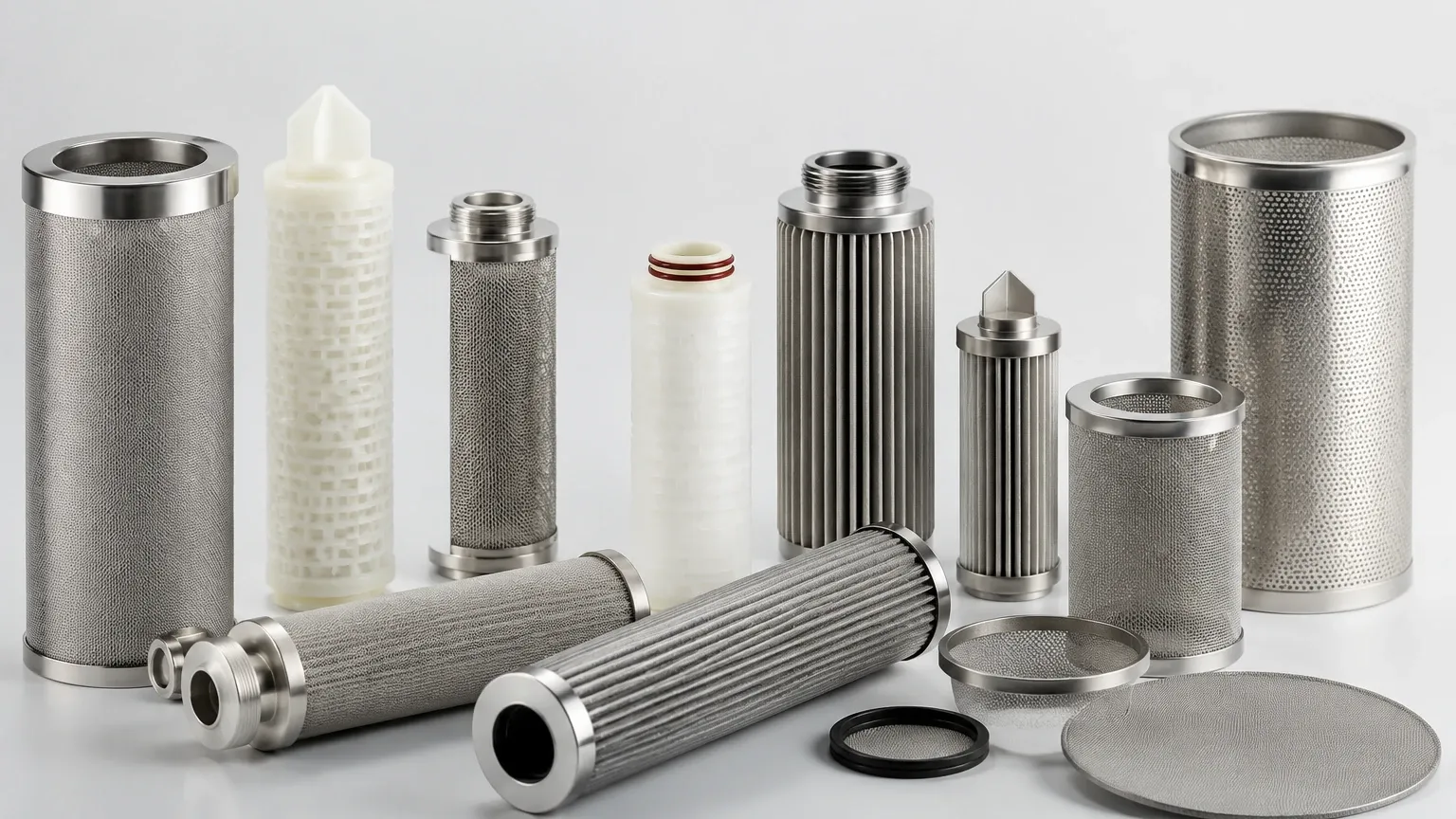
Pleated Filter Cartridges
Pleating the filter media significantly increases the effective filtration surface area—often by a factor of three to five compared to a smooth cylinder. This increased area allows for lower flux (flow per unit area), which reduces the pressure drop and extends the "on-stream" life of the filter. Pleated designs are ideal for high-capacity lines where minimizing downtime is a priority. However, the pleat geometry must be carefully engineered to avoid "dead zones" where polymer can stagnate and thermally degrade.
Cylindrical and Disc Filters
Cylindrical filters are simpler in construction and easier to clean, making them suitable for lower-viscosity polymers or smaller production batches. In some high-pressure extrusion processes, "leaf discs" or "spin packs" are used. These consist of circular filter elements stacked together, providing a robust and compact filtration solution that can handle the extreme mechanical stresses of the extrusion head.
Material Selection and Chemical Compatibility
The choice of stainless steel grade is dictated by the chemical nature of the polymer and the cleaning methods employed.
* Grade 304: Suitable for general-purpose applications with non-corrosive polymers.
* Grade 316/316L: Contains molybdenum, which provides enhanced resistance to pitting and corrosion. This is the standard for most industrial polymer applications, especially those involving additives or cleaning processes that use aggressive chemicals.
* Specialty Alloys: For polymers that release acidic byproducts (such as PVC) or for processes operating at exceptionally high temperatures, alloys like Hastelloy or Inconel may be required.
Engineers must also consider the compatibility of the gasket and sealing materials. In high-temperature polymer filtration, metallic seals or high-performance elastomers are necessary to prevent bypass and leakage.
Performance Evaluation and Quality Assurance
To ensure reliable performance in a production environment, polymer filters must undergo rigorous testing. Key performance metrics include:
1. Filtration Rating (Micron Rating): This defines the size of particles the filter is capable of removing. It is important to distinguish between "absolute" ratings (99.9% efficiency) and "nominal" ratings, as the latter can be misleading in critical applications.
2. Bubble Point Pressure: This test measures the pressure required to force air through a liquid-saturated filter. It is a non-destructive way to verify the integrity of the filter media and ensure there are no oversized pores or manufacturing defects.
3. Permeability: Measuring the flow of a standard fluid (usually air or water) at a specific pressure drop helps verify that the filter meets the design specifications for flow resistance.
4. Collapse Pressure: Given the high operating pressures in polymer melt processing, the filter must be rated for a maximum differential pressure to prevent structural failure during a surge or when the filter becomes loaded with contaminants.
Maintenance and the Total Cost of Ownership
While the initial purchase price of a polymer filter is a factor, the total cost of ownership is largely determined by the filter's service life and cleanability. Unlike disposable plastic filters used in other industries, stainless steel polymer filters are designed to be cleaned and reused multiple times.
Cleaning Methods
* Pyrolysis (Burn-off): The filter is placed in a vacuum or controlled-atmosphere oven to thermally decompose the residual polymer. This is effective but must be carefully controlled to avoid damaging the metal structure through overheating.
* Ultrasonic Cleaning: High-frequency sound waves create cavitation bubbles in a cleaning solution, which mechanically dislodge particles from deep within the filter media.
* Chemical Cleaning: Specialized solvents or alkaline/acidic baths are used to dissolve specific types of polymer or mineral deposits.
* Hydrodynamic Cleaning: High-pressure water jets can be used to remove surface debris after the bulk of the polymer has been removed.
Effective cleaning restores the filter to near-original pressure drop levels. However, every cleaning cycle subjects the metal to thermal and mechanical stress. Monitoring the "clean" pressure drop over time allows maintenance teams to determine when a filter has reached the end of its useful life and must be replaced.
Optimizing Selection for Industrial Applications
When specifying a polymer filter, engineers should provide detailed information regarding the process conditions to ensure the optimal design. Critical data points include:
* Polymer Type and Viscosity: High-viscosity melts require more robust support structures.
* Operating Temperature and Pressure: These dictate material selection and seal types.
* Target Contaminant Profile: Understanding whether the goal is to remove hard particles or soft gels influences the choice between wire mesh and fiber felt.
* Flow Rate Requirements: This determines the necessary filtration area to maintain an acceptable pressure drop.
By focusing on these technical parameters, purchasing teams can move beyond commodity-based buying and select filtration solutions that enhance process stability and product quality. For more information on customized stainless steel filtration components and engineering support, visit the Main Page.
Conclusion
The polymer filter is a small but vital component in the complex chain of polymer processing. Through the strategic use of stainless steel wire mesh and sintered fiber felt, manufacturers can achieve the precise filtration required for modern high-performance materials. Understanding the interplay between media structure, mechanical design, and maintenance protocols allows for the optimization of both product quality and operational efficiency. As industrial requirements continue to evolve toward finer filtration and longer production cycles, the role of specialized metal filtration manufacturers like Kaifil becomes increasingly central to successful polymer manufacturing.
