


Polymer Melt Filter
In the industrial production of plastics, fibers, and resins, the quality of the final product is inextricably linked to the purity of the polymer in its molten state. A polymer melt filter serves as the critical barrier between raw material inconsistencies and high-quality finished goods. These filtration systems are designed to operate under extreme conditions, including high temperatures, high pressures, and high-viscosity fluids, to remove contaminants such as unmelted particles, degraded polymer (gels), and foreign metallic or mineral fragments.
For engineers and procurement professionals, selecting the appropriate filtration solution requires a deep understanding of rheology, metallurgy, and mechanical design. Failure to implement an effective filtration strategy can lead to frequent production downtime, equipment damage (particularly to downstream components like spinnerets or extrusion dies), and significant material waste.
The Role of Filtration in Polymer Processing
Polymer melt filtration is not merely a cleaning step; it is a process stabilization mechanism. In extrusion and injection molding processes, the presence of even microscopic contaminants can create stress concentration points in the final product. In thin-film production, a single oversized particle can cause a "bubble break" or a hole, rendering an entire roll of material useless. In synthetic fiber spinning, contaminants can clog the fine holes of a spinneret, leading to filament breakage.
Beyond particle removal, a polymer melt filter aids in the homogenization of the melt. As the molten plastic passes through the tortuous paths of a multi-layered wire mesh or a sintered metal fiber medium, the shear forces help break up small aggregates and ensure a more uniform temperature distribution across the flow profile. This contributes to better dimensional stability and surface finish in the end product.
Types of Filter Media for Melt Applications
Technical performance depends heavily on the geometry and material of the filter media. Because polymer processing often involves temperatures exceeding 300°C and pressures up to 350 bar, stainless steel is the industry standard due to its thermal stability and mechanical strength.
1. Woven Wire Mesh
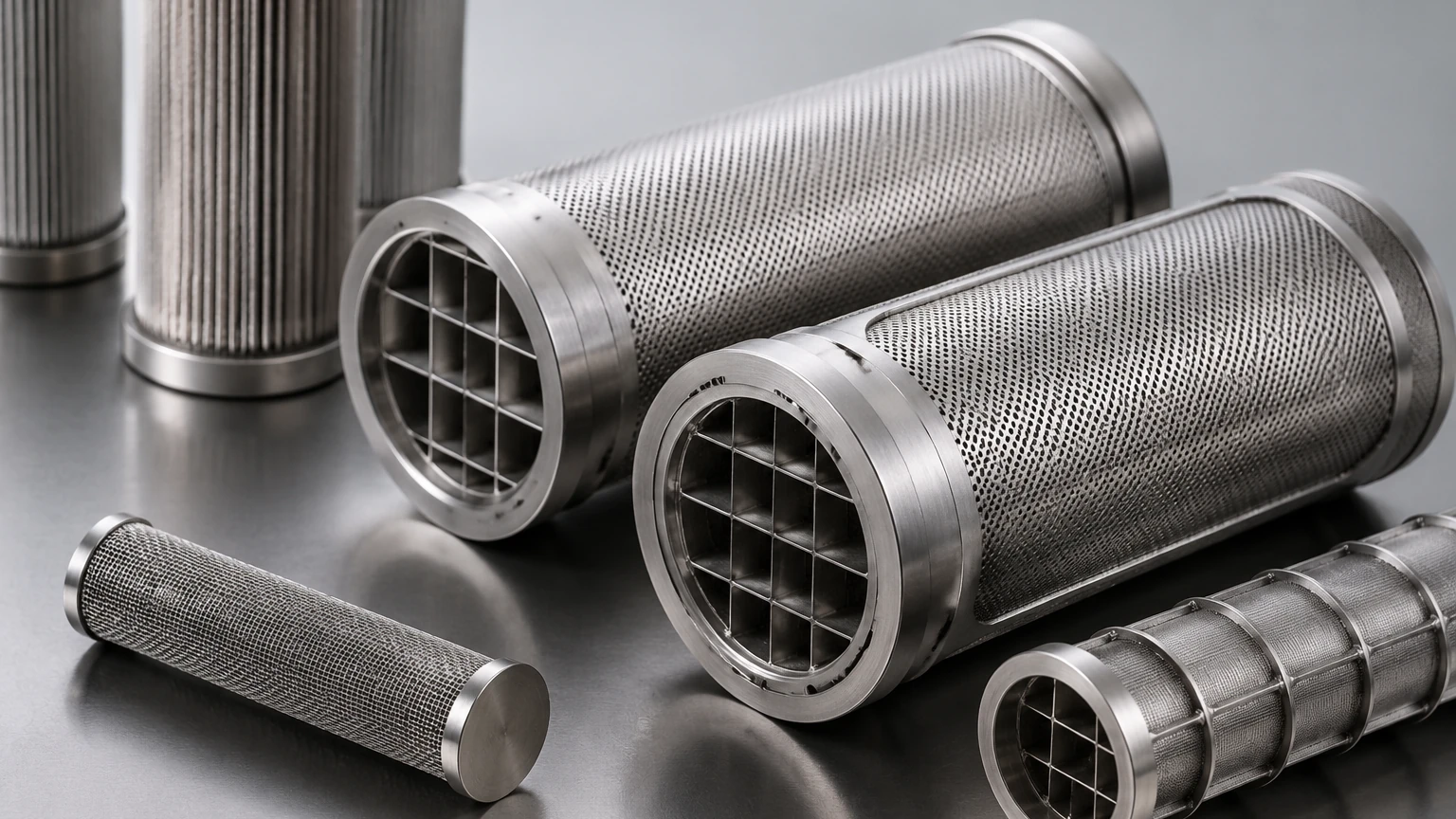
Stainless steel wire mesh is the most common medium used in polymer filtration. It is available in various weave patterns, such as plain, twill, or Dutch weave. For melt applications, multi-layer mesh packs are often used, where several layers of different mesh counts are sintered or welded together. This graduated structure allows for depth filtration, where larger particles are caught on the outer layers and finer particles are trapped within the inner layers, extending the service life of the filter.
2. Sintered Metal Fiber
Sintered metal fiber media consist of non-woven stainless steel fibers that are bonded together through a high-temperature sintering process. This creates a highly porous, three-dimensional structure. The primary advantage of metal fiber is its high dirt-holding capacity and low initial pressure drop compared to wire mesh. It is particularly effective for removing soft contaminants like gels, which can often "snake" through the straight pores of a standard wire mesh.
3. Sintered Metal Powder
In applications requiring extremely fine filtration or high structural rigidity, sintered metal powder components are used. These are formed by compressing and sintering metal spheres or irregular particles. While they offer exceptional precision, they typically have a higher pressure drop and are more challenging to clean than fiber or mesh-based filters.
Key Design Configurations: Candles, Discs, and Packs
The physical configuration of the polymer melt filter is determined by the required filtration surface area and the design of the filter housing or screen changer.
* Filter Screen Packs: These are flat, circular, or oval discs composed of multiple mesh layers. They are typically used in standard extruders with manual or hydraulic screen changers. They are cost-effective but offer a limited surface area relative to the housing size.
* Candle Filters: To maximize surface area within a compact volume, filter media are formed into cylindrical "candles." These are often pleated to further increase the effective filtration area. Candle filters are preferred in continuous polymer production (like PET or nylon resin plants) where long run times between filter changes are required.
* Leaf Discs: Used primarily in the production of biaxially oriented films (BOPP/BOPET) and high-quality fibers, leaf discs consist of a central support hub with multiple flat, circular filtration elements stacked along it. This design provides a very high surface area and a streamlined flow path to minimize residence time, which is crucial for heat-sensitive polymers.
Engineering Parameters for Filter Selection
When evaluating a polymer melt filter for a specific application, engineers must balance several competing technical factors. Providing accurate data to the manufacturer during the design phase is essential for optimizing the total cost of ownership.
Filtration Rating (Micron Rating)
Filtration rating is defined as either nominal or absolute. In polymer melt applications, the absolute rating is often more critical, as it defines the size of the largest spherical particle that can pass through the filter. For high-end optical films, filtration might be required down to 5 microns, while for recycled plastic lumber, 200 microns might be sufficient.
Differential Pressure (ΔP)
As contaminants accumulate, the pressure required to force the melt through the filter increases. The system must be designed to withstand the maximum expected differential pressure without the filter medium collapsing or the contaminants being forced through the mesh. A high initial pressure drop limits the available "headroom" for contaminant loading, leading to shorter filter life.
Residence Time and Dead Zones
Polymers are susceptible to thermal degradation if held at high temperatures for too long. The internal geometry of the filter and its housing must be designed to ensure a "first-in, first-out" flow pattern. Stagnant areas, or dead zones, can lead to polymer carbonization, which eventually sloughs off and contaminates the melt as black specks.
Viscosity and Shear Sensitivity
The rheological behavior of the polymer influences how it flows through the filter media. High-viscosity polymers require more robust filter supports to prevent deformation. Furthermore, some polymers are shear-sensitive; if the filter pores are too small or the flow rate too high, the resulting shear stress can degrade the molecular weight of the polymer.
Maintenance and Cleaning Protocols
Industrial polymer melt filters are typically designed to be cleaned and reused multiple times to reduce operational costs. Because the polymers harden at room temperature, specialized cleaning methods are required to remove the residual plastic from the intricate mesh or fiber structures.
1. Vacuum Pyrolysis / Burn-out Ovens: The filters are placed in a vacuum oven where the polymer is thermally decomposed into gases and carbon. This is a controlled process that prevents the metal from overheating and losing its temper.
2. Ultrasonic Cleaning: After the bulk of the polymer is removed via pyrolysis, ultrasonic baths with specialized detergents are used to dislodge microscopic carbon particles and inorganic residues from deep within the filter media.
3. Hydrolysis: For certain polymers like PET or Nylon, high-pressure steam or chemical hydrolysis can be used to break down the polymer chains into soluble monomers, which are then washed away.
4. Bubble Point Testing: After cleaning, it is standard engineering practice to perform a bubble point test. This involves submerging the filter in a fluid and applying air pressure to ensure the integrity of the mesh. If bubbles appear at a lower-than-specified pressure, it indicates a hole or a failed weld, and the filter must be decommissioned.
Customization for Demanding Environments
Standard filtration components often fail to meet the specific nuances of specialized polymer grades or unique extruder setups. Customization is frequently necessary in terms of alloy selection (using Hastelloy or Inconel for corrosive fluoropolymers), custom end-fittings for specific housing interfaces, and optimized pleat geometries to handle high contaminant loads.
Working with a manufacturer that understands the intersection of metallurgy and polymer rheology allows for the development of filtration solutions that maximize throughput while maintaining strict purity standards. For those seeking technical specifications and customized filtration components, you can Review product options and application support on our Main Page to find the right configuration for your industrial requirements.
Conclusion: Confirming Technical Requirements
Before finalizing a purchase for a polymer melt filter system, engineering teams should confirm the following data points with their supplier:
* Polymer Type and MFI: The Melt Flow Index (MFI) and chemical composition of the resin.
* Operating Temperature and Pressure: Both the standard operating levels and the maximum design limits of the system.
* Target Contaminant Profile: Are you removing hard metallic particles, soft gels, or carbonized specks?
* Throughput Requirements: The required kilograms per hour (kg/h) to ensure the filter surface area is sized correctly to prevent excessive pressure drop.
* Cleaning Compatibility: Ensure the filter construction can withstand the intended cleaning method (e.g., high-temperature pyrolysis).
By addressing these technical boundaries, manufacturers can ensure that their polymer melt filtration system provides a reliable, long-term solution that protects downstream equipment and guarantees the quality of the final product.
