


Portable Hydraulic Oil Filtration System
In industrial hydraulic systems, fluid cleanliness is the primary determinant of component longevity and operational reliability. Statistics across the fluid power industry consistently indicate that approximately 70% to 80% of hydraulic system failures are directly attributable to particulate or water contamination. While primary on-board filters provide a first line of defense, they are often insufficient for maintaining the ultra-clean fluid levels required by high-pressure proportional valves and precision actuators. This is where a portable hydraulic oil filtration system, often referred to as a filter cart or kidney-loop system, becomes an essential asset for maintenance teams.
A portable hydraulic oil filtration system operates independently of the main hydraulic circuit. By drawing fluid from a reservoir, passing it through high-efficiency filter media, and returning it to the tank, these systems provide supplemental cleaning that reduces the burden on internal filters and extends the service life of the oil. For engineers and maintenance managers, understanding the technical nuances of these systems—from micron ratings to material compatibility—is critical for optimizing machine uptime.
Engineering Principles of Portable Filtration
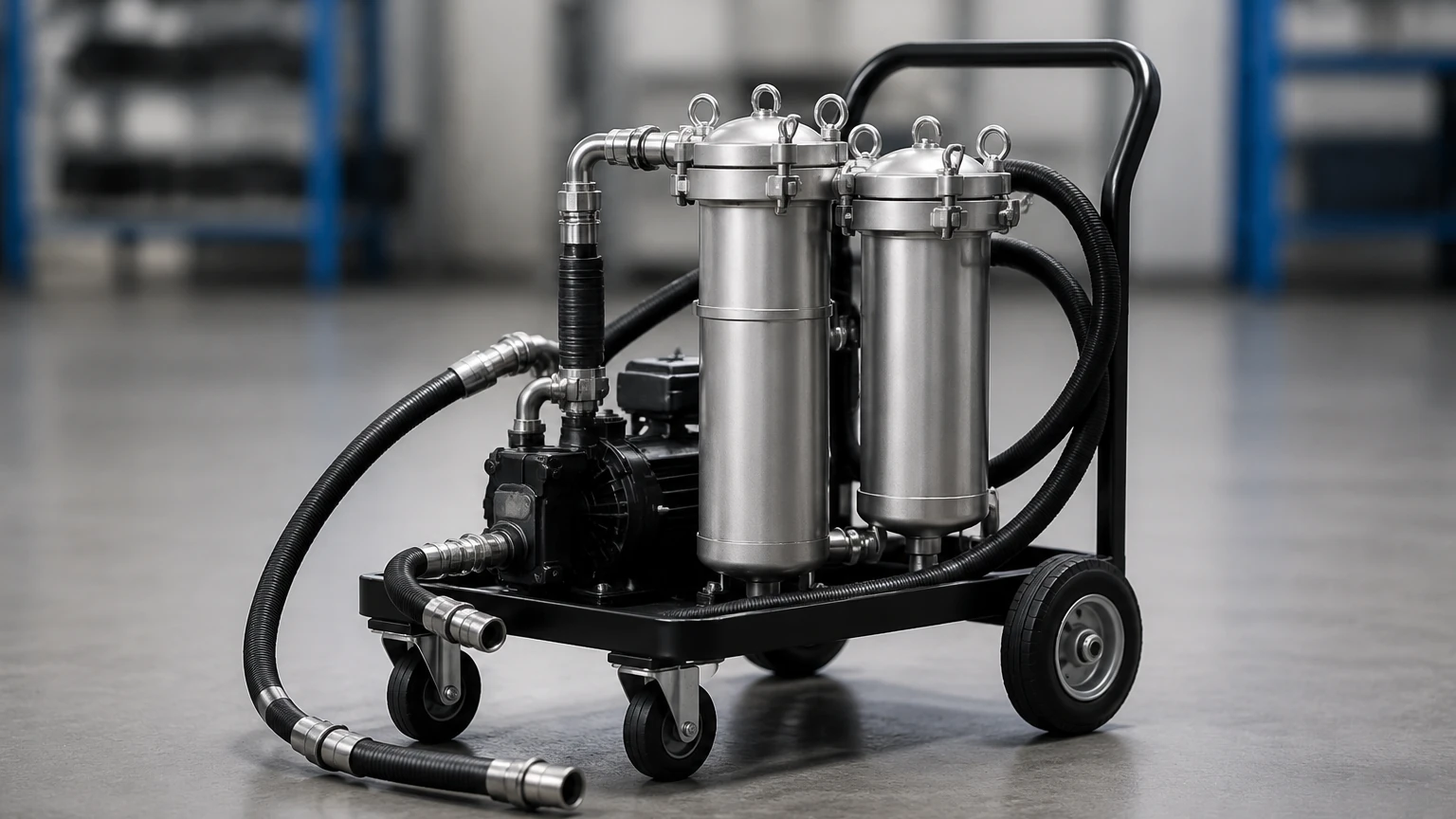
The core function of a portable hydraulic oil filtration system is to achieve a specific ISO 4406 cleanliness code that the machine’s built-in filtration may not be able to maintain under heavy duty cycles. These systems typically consist of a motor-driven pump, one or more filter housings, and a set of flexible hoses with quick-disconnect fittings.
The Kidney-Loop Concept
The term "kidney-loop" is used because the system mimics the biological function of a kidney, continuously scrubbing the "blood" (oil) of the machine. Unlike full-flow filters that must handle the entire system flow and high pressure, a portable system can utilize a lower, more consistent flow rate. This allows for the use of high-efficiency, high-area filter media that can capture finer particles without the risk of high differential pressure triggering a bypass valve during system surges.
Pump and Motor Selection
The pump in a portable system must be compatible with the viscosity of the hydraulic fluid. For high-viscosity gear oils or fluids used in cold environments, positive displacement pumps (such as gear or vane pumps) are standard. The motor must be sized to provide enough torque to move the fluid through the filter media even as the media becomes loaded with contaminants, which increases the resistance (differential pressure).
Key Evaluation Criteria for Filter Media
When selecting or specifying a portable hydraulic oil filtration system, the choice of filter media is the most significant technical decision. This is where the expertise of a manufacturer like Kaifil becomes vital, as the performance of the system depends on the precision of the filter elements used within the housings.
Micron Rating and Beta Ratio
Engineers must distinguish between nominal and absolute micron ratings. A nominal rating is an arbitrary micrometer value indicated by the manufacturer, whereas an absolute rating (Beta ratio) is determined through multi-pass testing. For critical hydraulic systems, a Beta ratio of βx(c) ≥ 1000 is often required, meaning that for every 1,000 particles of a certain size entering the filter, only one passes through.
Stainless Steel vs. Synthetic Media
While cellulose and synthetic glass fibers are common, stainless steel wire mesh filters and sintered metal cartridges offer distinct advantages in specific industrial contexts. Stainless steel filter elements are highly durable, resistant to chemical degradation, and capable of withstanding high temperatures that would compromise synthetic binders. Furthermore, stainless steel mesh can be cleaned and reused in certain applications, providing a different total cost of ownership (TCO) profile compared to disposable elements.
Water Removal Capabilities
Contamination is not limited to particulates. Water, whether dissolved, emulsified, or free, can lead to oil oxidation, additive depletion, and component corrosion. Many portable systems incorporate water-absorbing (super-absorbent polymer) media or vacuum dehydration stages to maintain water levels below saturation points.
Industrial Applications and Compatibility
Portable hydraulic oil filtration systems are utilized across a broad spectrum of industries, each with unique environmental challenges and fluid requirements. Selecting the right system requires a deep dive into the chemical and physical properties of the fluid being processed.
Chemical and Pharmaceutical Processing
In these environments, hydraulic systems often operate near sensitive chemical reactions. The filtration components must be made of materials that do not leach contaminants or react with the fluid. Stainless steel filtration solutions are the standard here due to their inert nature and ease of sterilization. You can Review product options and application support to see how custom metal components are engineered for these high-purity sectors.
Food and Beverage Industry
Filtration systems used in food production must often utilize food-grade lubricants. These lubricants can have different viscosity behaviors than standard mineral oils. Portable carts used in these facilities must be designed with wash-down capabilities and often utilize stainless steel housings to prevent rust and meet hygiene standards.
Heavy Industrial and Mobile Equipment
For construction, mining, and manufacturing, portable systems are used for "pre-filtering" new oil. It is a common misconception that new oil is clean; in reality, oil delivered in drums often exceeds the ISO cleanliness limits for modern hydraulic components. Using a portable system to transfer oil from a drum to a machine reservoir ensures that no new contaminants are introduced.
Performance Expectations and Maintenance
To ensure a portable hydraulic oil filtration system delivers the expected return on investment, maintenance teams must establish clear performance benchmarks and monitoring protocols.
ISO 4406 Cleanliness Targets
The success of a filtration program is measured by the ISO 4406 code (e.g., 16/14/11). Achieving these targets requires consistent use of the portable system. Engineers should perform regular oil analysis to verify that the system is effectively reducing the particle count. If the target code is not reached, it may indicate that the flow rate is too high for the media efficiency or that the media is bypassing.
Monitoring Differential Pressure
Every portable system should be equipped with a differential pressure gauge or indicator. This device measures the pressure drop across the filter element. As the element traps dirt, the pressure drop increases. Operating a system with a clogged filter not only reduces flow but can eventually lead to element collapse or the opening of a bypass valve, which allows unfiltered oil to circulate.
Replacement Cycles
The life of a filter element depends entirely on the contamination ingression rate of the system being cleaned. In a relatively clean system, an element might last months; when cleaning a heavily contaminated reservoir after a component failure, an element might reach capacity in hours. Using high-capacity pleated stainless steel elements can extend these cycles by providing a larger surface area for contaminant retention.
Customization and Engineering Considerations
Off-the-shelf portable filtration units may not meet the specific needs of every industrial application. Customization is often necessary to address constraints related to space, fluid type, or environmental hazards.
Material Selection
For applications involving aggressive fluids or extreme temperatures, standard seals (like Nitrile) and housings may fail. Engineers should specify Viton or EPDM seals and consider 304 or 316L stainless steel for all wetted parts to ensure long-term compatibility. Kaifil specializes in these types of custom stainless steel filtration solutions, providing the precision metal components required for demanding environments.
Flow Control and Safety
Portable systems should include safety features such as relief valves to prevent over-pressurization and motor overloads. In some cases, variable frequency drives (VFDs) are used to adjust the pump speed based on fluid viscosity, which is particularly useful for systems that must handle different types of oil at varying temperatures.
Portability and Ergonomics
The physical design of the cart matters for field use. Large, pneumatic tires are better for uneven plant floors, while compact, lightweight frames are necessary for transport between remote sites. The inclusion of long, high-quality hoses with dripless couplings prevents environmental contamination during the connection and disconnection process.
Conclusion: The Strategic Value of Off-line Filtration
Investing in a high-quality portable hydraulic oil filtration system is a strategic decision that moves a maintenance department from a reactive to a proactive stance. By maintaining fluid at or above the manufacturer's cleanliness specifications, companies can significantly reduce the frequency of component replacements, lower the volume of waste oil generated, and prevent the catastrophic downtime associated with hydraulic failure.
When evaluating these systems, it is essential to look beyond the initial purchase price and consider the total cost of ownership, including the durability of the filter housings and the efficiency of the replacement elements. For those requiring precision-engineered components, stainless steel options provide a level of reliability and chemical resistance that synthetic alternatives cannot match. For more information on specialized filtration components and custom manufacturing, visit the Kaifil Main Page to explore technical specifications and engineering support for your specific industrial needs.
