


String Water Filters
In the landscape of industrial liquid processing, string water filters—frequently referred to as string-wound cartridges—represent one of the most established technologies for sediment removal and depth filtration. These components are engineered to provide a tortuous path for fluid, capturing particulates throughout the entire thickness of the filter media rather than just on the surface. For engineers and procurement professionals managing chemical processing, food and beverage production, or large-scale water treatment facilities, understanding the technical nuances of string-wound media is essential for optimizing filtration efficiency and controlling operational costs.
While Kaifil specializes in high-performance stainless steel filtration components, a comprehensive understanding of traditional depth filtration like string-wound cartridges allows technical teams to make better-informed decisions regarding pre-filtration and the eventual transition to more durable, cleanable metal solutions. This guide explores the engineering principles, material considerations, and performance benchmarks of string water filters in industrial environments.
Understanding the Mechanics of String-Wound Depth Filtration
String water filters are manufactured by winding textile yarns around a perforated central core. The winding process is not arbitrary; it is a precision engineering task where the pitch and tension of the yarn determine the filtration characteristics. As the yarn is wound, it creates diamond-shaped openings that become progressively smaller toward the center of the cartridge.
Gradient Density
This structural design facilitates "gradient density" filtration. Larger particles are trapped in the wider outer layers of the yarn, while finer particles penetrate deeper into the cartridge before being captured by the more tightly packed inner layers. This mechanism prevents the surface from blinding prematurely, which is a common failure mode in surface-type filters. By utilizing the full depth of the media, string filters can maintain a lower pressure drop over a longer period compared to simple pleated paper or thin-film membranes.
The Role of the Core
The central core provides the structural integrity required to withstand the differential pressure (Delta P) generated as the filter becomes loaded with contaminants. In standard industrial applications, cores are typically made of polypropylene for general water use, tin-plated steel for oils and solvents, or 304/316 stainless steel for high-temperature or corrosive environments. If the core fails under pressure, the filter media can collapse, leading to immediate bypass and downstream contamination.
Material Selection and Chemical Compatibility
The performance of string water filters is heavily dependent on the chemical and thermal compatibility of both the yarn and the core. Selecting the wrong material can lead to media degradation, fiber migration, or chemical leaching into the process stream.
1. Polypropylene: The most common material for string water filters due to its broad chemical resistance and low cost. It is suitable for most water-based applications, acids, and alkalis up to temperatures of approximately 140°F (60°C). However, it is not compatible with strong oxidizing agents or high-temperature hydrocarbons.
2. Cotton (Bleached or Natural): Often used for oils, alcohols, and water where a higher temperature threshold (up to 250°F or 120°C) is required. Bleached cotton is preferred for food-grade applications to ensure the absence of natural oils and waxes that could contaminate the filtrate.
3. Glass Fiber: Reserved for high-temperature applications (up to 750°F or 400°C) and aggressive chemical environments where synthetic polymers would fail. Glass fiber filters are exceptionally rigid but can be more brittle and prone to fiber shedding if not properly finished.
4. Polyester and Nylon: These materials offer specific resistances to solvents and hydrocarbons that polypropylene cannot handle, filling the gap between standard polymers and high-cost specialty fibers.
For facilities requiring permanent, high-integrity solutions that exceed the capabilities of disposable yarns, reviewing advanced metal options on the Kaifil Main Page can provide insights into transitioning from disposable string filters to reusable stainless steel cartridges.
Performance Metrics: Micron Ratings and Dirt-Holding Capacity
When evaluating string water filters, engineers must distinguish between nominal and absolute micron ratings. Most string-wound cartridges are rated "nominally," meaning they are designed to capture a significant percentage (typically 60% to 85%) of particles at a specific micron size.
Nominal vs. Absolute Filtration
Unlike precision-engineered stainless steel wire mesh, which can offer absolute ratings (99.9% efficiency), string filters rely on the depth of the yarn to eventually trap particles. This means that a 5-micron string filter may allow some 5-micron particles to pass through initially, especially during flow surges or high-pressure conditions. In critical B2B applications where downstream equipment (such as RO membranes or high-pressure pumps) is sensitive to specific particle sizes, string filters are best utilized as pre-filters rather than final polishing stages.
Dirt-Holding Capacity
The primary advantage of string water filters is their high dirt-holding capacity. Because the filtration occurs throughout the depth of the wound yarn, these filters can accommodate a high volume of solids before the differential pressure reaches the change-out point (typically 20-30 PSI). This makes them ideal for raw water intake or processes with high turbidity.
Operational Challenges: Media Migration and Channeling
Despite their versatility, string water filters present several engineering challenges that must be managed to ensure process consistency.
Media Migration
One of the most significant risks with low-quality string filters is media migration. This occurs when individual fibers from the yarn break loose and enter the filtrate. In pharmaceutical or food and beverage sectors, this can lead to batch rejection. High-quality manufacturers use continuous filament yarns or thermal bonding to minimize this risk, but it remains a factor that engineers must monitor.
Channeling and Unloading
As differential pressure increases, the fluid may find a path of least resistance, effectively "pushing" through the yarn layers. This is known as channeling. Furthermore, if the filter is subjected to sudden pressure spikes, it can suffer from "unloading," where previously trapped contaminants are forced through the media and back into the process stream. This is a primary reason why string filters are often replaced by rigid stainless steel filter elements in high-pressure hydraulic or critical chemical loops.
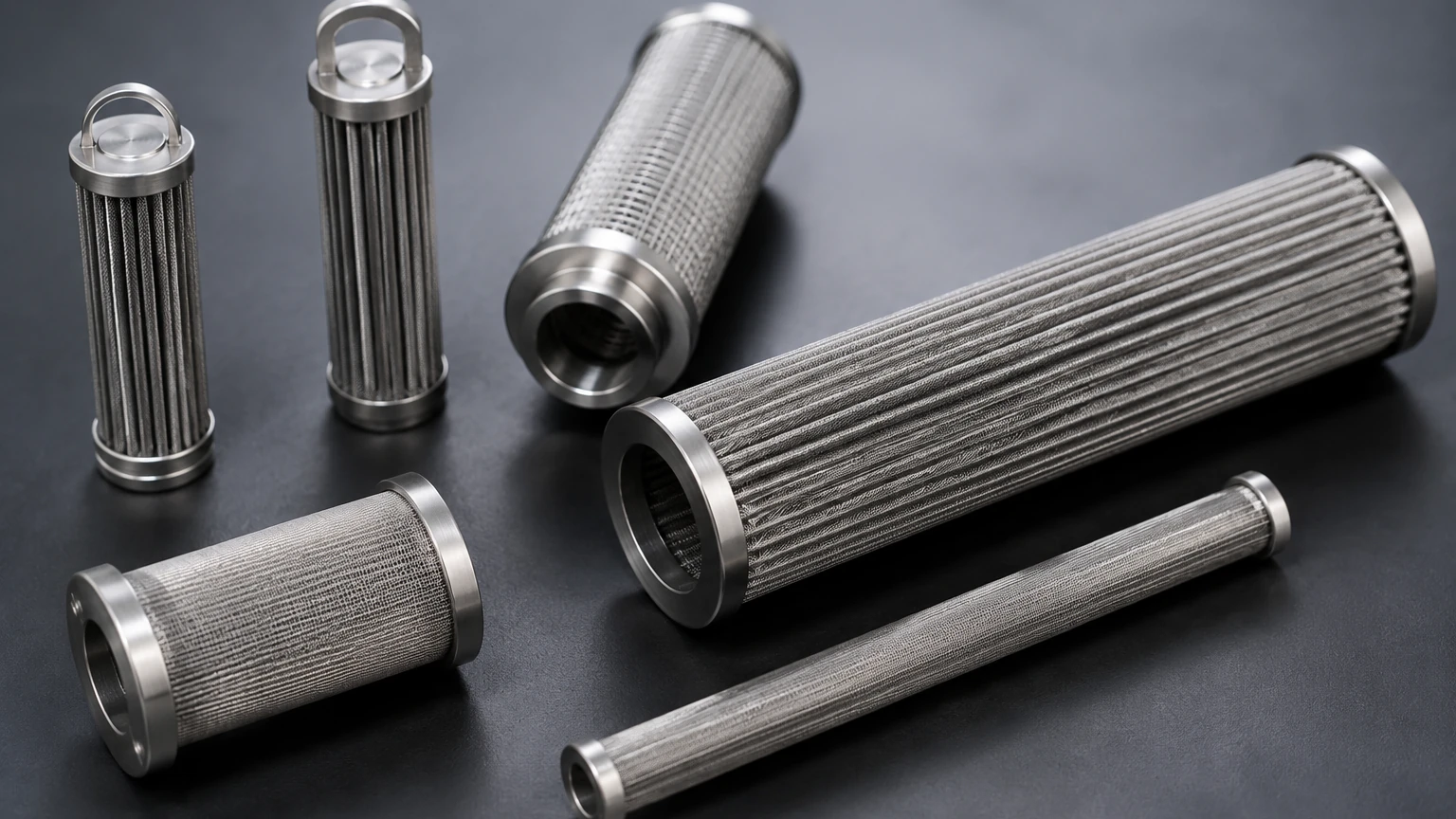
Comparing String Filters with Stainless Steel Solutions
For many B2B operations, the choice between disposable string water filters and permanent stainless steel filtration is a balance of upfront capital expenditure versus long-term operational efficiency.
| Feature | String-Wound Filters | Stainless Steel Filters (Kaifil) |
| :— | :— | :— |
| Initial Cost | Low | High |
| Reusability | Disposable | Cleanable and Reusable |
| Temperature Limit | Limited by fiber (max ~750°F) | High (up to 1000°F+) |
| Filtration Accuracy | Nominal | Absolute and Nominal |
| Chemical Resistance | Variable by material | Excellent (304/316L) |
| Structural Integrity | Moderate (subject to collapse) | Superior (high Delta P resistance) |
In applications involving high temperatures, aggressive solvents, or where the cost of filter disposal and downtime for replacement is prohibitive, stainless steel components provide a lower total cost of ownership. Engineers looking to optimize these demanding systems can find detailed specifications on customized metal filtration at https://www.kaifil.com/.
Best Practices for Industrial Selection and Maintenance
To maximize the effectiveness of string water filters in an industrial setting, the following selection and maintenance protocols should be implemented:
1. Proper Sizing for Flow Rate
Over-sizing the filter housing is generally preferable to under-sizing. A lower flow velocity through the media reduces the likelihood of particle shearing and unloading. It also extends the life of the cartridge by maintaining a lower initial pressure drop.
2. Monitoring Differential Pressure
Filters should never be run until they are completely clogged. Establishing a mandatory change-out pressure (e.g., 25 PSI) prevents core collapse and ensures that the downstream process is not starved of fluid. Automated pressure sensors are recommended for critical B2B lines to trigger maintenance alerts.
3. Compatibility Verification
Before switching brands or materials, verify the compatibility of the yarn, core, and any lubricants used during the winding process. In high-purity applications, "rinsing to resistivity" or pre-flushing the filters is necessary to remove any residual manufacturing debris.
4. Evaluating Total Cost of Ownership (TCO)
While the unit price of a string filter is low, the cumulative costs of labor for replacement, disposal of contaminated media, and potential process downtime can be significant. If a facility is replacing string filters more than once a week, it is often a technical signal that a transition to a more robust filtration technology, such as the precision metal solutions offered by Kaifil, is required.
Conclusion
String water filters remain a foundational component in industrial filtration due to their effective depth-loading capabilities and material versatility. By understanding the relationship between winding patterns, material properties, and operational limits, engineers can effectively utilize these filters for sediment control and pre-filtration. However, as process requirements become more demanding in terms of temperature, pressure, and purity, the limitations of disposable yarn media become apparent. In such cases, integrating durable stainless steel filtration components ensures long-term reliability and consistent performance in the most challenging industrial environments.
