


String Wound Filter vs Polypropylene
In industrial liquid processing, selecting the correct sediment filter is a fundamental decision that impacts downstream equipment longevity, product purity, and total operational costs. Two of the most ubiquitous options in depth filtration are string wound filters and polypropylene (melt-blown) filters. While both serve the primary function of removing suspended solids, their manufacturing processes, structural integrity, and performance under pressure differ significantly.
For engineers and procurement specialists, understanding the nuances of string wound filter vs polypropylene is essential for optimizing filtration systems. This guide provides a technical analysis of these two filter types, evaluating their construction, efficiency, and suitability for various industrial applications.
Understanding the Fundamentals of Depth Filtration
Both string wound and polypropylene melt-blown filters belong to the category of depth filtration. Unlike surface filters (such as membranes or fine wire mesh) that trap particles on a single plane, depth filters capture contaminants throughout the entire thickness of the filter media. This is achieved through a "tortuous path" where fluid must navigate a complex web of fibers, allowing for high dirt-holding capacity.
In a typical industrial setup, these filters act as pre-filters. By removing larger particulate matter, they protect more expensive secondary filtration stages, such as reverse osmosis (RO) membranes or high-precision Main Page components. However, the mechanism by which they create this depth varies, leading to distinct performance profiles.
String Wound Filters: Construction and Performance Characteristics
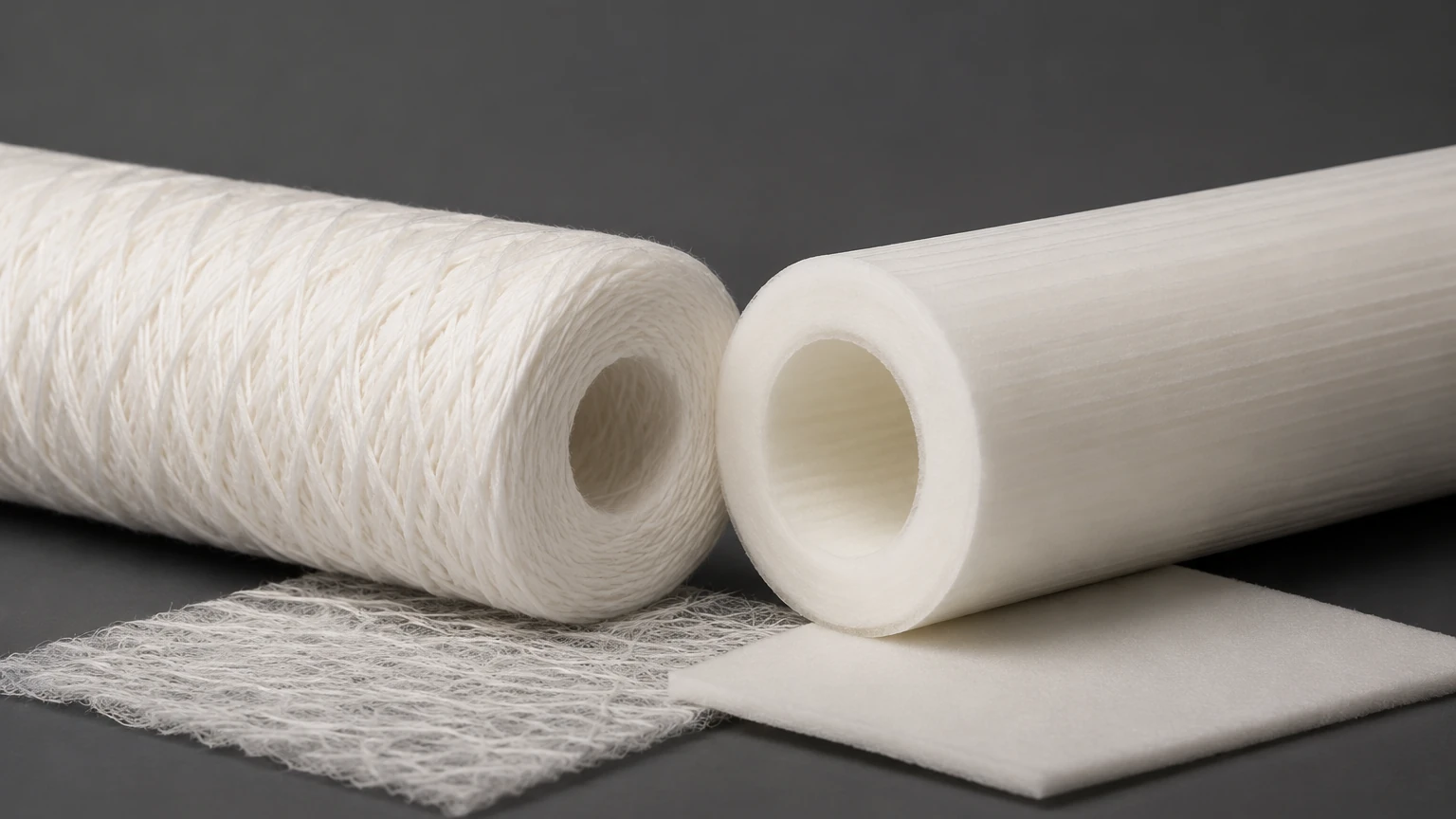
String wound filters are manufactured by winding specialized yarn around a central support core. The winding process is controlled by a computer-aided pattern that creates diamond-shaped openings. As the yarn is layered, the density increases toward the core, theoretically creating a graded pore structure.
Material Versatility
One of the primary advantages of string wound filters is the diversity of materials available. While polypropylene yarn is common, they can also be manufactured using cotton, glass fiber, or polyester. The internal core can be made of polypropylene for general use or stainless steel for high-temperature and high-pressure environments.
Performance Limitations
Despite their long history in the industry, traditional string wound filters face several engineering challenges:
1. Media Migration: Because the filter is made of wound yarn, individual fibers can break loose and enter the effluent stream, a phenomenon known as media migration. This is a significant concern in pharmaceutical or food and beverage applications.
2. Channeling and Bypass: Under high differential pressure, the yarn can shift or stretch. This creates "channels" that allow unfiltered liquid and large particles to bypass the media entirely.
3. Chemical Consistency: Some yarns require lubricants or anti-static agents during the spinning process, which may leach into the process fluid unless the filter is specifically washed and certified.
Polypropylene Melt-Blown Filters: Engineering and Efficiency
Polypropylene melt-blown filters are produced through a continuous extrusion process. Molten polypropylene resin is blown with high-velocity air onto a rotating mandrel, creating a self-bonded web of microfibers. This process requires no binders, resins, or lubricants, resulting in a highly pure filter cartridge.
True Graded Density
Modern melt-blown filters are engineered with a true graded density. The outer layers have a larger pore structure to capture coarse particles, while the inner layers become progressively denser to trap finer contaminants. This structural integrity ensures that the filter does not compress easily under increasing pressure, maintaining its micron rating throughout its service life.
Structural Stability
Because the fibers are thermally bonded, melt-blown filters are far less susceptible to media migration and channeling than string wound alternatives. The rigid structure allows for a more consistent pressure drop and predictable filtration efficiency, which is critical for precision industrial processes.
Critical Comparison: String Wound Filter vs Polypropylene
When evaluating string wound filter vs polypropylene, several technical metrics must be considered to determine the best fit for a specific installation.
1. Filtration Efficiency and Micron Rating
String wound filters are generally considered "nominal" filters. A 5-micron string wound filter might only capture 60% to 85% of 5-micron particles. In contrast, high-quality polypropylene melt-blown filters offer higher nominal efficiency and, in some cases, can approach absolute ratings. For applications where consistent particle size control is mandatory, polypropylene melt-blown is the superior choice.
2. Dirt-Holding Capacity
Historically, string wound filters were praised for their dirt-holding capacity due to the large voids created by the diamond pattern. However, advancements in melt-blown technology, specifically multi-zone density construction, have allowed polypropylene filters to match or exceed the dirt-holding capacity of string wound filters by utilizing the entire depth of the media more effectively.
3. Pressure Drop and Flow Rates
String wound filters often exhibit a lower initial pressure drop because of their more open structure. However, as they load with contaminants, the lack of structural rigidity can lead to a rapid increase in differential pressure. Polypropylene filters provide a more linear and predictable pressure drop curve, which simplifies system monitoring and maintenance scheduling.
4. Chemical and Thermal Compatibility
If the application involves high temperatures (exceeding 140°F/60°C) or aggressive solvents, a standard polypropylene melt-blown filter may fail. In these specific instances, a string wound filter with a stainless steel core and glass fiber or cotton media might be selected. However, for standard aqueous and many chemical applications at ambient temperatures, the chemical resistance of pure polypropylene is excellent.
Selection Criteria for Industrial Applications
Choosing between these two technologies requires an analysis of the specific process requirements. Engineers should confirm the following before finalizing a procurement decision:
* Fluid Compatibility: Does the liquid contain solvents that might degrade polypropylene? If so, are alternative yarn materials like glass fiber required?
* Purity Requirements: Is media migration acceptable? In food, beverage, or electronics manufacturing, the thermal bonding of a melt-blown filter is usually required to prevent fiber shedding.
* Pressure Stability: Will the system experience pressure surges? String wound filters are prone to unloading trapped contaminants during pressure spikes, whereas melt-blown filters maintain their structure better.
* Total Cost of Ownership: While string wound filters often have a lower unit price, the increased frequency of replacement and the risk of downstream contamination can make them more expensive in the long run compared to high-efficiency polypropylene cartridges.
The Role of Stainless Steel in High-Demand Environments
While this comparison focuses on disposable polymer-based filters, many industrial environments eventually reach the limits of what string wound or polypropylene media can handle. In applications involving extreme temperatures, high viscosity, or high-pressure differentials, disposable filters often collapse or require replacement so frequently that they become a bottleneck.
In these scenarios, transitioning to permanent, cleanable stainless steel filtration components is the most cost-effective engineering solution. Stainless steel wire mesh and sintered metal filters provide absolute filtration ratings, zero media migration, and the ability to be cleaned and reused hundreds of times. For facilities looking to optimize their filtration train beyond the capabilities of disposable cartridges, exploring custom metal filtration solutions is a logical next step.
Conclusion: Making an Informed Procurement Decision
The debate of string wound filter vs polypropylene often comes down to a balance between initial cost and performance reliability. String wound filters remain a viable, low-cost option for non-critical sediment removal where some degree of bypass or fiber shedding is tolerable. However, for modern industrial processes that demand high purity, consistent efficiency, and structural integrity, polypropylene melt-blown filters are typically the preferred standard.
By carefully assessing the particle size distribution of the influent, the chemical nature of the fluid, and the sensitivity of downstream components, engineers can select the filtration technology that provides the best protection for their system. Whether utilizing high-performance disposables or upgrading to robust stainless steel filtration, the goal remains the same: achieving reliable, repeatable, and cost-effective separation performance.
