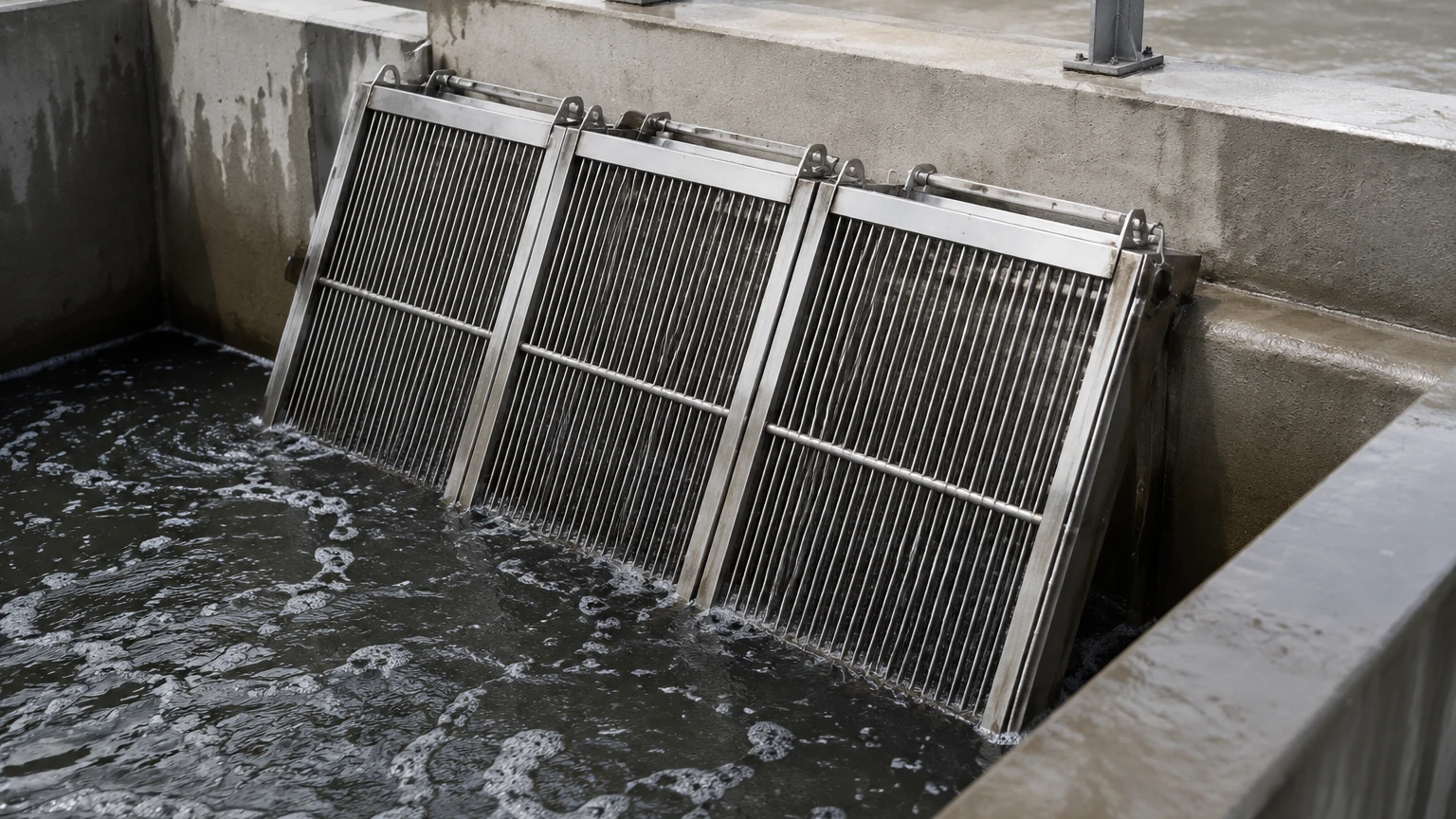
Wastewater Bar Screens
In the context of industrial and municipal wastewater treatment, the preliminary treatment phase is critical for protecting downstream equipment and ensuring the efficiency of biological and chemical processes. Wastewater bar screens serve as the primary mechanical barrier, designed to remove large solids, debris, and inorganic materials from the influent stream. For engineers and facility managers, selecting the appropriate screening technology involves a complex evaluation of hydraulic capacity, material durability, and filtration precision. As a specialized manufacturer of stainless steel filtration solutions, Kaifil provides the technical components and engineering expertise required to optimize these systems for demanding environments.
The Role of Preliminary Treatment in Wastewater Management
Wastewater bar screens are the first line of defense in a treatment plant. Their primary function is to prevent large objects—such as rags, plastics, wood, and stones—from entering pumps, pipes, and sensitive treatment units like membrane bioreactors (MBR) or aeration tanks. Failure to effectively screen these materials leads to mechanical damage, clogging, and increased maintenance costs.
The screening process is categorized by the size of the openings and the method of cleaning. While the concept of a bar screen is straightforward, the engineering behind it must account for variable flow rates, the nature of the debris, and the specific requirements of the subsequent treatment stages. High-quality filtration components, such as those found on the Main Page, are essential for maintaining the structural integrity of these screens under heavy hydraulic loads.
Categorization: Coarse vs. Fine Wastewater Bar Screens
Industrial filtration requirements typically dictate the use of either coarse or fine screens, or a combination of both in a multi-stage configuration.
Coarse Screens
Coarse screens, often referred to as trash racks, typically feature openings ranging from 6 mm to 150 mm (0.25 inches to 6 inches). These are used to capture large debris that could cause immediate mechanical failure in pumps. They are often installed at the headworks of a plant and may be manually or mechanically cleaned. The bars are usually rectangular or circular in cross-section, spaced to allow high flow rates with minimal head loss.
Fine Screens
Fine screens utilize openings smaller than 6 mm. These are increasingly common in modern facilities that utilize advanced treatment technologies like MBRs, where even small fibers can cause significant operational issues. Fine screens often employ specialized media, such as wedge wire, perforated plates, or precision-woven wire mesh. Because fine screens are more prone to blinding (clogging), they almost always require automated mechanical cleaning systems, such as brushes or high-pressure spray washes.
Engineering Parameters: Calculating Flow and Head Loss
When specifying wastewater bar screens, engineers must prioritize hydraulic performance. The two most critical factors are the approach velocity and the resulting head loss.
1. Approach Velocity: The velocity of the wastewater as it reaches the screen should be high enough to keep solids in suspension (typically above 0.4 m/s) but low enough to prevent debris from being forced through the screen openings (usually below 0.9 to 1.2 m/s during peak flow).
2. Head Loss: Head loss is the difference in the water level upstream and downstream of the screen. It is a function of the screen's open area, the accumulation of debris, and the flow velocity. Excessive head loss can lead to upstream flooding or the bypass of untreated wastewater. Engineers use the Bernoulli equation and specific discharge coefficients to calculate the expected head loss for different bar profiles (e.g., rectangular bars vs. teardrop-shaped bars).
Material Selection: The Case for Stainless Steel Components
The environment within a wastewater treatment plant is highly corrosive. The presence of hydrogen sulfide (H2S), chlorides, and varying pH levels necessitates materials that can withstand long-term exposure without structural degradation.
Stainless steel is the industry standard for high-performance wastewater bar screens. Kaifil specializes in the fabrication of custom stainless steel filtration components, typically utilizing Grade 304 or Grade 316L.
* Grade 304: Suitable for standard municipal wastewater applications with moderate corrosive potential.
* Grade 316L: Recommended for industrial wastewater, coastal environments, or facilities with high chloride concentrations. The addition of molybdenum provides superior resistance to pitting and crevice corrosion.
Beyond corrosion resistance, stainless steel offers the structural rigidity required to withstand the physical impact of heavy debris and the mechanical stresses of automated raking systems. Precision manufacturing ensures that the gap between bars remains consistent, which is vital for maintaining the rated filtration accuracy.
Mechanical Cleaning Mechanisms
In most B2B and industrial applications, manual cleaning is insufficient due to the volume of debris and labor costs. Mechanically cleaned wastewater bar screens are categorized by their movement and cleaning action:
* Climbing Screens: Use a rake mechanism that travels up the face of the screen to lift debris to a discharge point. These are robust and suitable for deep channels.
* Catenary Screens: Feature a chain-driven rake that follows a catenary curve, allowing the rake to engage the bars without the need for underwater sprockets or bearings, reducing maintenance in submerged environments.
* Step Screens: Consist of two sets of thin, stepped plates (one fixed, one movable). The movable plates lift the solids up the "steps" with each cycle. These are highly effective for fine screening.
* Continuous Belt Screens: Utilize a continuous loop of screen panels or elements. These are excellent for high-solids loading but require careful maintenance of the drive system.
Customization and Manufacturing Precision in Filtration
No two wastewater treatment applications are identical. Factors such as channel width, depth, peak flow, and the specific characteristics of the waste stream require customized filtration solutions.
As a professional manufacturer, Kaifil supports engineers by providing customized wire mesh and precision metal filter components that serve as the functional core of these screening systems. Whether the design requires specific wedge wire profiles to minimize blinding or reinforced mesh for high-pressure applications, customization ensures that the screen performs according to the specific hydraulic modeling of the project. For more information on available materials and custom fabrication capabilities, professionals can review the technical resources on the Main Page.
Operational Lifecycle and Maintenance Requirements
The total cost of ownership (TCO) for wastewater bar screens is heavily influenced by maintenance cycles and the durability of the screen media. A screen that is prone to bending or corrosion will require frequent part replacements and may lead to downstream equipment failure.
Key maintenance considerations include:
* Lubrication: Mechanical drive components (chains, bearings, motors) require regular lubrication, unless designed for submerged, non-lubricated operation.
* Rake Alignment: For raked screens, ensuring the rake teeth accurately engage the bar gaps is essential to prevent "comb-out" or damage to the bars.
* Media Inspection: Regular inspection of the stainless steel bars or mesh for signs of abrasion or localized corrosion. In many cases, individual filter cartridges or screen segments can be replaced rather than the entire unit, provided the system was designed with modularity in mind.
* Washwater Pressure: For fine screens using spray bars, maintaining the correct water pressure is vital to ensure that the media is fully cleaned during each cycle, preventing the buildup of fats, oils, and grease (FOG).
Conclusion
Wastewater bar screens are foundational to the operational success of any water treatment facility. By selecting the right screening technology—balancing coarse and fine filtration with durable stainless steel construction—engineers can significantly reduce operational risks and extend the life of downstream machinery. The integration of precision-engineered components, such as those manufactured by Kaifil, ensures that these systems meet the rigorous demands of modern industrial processing.
When evaluating filtration solutions, it is essential to confirm the material grades, hydraulic capacity, and customization options available. For a deeper look at industrial filtration components and to discuss specific project requirements, visit the Main Page to connect with technical experts who can assist in the selection and design process.