


Wastewater Treatment Filters
In industrial operations, the management of effluent and process water is a critical engineering challenge. Wastewater treatment filters serve as the primary line of defense in removing suspended solids, protecting downstream equipment, and ensuring compliance with environmental regulations. Unlike municipal systems, industrial wastewater often contains high concentrations of abrasive particles, corrosive chemicals, and varying thermal loads, necessitating robust filtration solutions that can withstand demanding conditions without frequent failure.
Selecting the appropriate filtration technology requires a deep understanding of fluid dynamics, material science, and the specific contaminants present in the waste stream. For engineers and procurement teams, the objective is to balance filtration efficiency with operational longevity and maintenance costs. This guide examines the technical considerations, material requirements, and selection criteria for industrial wastewater treatment filters.
Engineering Fundamentals of Industrial Wastewater Filtration
The primary function of wastewater treatment filters in an industrial context is the mechanical separation of solids from a liquid carrier. This process is typically categorized into primary, secondary, and tertiary stages. Metal-based filtration components, such as those manufactured by Kaifil, are most frequently utilized in stages where durability and precision are paramount.
Material Selection: 304 vs. 316L Stainless Steel
Material selection is the most significant factor in determining the service life of a filter. Industrial wastewater can be highly acidic, alkaline, or rich in chlorides, which can lead to pitting or stress corrosion cracking in inferior materials.
* Grade 304 Stainless Steel: Suitable for general-purpose applications where the wastewater is relatively neutral and lacks high chloride concentrations. It offers excellent mechanical strength and cost-effectiveness for standard industrial runoff.
* Grade 316L Stainless Steel: The "L" denotes low carbon, which improves weldability and resistance to intergranular corrosion. The addition of molybdenum makes 316L essential for wastewater containing salts, acids, or harsh chemical cleaning agents commonly found in the pharmaceutical and chemical processing industries.
Structural Integrity and Pressure Management
Filters must be engineered to withstand significant differential pressure (ΔP). As solids accumulate on the filter surface, the resistance to flow increases. If a filter element lacks sufficient structural reinforcement, the pressure can cause the mesh to deform or the cartridge to collapse. High-quality wastewater treatment filters utilize reinforced cores and precision-welded seams to maintain integrity under peak load conditions.
Types of Metal Filtration Media for Wastewater
Different industrial applications require different media structures to achieve the desired level of clarity. The choice between surface filtration and depth filtration depends on the particle size distribution and the nature of the solids being removed.
Stainless Steel Wire Mesh
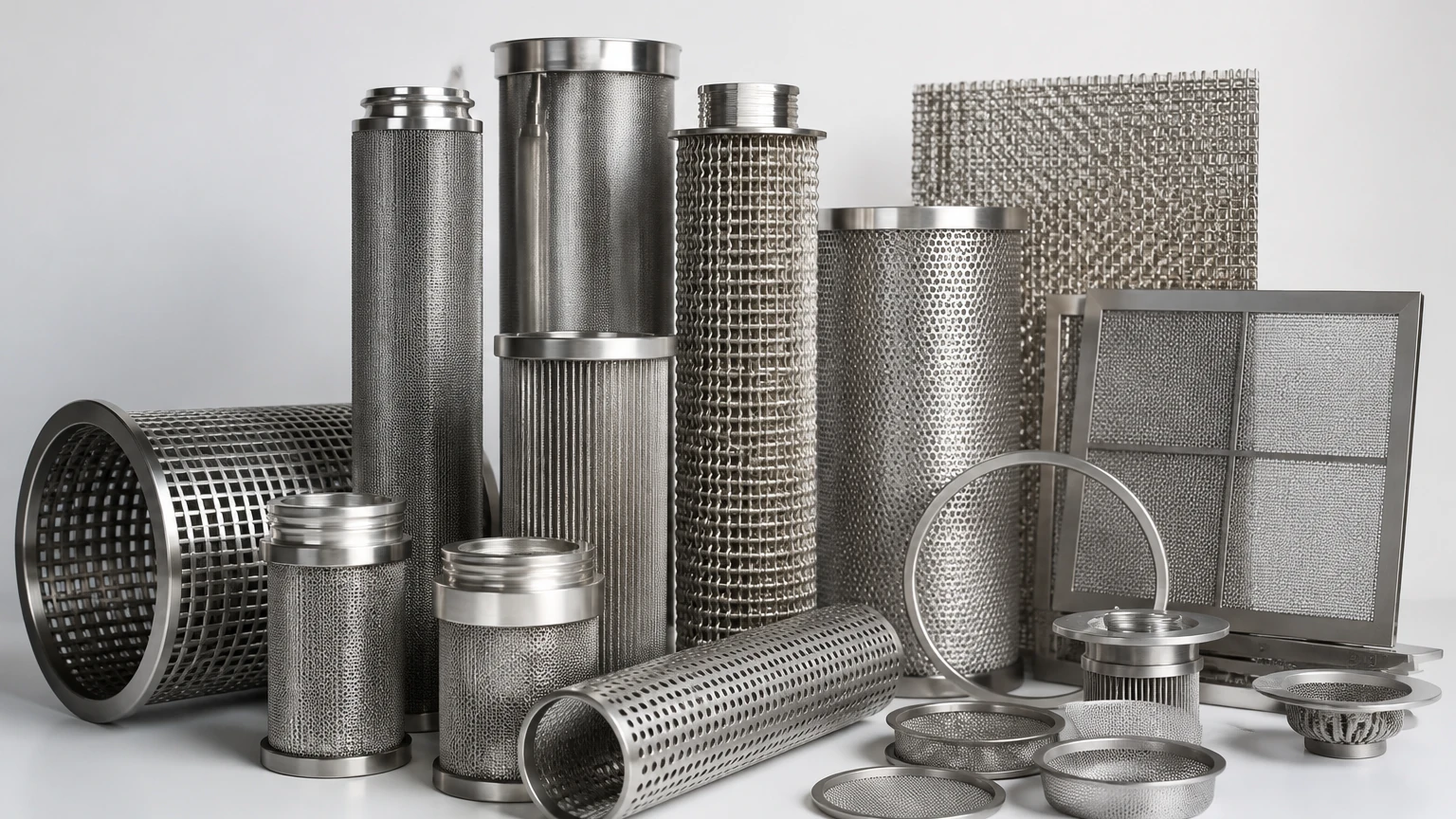
Wire mesh filters are characterized by their precise pore sizes and high open-area ratios. They are ideal for surface filtration where particles are larger than the mesh openings. In wastewater applications, woven wire mesh is often used in strainers and basket filters for the removal of grit and large debris. Its primary advantage is the ease of cleaning; most mesh filters can be backwashed or ultrasonically cleaned for reuse.
Sintered Metal Filter Elements
Sintered filters are created by fusing multiple layers of wire mesh or metal powders under high heat and pressure. This creates a porous, rigid structure that offers exceptional depth filtration capabilities. Sintered wastewater treatment filters are used when high-precision filtration (down to sub-micron levels) is required or when the filter must operate under extreme temperatures that would degrade polymer-based media.
Wedge Wire Screens
Wedge wire is a specialized filtration medium consisting of V-shaped profiles resistance-welded onto support rods. This design is particularly effective in wastewater treatment because the V-shaped opening narrows toward the outside, creating a "non-clogging" effect. It is widely used in rotating drum screens and static sieves for heavy-duty solids separation.
Performance Evaluation and Micron Ratings
When specifying wastewater treatment filters, engineers must distinguish between nominal and absolute micron ratings. A nominal rating indicates the filter's ability to retain a major percentage of particles of a certain size, while an absolute rating refers to the diameter of the largest hard spherical particle that will pass through the filter under specified test conditions.
Flow Rate and Flux
The flux—defined as the volume of fluid passing through a unit area of filter media per unit of time—is a critical metric. In wastewater systems, high flux rates can lead to "blinding" or premature clogging if the filter surface area is insufficient for the solids loading. Increasing the surface area through pleated designs is a common engineering solution to maintain high flow rates while extending the time between cleaning cycles.
Filtration Efficiency and Particle Size Distribution (PSD)
Before selecting a filter, a PSD analysis of the wastewater is recommended. If the majority of contaminants are 50 microns in size, using a 5-micron filter will lead to unnecessary pressure drops and frequent maintenance. The goal is to select a micron rating that protects downstream components without over-specifying, which increases the total cost of ownership.
Operational Challenges: Fouling and Cleaning
In wastewater environments, filters are subject to various types of fouling, including biological growth (biofouling), chemical scaling, and physical plugging. Understanding these risks is essential for developing a maintenance schedule.
Backwashing and Automated Cleaning
To minimize downtime, many industrial wastewater treatment filters are integrated into self-cleaning systems. These systems monitor the differential pressure across the filter. Once a predetermined threshold is reached, the system triggers a backwash cycle, where a portion of the filtered fluid (or compressed air) is sent in the reverse direction to dislodge the filter cake. Metal filters are uniquely suited for this because they can withstand the mechanical stresses of high-pressure backpulsing.
Chemical Compatibility and CIP (Clean-in-Place)
In industries like food and beverage or pharmaceuticals, filters must be sanitized regularly. Stainless steel wastewater treatment filters are compatible with a wide range of caustic and acidic cleaning agents used in CIP protocols. This allows the filters to be cleaned without removal from the housing, significantly reducing labor costs and the risk of contamination during handling.
Total Cost of Ownership (TCO) in Industrial Filtration
The initial purchase price of a filter is only a fraction of its total lifetime cost. When evaluating wastewater treatment filters, procurement teams should consider the following:
1. Replacement Frequency: While polymer filters may have a lower upfront cost, they are often disposable. Stainless steel filters, though more expensive initially, can be cleaned and reused for years, providing a lower cost-per-liter of treated water over time.
2. Energy Consumption: A filter that clogs quickly or operates at a high differential pressure requires more pump energy. Selecting a filter with optimized open area and flow characteristics reduces the electrical load on the system.
3. Disposal Costs: Disposable filter cartridges contribute to industrial waste streams and may require specialized disposal if they have captured hazardous materials. Permanent metal filters eliminate this waste stream.
4. Downtime Protection: High-quality filters reduce the risk of bypass or failure, which could otherwise lead to the contamination of expensive downstream membranes (like Reverse Osmosis units) or the violation of discharge permits.
Customization and OEM Capabilities
Standard off-the-shelf filters rarely meet the specific needs of complex industrial wastewater plants. Customization is often required to fit existing housing dimensions, accommodate unusual flow rates, or handle specific chemical compositions.
As a professional manufacturer, Kaifil specializes in developing custom stainless steel filtration solutions. From selecting the appropriate weave pattern for a wire mesh filter to engineering high-pressure sintered cartridges, Kaifil works with engineering teams to ensure that the filtration component is optimized for the specific application. For more information on custom designs and technical specifications, visit the Main Page to review product options and application support.
Application-Specific Considerations
Chemical and Petrochemical Processing
In these environments, wastewater often contains hydrocarbons and aggressive solvents. Filters must be resistant to swelling and chemical degradation. Stainless steel 316L or higher alloys are typically mandated to ensure safety and performance.
Food and Beverage Industry
Filtration in this sector focuses on removing organic solids and ensuring that the filter media itself does not leach any substances into the water. Compliance with food-grade standards and the ability to withstand frequent steam sterilization are key requirements for wastewater treatment filters in this industry.
Pharmaceutical Manufacturing
Pharmaceutical wastewater may contain active ingredients that must be captured with high precision. Sintered metal filters provide the necessary absolute micron ratings to ensure that fine particulates are removed before the water reaches the treatment plant or is recycled into the facility.
Conclusion
Effective wastewater treatment is a cornerstone of modern industrial efficiency and environmental stewardship. By selecting high-performance stainless steel wastewater treatment filters, engineers can ensure reliable solids separation, protect sensitive equipment, and achieve a sustainable balance between performance and cost. Whether the requirement is for a standard wire mesh strainer or a highly customized sintered metal cartridge, understanding the technical nuances of material selection, pressure management, and cleaning protocols is essential for making an informed purchasing decision. For organizations seeking precision-engineered filtration components, partnering with an experienced manufacturer ensures that the final product meets the rigorous demands of industrial wastewater applications.
