


Wedge Wire
In the landscape of industrial filtration and separation, wedge wire stands as one of the most robust and efficient media available. Characterized by its unique V-shaped profile wire and high-precision construction, this technology is a staple in sectors where durability, precision, and low maintenance are non-negotiable. For engineers and procurement specialists, understanding the technical nuances of wedge wire—from its geometric properties to its mechanical performance under pressure—is essential for optimizing process efficiency and reducing long-term operational costs.
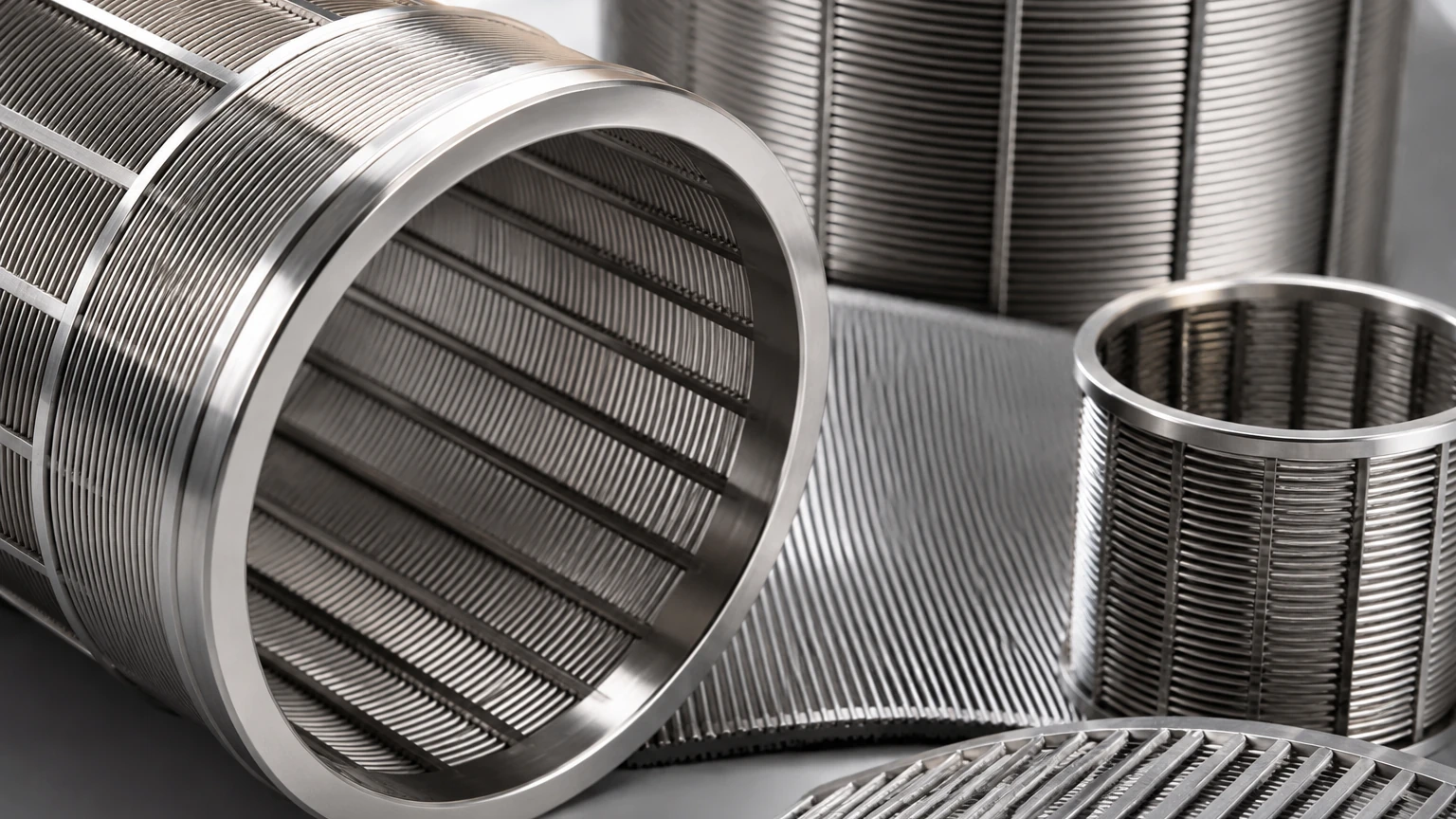
At its core, wedge wire is a metallic screen manufactured by resistance-welding V-shaped stainless steel wires onto support rods at each intersection. This process creates a continuous slot that widens inwardly, a design feature that fundamentally distinguishes it from traditional woven wire mesh or perforated plate. As a specialized manufacturer, Kaifil provides these precision-engineered components to meet the rigorous demands of chemical, pharmaceutical, and food processing industries.
The Engineering Principles of Wedge Wire Geometry
The primary advantage of wedge wire lies in its geometric configuration. The "wedge" or V-shaped profile is oriented so that the narrowest part of the slot is at the filtration surface. As particles pass through the slot, the opening immediately widens. This design is intentionally engineered to prevent "blinding" or clogging. In traditional square-mesh filters, a particle that is slightly larger than the aperture can become wedged in the opening, eventually restricting flow. In contrast, with wedge wire, any particle that passes the surface aperture will easily clear the rest of the screen.
Slot Opening Precision
The gap between the profile wires, known as the slot opening, determines the filtration rating. Unlike woven mesh, which can suffer from wire displacement under high pressure, the resistance-welded joints of wedge wire ensure that the slot width remains constant across the entire surface. This precision allows for consistent particle retention, which is critical in applications such as resin traps in water treatment or catalyst recovery in petrochemical processing.
Open Area and Flow Efficiency
The ratio of the total slot area to the total screen surface area is referred to as the "open area." Engineers must balance the required filtration fineness (slot width) with the need for high flow rates. A larger open area reduces the pressure drop across the filter, which in turn lowers energy consumption for pumps and increases the time between cleaning cycles. Because wedge wire can be customized with various wire profiles and support rod spacings, it offers a higher degree of hydraulic efficiency compared to many other filter media.
Material Selection and Structural Integrity
Industrial filtration environments are often characterized by corrosive fluids, high temperatures, and significant mechanical stress. Consequently, material selection is a primary consideration in the specification of wedge wire components.
Stainless Steel Grades
Most high-performance wedge wire is manufactured from stainless steel due to its inherent corrosion resistance and mechanical strength.
- SS304: Suitable for general industrial applications where moderate corrosion resistance is required.
- SS316L: The preferred choice for marine environments, chemical processing, and pharmaceutical applications. The addition of molybdenum and lower carbon content provides superior resistance to pitting and crevice corrosion.
- Duplex Stainless Steels: Utilized in highly aggressive environments where both high strength and exceptional resistance to stress corrosion cracking are required.
Mechanical Strength and Pressure Resistance
Unlike flexible filter media, wedge wire is a rigid structural component. The support rods provide the necessary framework to withstand high differential pressures. During the design phase, engineers must calculate the collapse strength and burst pressure based on the flow direction and the expected solids loading. By adjusting the frequency and diameter of the support rods, manufacturers can tailor the screen to handle extreme mechanical loads without deforming, ensuring the longevity of the filtration system.
Flow Directions and Configuration Types
Wedge wire can be fabricated into various shapes and configurations depending on the equipment it is intended for. The direction of flow relative to the V-shape is a critical technical specification.
FITO vs. FOTI Configurations
- FITO (Flow In-To-Out): In this configuration, the V-shaped wire is on the inside of the cylinder, with the flat surface facing inward. This is commonly used in centrifugal separators or internal pressure filters where solids accumulate on the interior surface.
- FOTI (Flow Out-To-In): This is the most common configuration for filter cartridges. The V-shaped wire is on the outside, creating a smooth external surface for filtration. This setup is ideal for backwashing, as the cleaning fluid can easily dislodge the filter cake from the smooth outer surface.
Common Fabricated Forms
Beyond simple cylinders, wedge wire is versatile enough to be formed into:
1. Flat Panels: Used in vibrating screens and flooring for drainage.
2. Sieve Bends: Curved screens used in mineral processing and wastewater treatment to utilize gravity and centrifugal force for separation.
3. Conical Baskets: Frequently found in centrifuges for dewatering applications.
4. Nozzles and Laterals: Used in the bottom of ion exchange tanks to ensure even distribution of flow while retaining resin beads.
Performance Evaluation and Selection Criteria
When selecting wedge wire for a specific project, engineers must move beyond basic dimensions and consider the total performance profile. To assist in this process, reviewing technical resources on the Main Page can provide deeper insights into specific product capabilities.
Micron Rating and Particle Distribution
While wedge wire is often specified by slot width in millimeters or inches, it is important to correlate this to the micron rating required for the process. Because the slots are continuous, wedge wire is exceptionally effective at removing elongated or fibrous particles that might otherwise pass through a square mesh. Engineers should analyze the particle size distribution (PSD) of the influent to determine the optimal slot size that maximizes retention without causing excessive pressure buildup.
Surface Finish and Friction
In applications involving food, beverage, or pharmaceutical production, the surface finish of the wedge wire is paramount. Electropolishing or mechanical polishing can be applied to reduce surface roughness. A smoother surface not only meets sanitary standards but also reduces the friction coefficient, allowing for better flow and easier removal of sticky or viscous filter cakes.
Maintenance, Cleaning, and Total Cost of Ownership
One of the most compelling arguments for adopting wedge wire technology is the reduction in long-term operational costs. While the initial capital expenditure may be higher than that of disposable or woven mesh filters, the "Total Cost of Ownership" (TCO) is often significantly lower.
Backwashing and In-Place Cleaning
Wedge wire is uniquely suited for automated self-cleaning systems. Because the slots widen inwardly, a reverse flow of fluid (backwashing) or a mechanical scraper can efficiently remove the accumulated solids. This capability eliminates the need for frequent manual intervention and reduces the downtime associated with filter changes. In many high-volume industrial processes, the ability to clean the filter in-place (CIP) is essential for maintaining continuous production.
Durability and Replacement Cycles
Disposable filter cartridges represent a recurring cost and a waste stream. In contrast, a well-engineered stainless steel wedge wire element can last for years, even in abrasive environments. The resistance to mechanical wear and chemical degradation means that the replacement cycle is measured in years rather than weeks. This durability also ensures that the filtration performance remains consistent over time, whereas woven meshes may stretch or tear, leading to bypass and contamination.
Confirming Specifications for Procurement
Before finalizing a purchase or design specification, technical teams should confirm several key data points with the manufacturer to ensure the component is fit for purpose:
- Maximum Differential Pressure: What is the maximum pressure the screen will encounter before cleaning, and can the support structure handle it?
- Chemical Compatibility: Is the selected alloy resistant to all chemicals in the process stream, including cleaning agents?
- End Fittings and Integration: Does the design include the necessary flanges, threads, or gaskets for seamless integration into existing housing?
- Flow Rate Requirements: Has the open area been calculated to ensure that the process flow is not throttled?
By addressing these engineering considerations early in the design phase, purchasing teams can avoid costly retrofits and ensure that the filtration system operates at peak efficiency from day one. Kaifil’s expertise in custom stainless steel filtration solutions provides the technical foundation necessary for these demanding industrial applications, offering reliable OEM support and precision manufacturing for global clients.
In summary, wedge wire is more than just a screening medium; it is a precision-engineered tool designed to solve complex separation challenges. Its non-clogging geometry, structural strength, and ease of cleaning make it the gold standard for industries that cannot afford process interruptions or inconsistent product quality. Whether for water treatment, chemical synthesis, or food production, the strategic implementation of wedge wire technology is a proven method for enhancing industrial performance.
