


Well Screen
In industrial water extraction, oil and gas production, and environmental monitoring, the well screen serves as the critical interface between the geological formation and the intake system. Its primary function is to permit the efficient flow of fluids—such as water, oil, or gas—into the wellbore while simultaneously excluding sand, gravel, and other formation solids. For engineers and procurement specialists, selecting the appropriate well screen is not merely a matter of sizing; it is a complex engineering decision that impacts the longevity of the well, the efficiency of the pump, and the total cost of ownership.
As a manufacturer specializing in high-performance stainless steel filtration, Kaifil understands that the reliability of a well screen depends on precise manufacturing tolerances and material integrity. This guide examines the technical specifications, selection criteria, and operational risks associated with industrial well screens to assist technical teams in making informed decisions.
The Fundamental Role of the Well Screen
A well screen is a filtering device positioned at the bottom of a well string. Its design must address two conflicting requirements: maximizing the open area to allow fluid entry with minimal pressure drop, and maintaining a physical barrier narrow enough to prevent formation migration.
When a well screen is poorly selected, the consequences are typically immediate and costly. Excessive sand ingress can lead to "sanding up" of the well, which restricts flow and can eventually bury the pump. Furthermore, abrasive particles passing through the screen cause rapid wear on pump impellers, valves, and downstream filtration components. Conversely, if the screen is too restrictive, the resulting high entrance velocity increases the rate of encrustation and mechanical stress on the screen structure.
Engineering Evaluation: Key Design Criteria
To ensure optimal performance, several engineering parameters must be evaluated during the specification phase. These factors determine the screen’s hydraulic efficiency and its ability to withstand the physical rigors of the subsurface environment.
1. Slot Size and Aperture Precision
The slot size is perhaps the most critical variable. It is determined based on a sieve analysis of the formation samples or the filter pack material. In a naturally developed well, the slot size is typically chosen to retain approximately 30% to 50% of the formation material. In a gravel-packed well, the slot size must be small enough to retain 90% or more of the gravel pack media.
Precision in manufacturing is vital. Inconsistent slot widths create localized areas of high velocity, leading to premature erosion or localized plugging. For high-demand applications, continuous-slot designs—often referred to as wedge wire screens—are preferred because their V-shaped profile provides a self-cleaning effect, allowing particles that pass the initial opening to continue through without becoming wedged.
2. Open Area and Entrance Velocity
The percentage of open area is the ratio of the total area of the openings to the total outer surface area of the screen. A higher open area reduces the entrance velocity of the fluid. Engineering standards typically recommend keeping entrance velocities below 0.1 feet per second (0.03 meters per second).
Low entrance velocities offer several technical advantages:
* Reduced Head Loss: Minimizes the energy required for pumping.
* Decreased Encrustation: Slower fluid movement reduces the rate at which dissolved minerals precipitate and clog the screen.
* Corrosion Mitigation: High-velocity flow can strip protective passive layers from stainless steel, accelerating localized corrosion.
3. Structural Integrity: Collapse and Tensile Strength
Well screens are subject to significant mechanical loads. During installation, the screen must support the weight of the entire pipe string (tensile strength). Once positioned, it must resist the lateral pressure exerted by the surrounding formation and the hydrostatic pressure of the fluid column (collapse strength).
Engineers must calculate the maximum anticipated differential pressure, especially during well development or high-drawdown pumping scenarios. Utilizing high-grade stainless steel alloys and optimizing the gauge of the support rods and surface wires are standard methods for increasing structural limits without sacrificing open area.
Material Selection for Longevity
The chemical environment of the wellbore dictates the material requirements. While carbon steel is an option for temporary or low-budget applications, industrial standards favor stainless steel due to its superior corrosion resistance and mechanical durability.
* Stainless Steel 304/304L: Suitable for most freshwater applications where chloride levels are moderate and pH is relatively neutral.
* Stainless Steel 316L: Contains molybdenum, providing enhanced resistance to pitting and crevice corrosion, making it the preferred choice for brackish water, chemical processing, and environments with higher chloride concentrations.
* Duplex Stainless Steels: Used in highly aggressive environments, such as deep-sea oil extraction or geothermal wells, where both high strength and extreme corrosion resistance are required.
By visiting the Main Page of the Kaifil website, engineers can review the specific material grades and customized configurations available for demanding industrial filtration environments.
Common Types of Well Screens
Different geological and operational conditions require specific screen architectures. Understanding the pros and cons of each type is essential for effective system design.
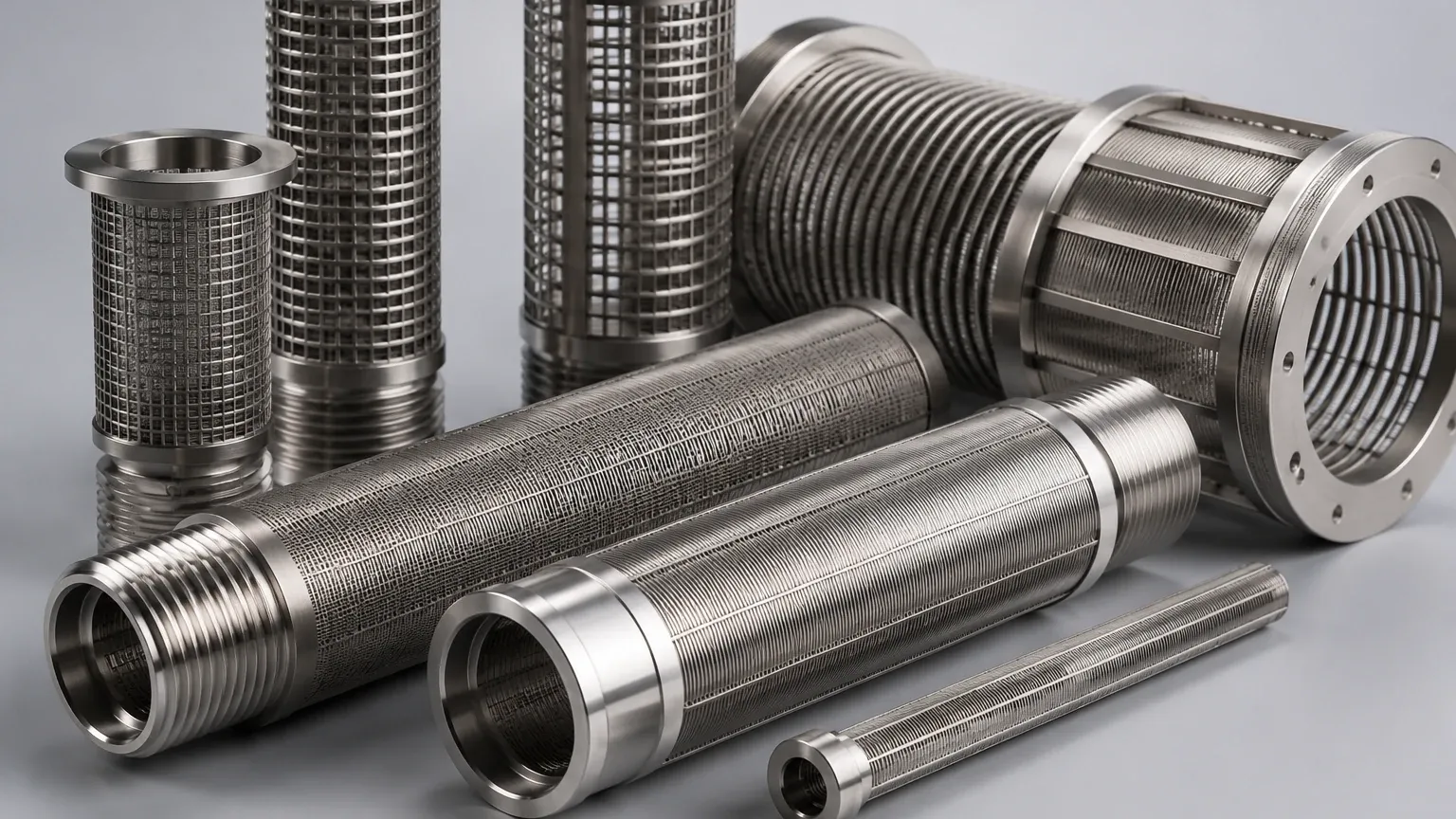
Continuous-Slot (Wedge Wire) Screens
These are manufactured by wrapping a triangular-shaped wire around a circular array of internal support rods. Each intersection is fusion-welded for maximum strength.
* Advantages: Highest open area, precise slot control, and non-clogging V-wire geometry.
* Applications: High-capacity water wells, industrial intake systems, and food/beverage processing.
Pipe-Base Well Screens
This design utilizes a perforated base pipe over which a wedge wire screen or wire mesh is wrapped. The base pipe provides the primary structural support, while the outer jacket provides the filtration.
* Advantages: Extreme collapse strength for very deep wells or high-pressure applications.
* Applications: Deep oil and gas wells, high-pressure water injection.
Slotted and Perforated Pipes
These are created by cutting slots or punching holes directly into a standard pipe.
* Advantages: Low cost and high mechanical strength.
* Disadvantages: Very low open area and high risk of clogging. They are generally unsuitable for fine-sand formations.
Operational Risks and Failure Modes
Even a well-designed well screen can fail if operational risks are not managed. Engineers should be aware of the following common issues:
1. Biofouling and Encrustation: In water wells, iron-oxidizing bacteria or calcium carbonate scales can accumulate on the screen surface. This reduces the open area and increases drawdown. Periodic chemical treatment or mechanical surging may be required to restore performance.
2. Mechanical Collapse: If the pump is operated at a rate exceeding the well's recharge capacity, the resulting pressure differential can exceed the screen's collapse rating, leading to structural failure and well loss.
3. Erosion-Corrosion: In high-velocity environments, the combination of abrasive sand particles and corrosive fluids can rapidly thin the screen wires, eventually leading to a breach in the filtration barrier.
Confirming Specifications Before Procurement
When transitioning from the design phase to procurement, technical professionals should confirm several key details with their manufacturer to ensure the product meets the site-specific requirements:
* Grain Size Distribution: Provide the sieve analysis data to the manufacturer to verify that the proposed slot size is appropriate for the formation.
* Fluid Chemistry: Disclose pH levels, chloride content, and the presence of H2S or CO2 to ensure the correct alloy selection.
* Installation Depth: Confirm the required collapse strength based on the total depth and anticipated drawdown levels.
* Connection Compatibility: Ensure the screen end-fittings (e.g., NPT threads, weld rings, or flanges) match the rest of the well casing string.
* Quality Documentation: Request material mill certificates and weld inspection reports to verify that the product meets industrial standards (such as ASTM or ISO).
Conclusion
The well screen is a vital component that determines the efficiency and lifespan of a well system. By focusing on precise slot design, material compatibility, and structural integrity, engineers can prevent the costly downtime associated with sand ingress and mechanical failure. For customized filtration solutions and technical support regarding stainless steel components, professionals can consult the Main Page for detailed product specifications and engineering guidance. Selecting a high-quality, purpose-built well screen is an investment in the long-term stability and productivity of any industrial fluid extraction project.
