


3 4 #9 Expanded Metal Thickness
In industrial engineering and filtration design, selecting the correct structural media is as critical as the filtration rating itself. Among the various specifications available, 3/4 #9 expanded metal stands out as one of the most versatile and widely utilized patterns. Understanding the nuances of 3 4 #9 expanded metal thickness—both in its standard (raised) and flattened forms—is essential for engineers who must balance structural integrity, flow dynamics, and weight constraints in demanding environments.
At Kaifil, where precision in stainless steel filtration solutions is paramount, we recognize that the physical dimensions of expanded metal serve as the foundation for durable filter cartridges and industrial strainers. This guide provides a technical deep dive into the thickness specifications, material behaviors, and engineering considerations for 3/4 #9 expanded metal.
Understanding the 3/4 #9 Specification
The nomenclature "3/4 #9" refers to a specific combination of diamond size and material weight. To accurately assess thickness, one must first understand what these numbers represent in an industrial context.
* 3/4-inch Designation: This refers to the nominal width of the diamond opening. Specifically, it relates to the Short Way of the Diamond (SWD). In a standard 3/4 #9 configuration, the actual SWD measurement is typically 0.923 inches from the center of one bond to the center of the next, while the Long Way of the Diamond (LWD) is approximately 2.00 inches.
* #9 Designation: This is a traditional gauge-style designation that indicates the thickness and weight of the metal. For carbon steel, #9 is roughly equivalent to 10-gauge material. However, when expanded, the physical properties change depending on whether the material remains in its "Standard" raised state or is processed into a "Flattened" state.
The Two Types of Thickness: Standard vs. Flattened
One of the most common points of confusion for purchasing teams and junior engineers is the difference between strand thickness and overall thickness. In the context of 3 4 #9 expanded metal thickness, these two measurements vary significantly.
Standard (Raised) Expanded Metal
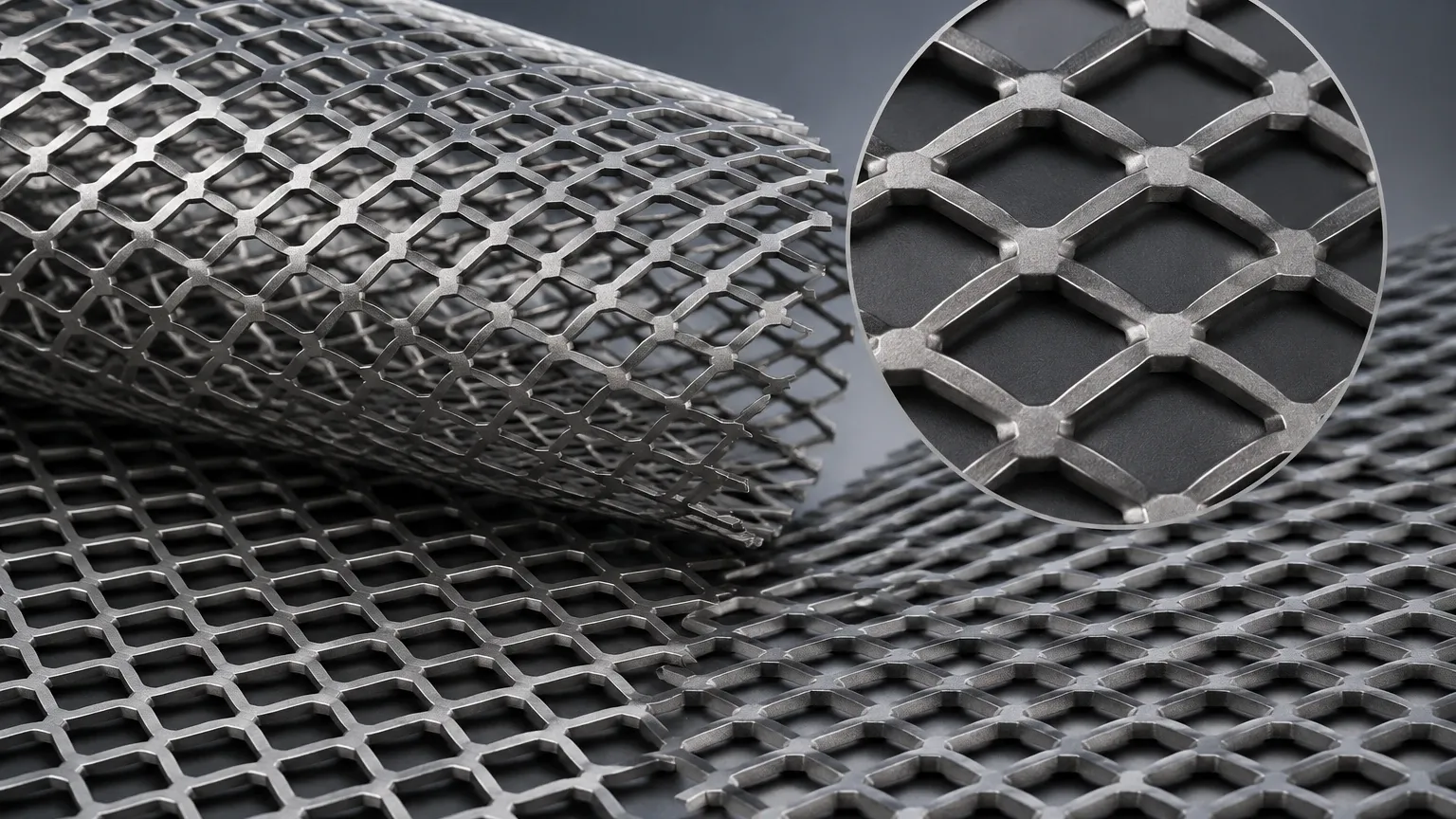
Standard expanded metal is the product as it comes off the expanding press. The strands and bonds are set at a uniform angle to the plane of the sheet. This creates a three-dimensional surface that offers high rigidity and excellent grip.
* Strand Thickness: For #9 material, the initial sheet thickness is approximately 0.134 inches (3.4mm).
* Overall Thickness: Because the strands are tilted, the total depth of the finished sheet is much greater than the thickness of the metal itself. For standard 3/4 #9, the overall thickness is approximately 0.430 inches (10.9mm). This added dimension provides significant structural depth, making it ideal for heavy-duty support in large-scale Perforated & Expanded Metal applications.
Flattened Expanded Metal
Flattened expanded metal is produced by passing standard expanded metal through a cold-roll reducing mill. This process flattens the strands and bonds into a single plane, resulting in a smooth, flush surface.
* Finished Thickness: The flattening process reduces the original thickness of the metal. For 3/4 #9 flattened expanded metal, the final thickness is typically around 0.120 inches (3.0mm).
* Engineering Trade-offs: While flattening provides a smooth surface that prevents material bypass and is easier to clean, it slightly reduces the structural rigidity compared to the raised version. It is the preferred choice for internal filter cores where a smooth interface with wire mesh is required.
Material Selection and Its Impact on Thickness
While carbon steel is the baseline for #9 specifications, industrial filtration often demands the corrosion resistance of stainless steel. Kaifil specializes in manufacturing these components from 304 and 316L stainless steel, where thickness tolerances must be strictly maintained to ensure compatibility with high-pressure hydraulic and chemical systems.
Stainless Steel Considerations
In stainless steel 3/4 #9, the thickness remains consistent with the carbon steel equivalent (approx. 0.134" for the strand), but the mechanical properties differ. Stainless steel has a higher work-hardening rate. During the expansion process, the metal becomes significantly stronger. This allows engineers to potentially use a slightly thinner gauge if weight reduction is necessary, though #9 remains the standard for heavy-duty industrial cages.
Corrosion Allowance
When calculating the required 3 4 #9 expanded metal thickness for a project, engineers must account for the environment. In chemical processing, a thickness margin may be added to compensate for potential surface oxidation over the component's lifecycle. Using 316L stainless steel provides superior resistance to pitting and crevice corrosion, ensuring the structural thickness remains within safe limits for longer durations.
Structural Performance and Load Bearing
The thickness of the 3/4 #9 pattern directly dictates its performance under mechanical stress. In many filtration applications, the expanded metal acts as a support skeleton for a finer wire mesh or filter media.
1. Pressure Differential Resistance: In high-flow systems, the filter media is subjected to significant pressure. The 0.134-inch strand thickness of #9 provides the necessary resistance to prevent the collapse of the filter element.
2. Open Area and Flow: 3/4 #9 typically offers an open area of approximately 68% to 75% in its standard form. The thickness of the strands affects the "shading" of the flow. Thicker strands (like #9 compared to #13) provide more strength but can slightly increase turbulence if not oriented correctly relative to the flow direction.
3. Weldability: The thickness of #9 material makes it exceptionally well-suited for TIG and MIG welding. In the construction of custom filter cartridges, the bond points provide robust areas for structural welds, ensuring the cylindrical integrity of the component.
Applications in Industrial Filtration
Kaifil integrates 3/4 #9 expanded metal into various filtration architectures. Its specific thickness makes it a preferred choice for several critical roles:
* Outer Protection Cages: For large industrial filters used in water treatment or oil and gas, 3/4 #9 serves as a protective outer wrap. Its thickness shields the delicate inner pleats from mechanical damage during installation and maintenance.
* Support Cores: In high-viscosity fluid filtration, the internal core must resist inward pressure (collapse pressure). The structural depth of standard 3/4 #9 provides a high moment of inertia, resisting deformation better than thinner perforated tubes of the same weight.
* Debris Strainers: For coarse filtration, the 3/4-inch opening combined with the #9 thickness creates a rugged strainer capable of capturing large particulates without bending or eroding under the impact of high-velocity solids.
Engineering Selection Guide: What to Confirm
Before finalizing a specification for 3/4 #9 expanded metal, engineers and purchasing teams should confirm the following technical parameters with their manufacturer:
1. Style: Is the application better served by "Standard" (for maximum strength and grip) or "Flattened" (for a smooth surface and precise thickness)?
2. Material Grade: Does the application involve corrosive chemicals? If so, specify 304, 316, or 316L stainless steel.
3. Dimensional Tolerances: While industry standards exist, custom filtration often requires tighter tolerances. Confirm the allowable variance in strand thickness and overall sheet thickness.
4. Edge Condition: Expanded metal can have "random sheared" or "bond sheared" edges. For filter assemblies, bond shearing is often preferred to provide a cleaner welding surface and to ensure the overall diameter of the cartridge remains consistent.
5. Direction of the Diamond: The orientation of the LWD and SWD relative to the length of the sheet or cylinder affects both the strength and the flow characteristics.
Total Cost of Ownership and Durability
While thinner expanded metal (such as #13 or #16) may offer a lower initial material cost, the 3 4 #9 expanded metal thickness provides a significantly longer service life in industrial environments. The increased mass of the #9 specification allows it to withstand more rigorous cleaning cycles, including backwashing and ultrasonic cleaning, without losing its structural form.
For engineers, the choice of #9 thickness is an investment in reliability. It reduces the risk of structural failure, which could lead to media migration—a catastrophic event in pharmaceutical or food and beverage processing where downstream purity is non-negotiable.
Conclusion
The 3/4 #9 expanded metal specification is a cornerstone of industrial design, offering a balance of strength, open area, and durability. Whether used as a protective barrier or a structural core, its thickness is the primary determinant of its performance limits. By understanding the difference between standard and flattened profiles and selecting the appropriate material grade, engineering teams can optimize their filtration systems for both efficiency and longevity.
For specialized requirements involving custom dimensions, unique alloys, or precision-engineered filtration components, Kaifil provides the technical expertise and manufacturing capability to meet the most demanding specifications. Selecting the right Perforated & Expanded Metal is the first step toward a high-performance filtration solution that stands up to the rigors of industrial operation.
