


3 4 Expanded Metal Sheet
In industrial filtration and structural engineering, the 3 4 expanded metal sheet represents one of the most versatile and widely utilized specifications for reinforcement, screening, and support. As a specialized manufacturer of stainless steel filtration solutions, Kaifil recognizes that selecting the correct expanded metal profile is critical for ensuring the structural integrity of filter cartridges and the efficiency of fluid processing systems. This guide examines the technical specifications, material considerations, and engineering applications of 3/4-inch expanded metal within heavy-duty industrial environments.
Understanding the Specifications of 3 4 Expanded Metal Sheet
The term "3/4" in the context of expanded metal refers to the nominal width of the diamond opening, measured from the center of one bridge to the center of the next bridge along the Short Way of the Diamond (SWD). It is important for engineers to distinguish between the nominal size and the actual clear opening, as the manufacturing process involves slitting and stretching a solid metal sheet, which creates a unique geometry.
Key Dimensional Variables
When specifying a 3 4 expanded metal sheet, several technical parameters must be defined to ensure compatibility with industrial filtration housings:
* SWD (Short Way of Design/Diamond): The distance from a point on a bond to a corresponding point on the next bond across the short axis. For a standard 3/4" specification, the actual SWD is typically approximately 0.923 inches.
* LWD (Long Way of Design/Diamond): The distance across the long axis of the diamond, usually measuring around 2.100 inches for this size.
* Strand Width: The amount of metal fed into the precision dies between the slits. This determines the thickness of the "walls" of the diamond.
* Strand Thickness: The gauge of the original base metal sheet. Common gauges for 3/4" expanded metal include #9 (approx. 0.120") and #13 (approx. 0.072").
By manipulating these variables, manufacturers can adjust the weight per square foot and the percentage of open area, which directly impacts the flow rate and pressure drop in filtration applications.
Material Selection for Industrial Filtration Environments
The performance of a 3 4 expanded metal sheet is heavily dependent on its metallurgical composition. In the sectors served by Kaifil—such as chemical processing, pharmaceuticals, and food and beverage—material purity and corrosion resistance are paramount.
Stainless Steel (304 and 316L)
Stainless steel is the preferred material for high-performance filtration. Grade 304 provides excellent durability and resistance to oxidation, making it suitable for general industrial use. However, for applications involving chlorides, high temperatures, or acidic chemicals, Grade 316L is recommended due to its molybdenum content, which enhances pitting corrosion resistance. Using Perforated & Expanded Metal fabricated from stainless steel ensures that the filter support does not introduce contaminants into the process stream.
Carbon Steel
In hydraulic systems or oil filtration where moisture is not a primary concern, carbon steel expanded metal offers a cost-effective structural solution. It provides high tensile strength but requires protective coatings (such as galvanization or powder coating) if exposed to the atmosphere to prevent oxidation.
Aluminum
For aerospace or portable filtration equipment where weight reduction is a priority, aluminum expanded metal provides a high strength-to-weight ratio. While less common in heavy chemical processing, it is highly effective in air intake and HVAC filtration systems.
Standard vs. Flattened: Performance Implications
When ordering a 3 4 expanded metal sheet, engineers must choose between the "Standard" (raised) and "Flattened" varieties. This choice significantly affects the mechanical behavior of the sheet within a filter assembly.
Standard (Raised) Expanded Metal
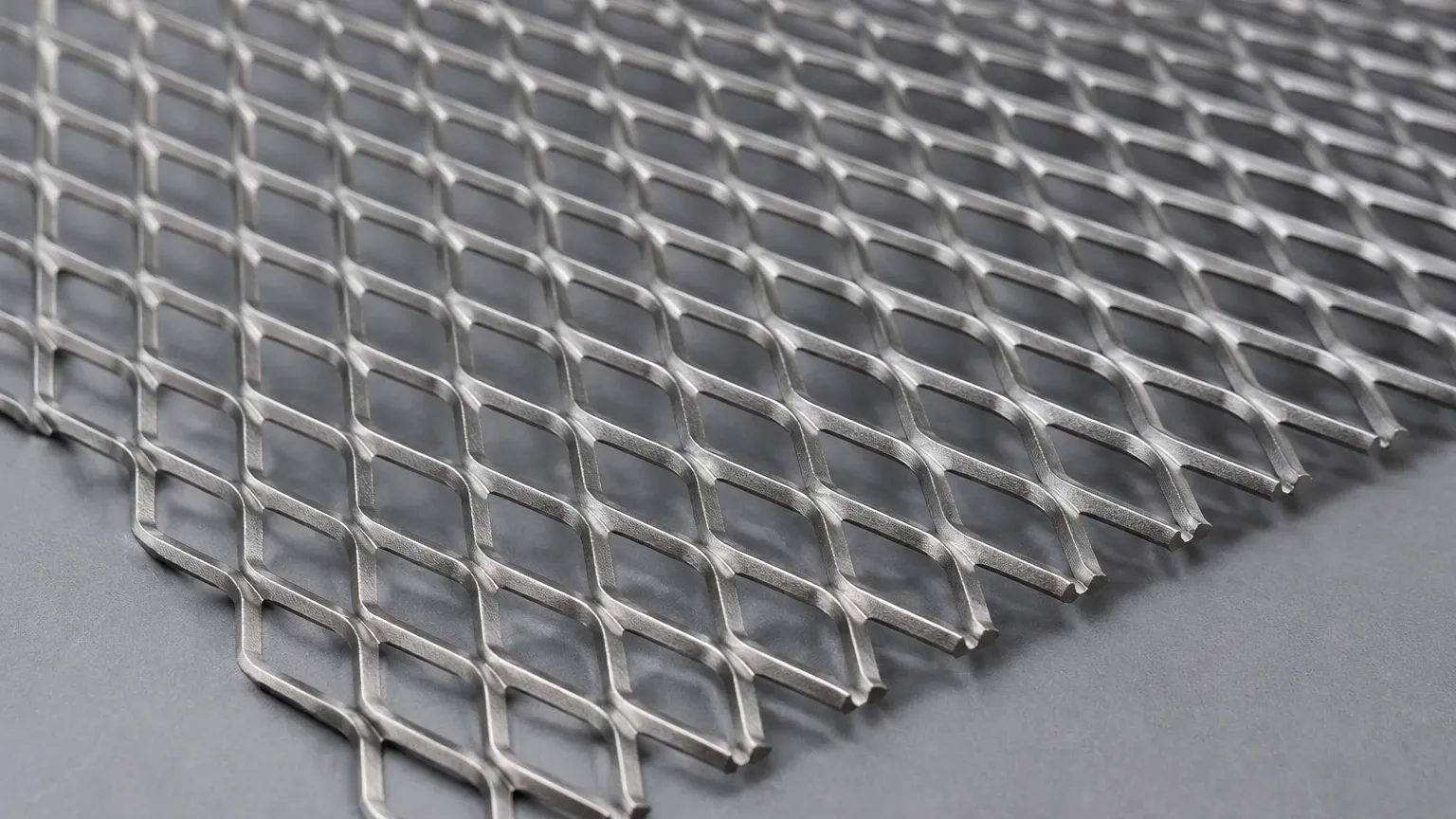
Standard expanded metal is the product as it comes off the expanding machine. The strands and bonds are set at a uniform angle to the plane of the sheet. This creates a 3D structure that offers:
* Increased Rigidity: The angular orientation of the strands provides superior resistance to bending and shearing forces.
* Enhanced Turbulence: In fluid dynamics, the raised edges can promote localized turbulence, which may be beneficial in certain mixing or pre-filtration stages to prevent the rapid buildup of a filter cake.
* Superior Grip: The raised surface is ideal for applications where the metal serves as a substrate for other filter media layers.
Flattened Expanded Metal
Flattened expanded metal is produced by passing the standard expanded sheet through a cold-roll reducing mill. This process flattens the strands and bonds into the same plane, resulting in a smooth, level surface. The advantages include:
* Media Protection: A flattened 3 4 expanded metal sheet is less likely to abrade or puncture delicate wire mesh or synthetic filter membranes.
* Consistent Thickness: Flattening ensures a uniform thickness across the entire sheet, which is critical for maintaining tight tolerances in cylindrical filter cartridge construction.
* Ease of Cleaning: The smooth surface reduces the number of crevices where particles can become trapped, facilitating more effective backwashing or manual cleaning.
Engineering Considerations for Filter Support and Reinforcement
In industrial filtration, the expanded metal sheet rarely acts as the primary filtration medium. Instead, it serves as the "backbone" of the filter element. Engineers must evaluate several factors when integrating 3/4" expanded metal into their designs.
Open Area and Flow Rate
The percentage of open area determines the hydraulic resistance of the support layer. A typical 3/4" #9 expanded metal sheet provides approximately 60% to 75% open area. If the open area is too low, the support layer itself will contribute to an unnecessary pressure drop (delta P), reducing the overall efficiency of the system. Conversely, if the open area is too high, the structural support may fail under the high-pressure conditions often found in hydraulic or deep-well water treatment applications.
Structural Integrity Under Pressure
Filter elements often face significant differential pressures as the primary media becomes loaded with contaminants. The 3 4 expanded metal sheet must be capable of resisting collapse or bursting. The "bond" of the expanded metal—the point where the strands intersect—is the strongest part of the mesh. Aligning the LWD or SWD with the direction of the primary stress is a key engineering decision during the fabrication of cylindrical filter baskets.
Fabrication and Welding
Stainless steel expanded metal is highly weldable, but the thin strands require precision. At Kaifil, we utilize advanced welding techniques to ensure that the joints between the expanded metal support and the end caps or inner cores are robust and free of burrs. Burrs or sharp edges on the expanded metal can lead to bypass—where unfiltered fluid escapes through a puncture in the primary media—compromising the entire filtration process.
Quality Control and Manufacturing Standards
To ensure the reliability of a 3 4 expanded metal sheet in critical B2B applications, manufacturing must adhere to strict quality standards. This includes monitoring the following:
1. Dimensional Accuracy: Ensuring that the SWD and LWD remain within industry tolerances (typically +/- 5% for standard expanded metal).
2. Flatness: For flattened sheets, the "camber" or bow of the sheet must be minimized to ensure it can be rolled into perfectly concentric cylinders.
3. Surface Finish: In the pharmaceutical and food industries, the metal must be free of oils, greases, and metallic dust. Passivation is often required for stainless steel components to restore the protective oxide layer after the expanding and shearing process.
4. Material Certification: Providing Mill Test Reports (MTRs) to verify the chemical composition and mechanical properties of the steel used.
Procurement Guidelines for Custom Filtration Projects
When purchasing 3/4" expanded metal for industrial use, procurement teams should confirm specific details to avoid costly errors and project delays. Before finalizing an order, verify the following with your manufacturer:
* Exact Style: Specify "Standard" or "Flattened."
* Weight Requirements: Confirm the poundage per square foot, as this indicates the density and strength of the material.
* Sheet Orientation: Indicate whether the diamonds should run parallel to the length or the width of the sheet, as this affects the forming process.
* Edge Conditions: Decide between "Random Sheared" (diamonds are cut through) or "Bond Sheared" (cuts are made through the bonds to provide a closed-edge finish).
Kaifil provides comprehensive OEM and customized filtration solutions, leveraging extensive experience in metal fabrication to deliver components that meet the most demanding specifications. Whether you require a 3 4 expanded metal sheet for a large-scale water treatment facility or a precision-engineered chemical strainer, our technical team works closely with you to optimize material selection and design for maximum service life and performance.
By understanding the technical nuances of expanded metal geometry and material science, engineers can select the most appropriate support structures for their filtration systems, ensuring long-term reliability and lower total cost of ownership.
