


6320d Expanded Metal
In the landscape of industrial filtration and structural engineering, the selection of support media is as critical as the selection of the primary filtration layer. Among the various specifications available to engineers, 6320d expanded metal stands out as a robust, high-strength solution frequently utilized in heavy-duty applications. This specification, often categorized under broader Perforated & Expanded Metal offerings, provides a unique balance of open area, structural rigidity, and cost-effectiveness.
Understanding the technical nuances of the 6320d pattern is essential for procurement teams and design engineers who must ensure that their filtration systems or architectural components can withstand mechanical stress while maintaining optimal flow characteristics. This guide provides a technical deep dive into the 6320d specification, its manufacturing principles, and its strategic application in industrial environments.
Understanding the 6320d Specification
The term "6320d" refers to a specific geometric configuration of expanded metal, typically governed by industrial standards such as JIS G 3351 or similar international benchmarks for expanded steel. To evaluate this material correctly, engineers must break down the nomenclature into its dimensional components.
Geometric Parameters
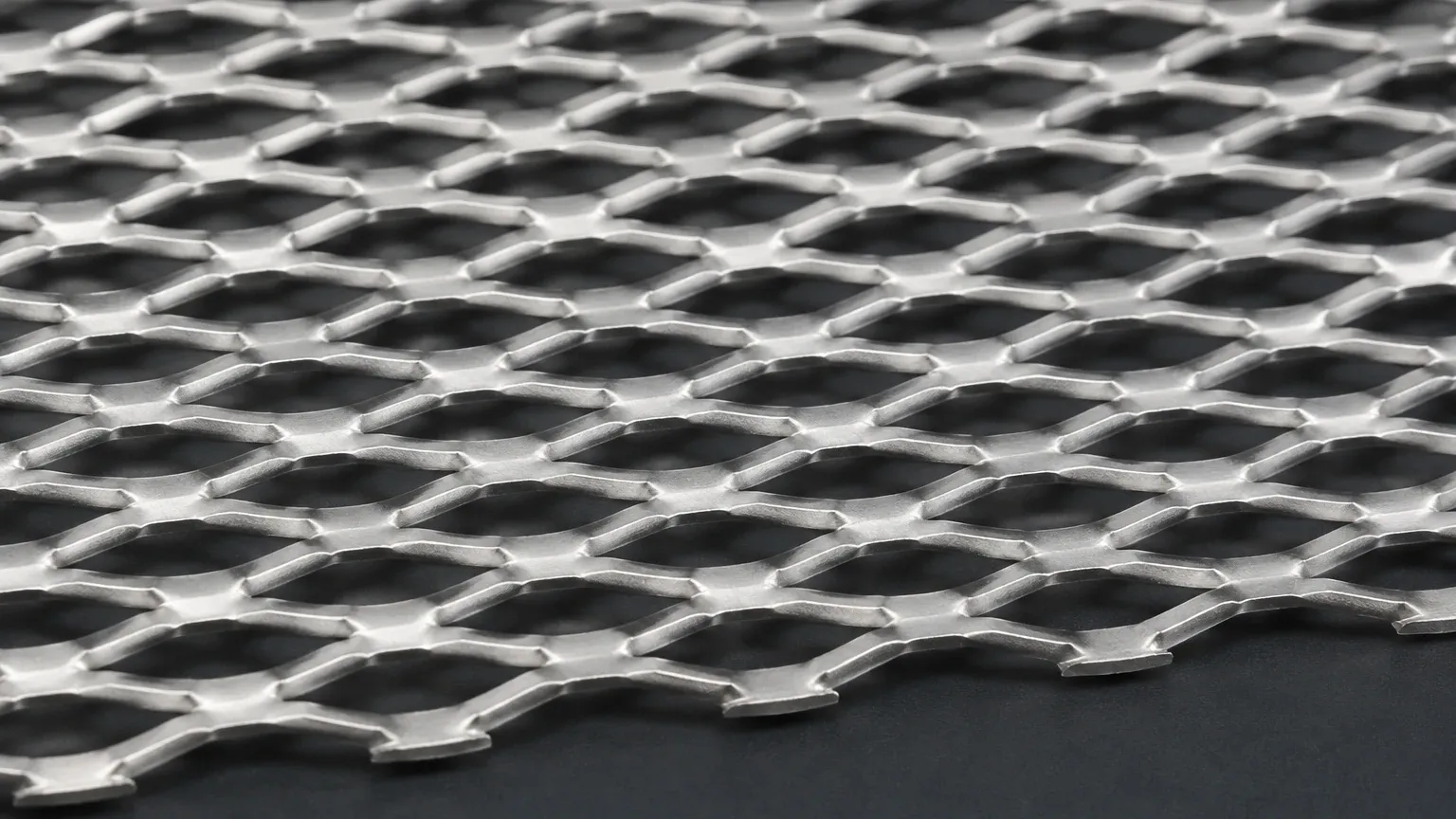
Expanded metal is defined by the diamond-shaped openings created during the manufacturing process. For the 6320d pattern, the primary measurements include:
* LWM (Long Way of Mesh): This is the distance from a point on a diamond to the corresponding point on the next diamond, measured across the long diagonal. In the 6320d specification, this is nominally 63.0 mm.
* SWM (Short Way of Mesh): This is the distance measured across the short diagonal. For this pattern, it is nominally 20.0 mm.
* Strand Width: This refers to the amount of metal between the openings. In 6320d, the strand width is typically substantial, often ranging from 4.0 mm to 7.0 mm depending on the specific heavy-duty requirement.
* Strand Thickness: This is the thickness of the base material. The "d" in the 6320d designation often correlates to a specific thickness-to-width ratio, commonly utilizing plate thicknesses between 3.2 mm and 6.0 mm.
By combining a 63mm long pitch with a 20mm short pitch, the 6320d pattern creates a relatively elongated diamond. This geometry is particularly effective for applications requiring high longitudinal strength and a moderate open area, which typically hovers between 40% and 60% depending on the exact strand dimensions.
Manufacturing and Customization of Perforated & Expanded Metal
The production of 6320d expanded metal differs significantly from perforated metal. While perforated metal is created by punching holes and removing material (slugs), expanded metal is produced through a simultaneous slitting and stretching process. This method offers several engineering advantages.
The Expansion Process
A solid sheet or plate is fed through a machine equipped with a reciprocating knife. As the knife slits the metal, it also stretches it upward or downward. Because no material is lost during this process, expanded metal is often more cost-effective than perforated metal of the same thickness and material grade. The resulting 6320d pattern is a single, continuous piece of metal without welds or joints, which eliminates potential points of failure and stress concentration.
Raised vs. Flattened Variations
Engineers must specify whether they require "Raised" (standard) or "Flattened" 6320d expanded metal:
1. Raised Expanded Metal: The strands are set at a sharp angle to the plane of the sheet. This provides maximum rigidity and acts as an excellent mechanical bond for secondary materials (like filter media or concrete). It also provides a non-slip surface for industrial walkways.
2. Flattened Expanded Metal: The raised sheet is passed through a cold-rolling reducing mill. This flattens the strands and bonds into the same plane, resulting in a smooth, level surface. Flattening slightly increases the LWM and SWM dimensions while reducing the overall thickness. This is often preferred when the 6320d metal is used as an outer cage for delicate filter cartridges to prevent abrasion.
Role of 6320d in Industrial Filtration Systems
Within the scope of Kaifil’s expertise in stainless steel filtration, 6320d expanded metal serves as a critical component in multi-stage filtration assemblies. Its primary roles include structural support and coarse pre-filtration.
Structural Support for Fine Media
In high-pressure hydraulic or chemical processing systems, fine wire mesh filters lack the inherent strength to resist collapsing under high differential pressure (ΔP). 6320d expanded metal is used as a "support tube" or "outer shroud." Its rigid diamond structure provides the necessary hoop strength to maintain the cylindrical shape of the filter cartridge, ensuring that the fine mesh remains in place even during pressure surges or backwashing cycles.
Coarse Filtration and Debris Capture
In water treatment or intake systems, 6320d can act as the primary filtration stage. The 20mm SWM is ideal for capturing large debris, stones, or organic matter before the fluid reaches more sensitive downstream components. Because the strands are angled (in the raised version), they can also influence fluid turbulence, which may be beneficial in certain mixing or aeration applications.
Flow Dynamics and Pressure Drop
One of the most important considerations for an engineer is the pressure drop across the filter. The 6320d pattern offers a high open-area-to-weight ratio. By minimizing the amount of solid material in the flow path while maximizing structural integrity, it allows for high flow rates with minimal resistance. This efficiency is vital for reducing energy consumption in pumping systems.
Key Evaluation Criteria for Engineers
When specifying 6320d for a project, several technical factors must be evaluated to ensure the component’s longevity and performance.
Material Selection and Chemical Compatibility
While carbon steel is common for general structural use, industrial filtration typically requires stainless steel.
* Grade 304: Suitable for general industrial use and food-grade applications where corrosion risk is moderate.
* Grade 316L: Essential for chemical processing, marine environments, and pharmaceutical applications due to its superior resistance to pitting and crevice corrosion.
* Specialty Alloys: For high-temperature or highly acidic environments, alloys like Monel or Inconel may be required.
Load-Bearing Capacity
Engineers must calculate the UDL (Uniformly Distributed Load) or concentrated load that the 6320d sheet will encounter. Because expanded metal has directional strength (stronger along the LWM), the orientation of the diamonds relative to the support structure is critical. In filtration, this relates to the burst pressure rating of the filter housing.
Dimensional Tolerances
In precision OEM manufacturing, tolerances on the LWM, SWM, and overall sheet flatness are paramount. Inconsistent diamond sizes can lead to uneven stress distribution or difficulties in welding the expanded metal to end caps or flanges. Specifying tight tolerances ensures a seamless fit within the final assembly.
Common Risks and Mitigation in Procurement
Procuring industrial-grade expanded metal involves navigating potential quality pitfalls that can compromise the final product.
Burrs and Sharp Edges
The expansion process naturally creates sharp edges at the strand intersections. In filtration, these burrs can puncture fine wire mesh or cause injury to maintenance personnel. Mitigation involves specifying de-burring processes, such as vibratory finishing or pickling, to ensure the 6320d component is safe to handle and compatible with delicate media.
Material Fatigue and Stress Cracking
If the expansion ratio is too high or the material quality is poor, micro-cracks can form at the bonds (the points where diamonds join). Under cyclic loading—common in hydraulic systems—these micro-cracks can lead to catastrophic failure. Engineers should request material mill certificates and, in critical cases, non-destructive testing (NDT) to ensure the integrity of the bonds.
Inaccurate Open Area Calculations
Many purchasers rely on generic tables for open area percentages. However, small variations in strand width can significantly alter the actual open area. For precise flow calculations, it is recommended to confirm the exact strand width and thickness with the manufacturer before finalizing the design.
Selection Guide: When to Choose 6320d over Other Grids
Why choose 6320d instead of a perforated plate or a smaller expanded metal pattern? The decision usually comes down to three factors: weight, cost, and aperture size.
* Weight vs. Strength: 6320d provides a much higher strength-to-weight ratio than a perforated plate of the same thickness. This is particularly beneficial in large-scale filtration units where reducing the overall weight of the cartridge simplifies maintenance and replacement.
* Aperture Size: If the application requires capturing particles in the 15mm–25mm range, the 20mm SWM of the 6320d is the logical choice. Smaller patterns (like 1210 or 2510) would provide too much flow resistance, while larger patterns (like 8040) might not provide enough support for the internal mesh.
* Cost Efficiency: As previously mentioned, the lack of material waste in the expansion process makes 6320d a more economical choice for large-volume OEM projects compared to perforated metal, especially when using expensive alloys like 316L stainless steel.
Technical Checklist Before Purchasing
Before initiating a purchase order for 6320d expanded metal, engineers and purchasing teams should confirm the following details with their supplier:
1. Material Grade: Confirm the exact alloy and request a Material Test Report (MTR).
2. Surface Finish: Specify if the material should be mill finish, passivated (for stainless steel), or galvanized (for carbon steel).
3. Flattening Requirement: Clearly state if the application requires a flattened or raised profile.
4. Direction of Diamonds: For sheet orders, specify whether the LWM should run parallel or perpendicular to the length of the sheet.
5. Edge Configuration: Determine if the sheets should have "random sheared" edges or "bonded" edges (where the diamonds are left intact at the perimeter).
6. Quantity and Lead Time: For OEM applications, ensure the manufacturer can scale production to meet assembly line requirements.
By focusing on these technical parameters, industrial professionals can leverage the unique properties of 6320d expanded metal to enhance the durability and efficiency of their filtration and structural systems. Whether used as a protective shroud or a structural backbone, this specification remains a cornerstone of modern industrial metal fabrication.
