


.75 #9 Expanded Metal
In the realm of industrial filtration and structural support, material selection is dictated by the balance between mechanical strength, open area, and chemical compatibility. Among the various specifications available to engineers, .75 #9 expanded metal stands out as a versatile and robust choice. This specific configuration is frequently employed in demanding environments where structural integrity cannot be sacrificed for permeability.
As a specialized manufacturer, Kaifil provides high-performance filtration components that utilize expanded metal as a core structural element. Understanding the technical nuances of .75 #9 expanded metal is essential for procurement teams and engineers who must ensure that their filtration systems can withstand high differential pressures while maintaining efficient flow rates.
Technical Specifications of .75 #9 Expanded Metal
To accurately specify expanded metal for an industrial application, one must understand the nomenclature used in the industry. The designation ".75 #9" refers to two primary dimensions: the diamond size and the material thickness (gauge).
Short Way of Diamond (SWD)
The ".75" in the specification refers to the nominal Short Way of Diamond (SWD). This is the distance measured from the center of a bond to the center of the next bond across the short axis of the diamond opening. In a .75 configuration, this distance is approximately 3/4 of an inch. The Long Way of Diamond (LWD) for this specification typically measures around 2.0 to 2.1 inches. These dimensions determine the density of the mesh and the size of the particles or objects the metal can effectively retain or deflect.
Material Gauge and Strand Dimensions
The "#9" refers to the thickness of the starting sheet metal. In the context of expanded metal, #9 gauge is approximately 0.134 inches thick. However, it is important to distinguish between the thickness of the metal and the width of the strand. The strand width is the amount of metal fed into the expanding machine between the slitting and stretching process. For .75 #9 expanded metal, the strand width is often around 0.150 inches. When these two dimensions—thickness and width—are combined, they create a cross-sectional area that provides significant rigidity compared to lighter gauges like #13 or #18.
Manufacturing Variations: Raised vs. Flattened
When sourcing Perforated & Expanded Metal for industrial use, engineers must choose between "Standard" (Raised) and "Flattened" finishes. This choice significantly impacts the performance of the filter or support structure.
Standard (Raised) Expanded Metal
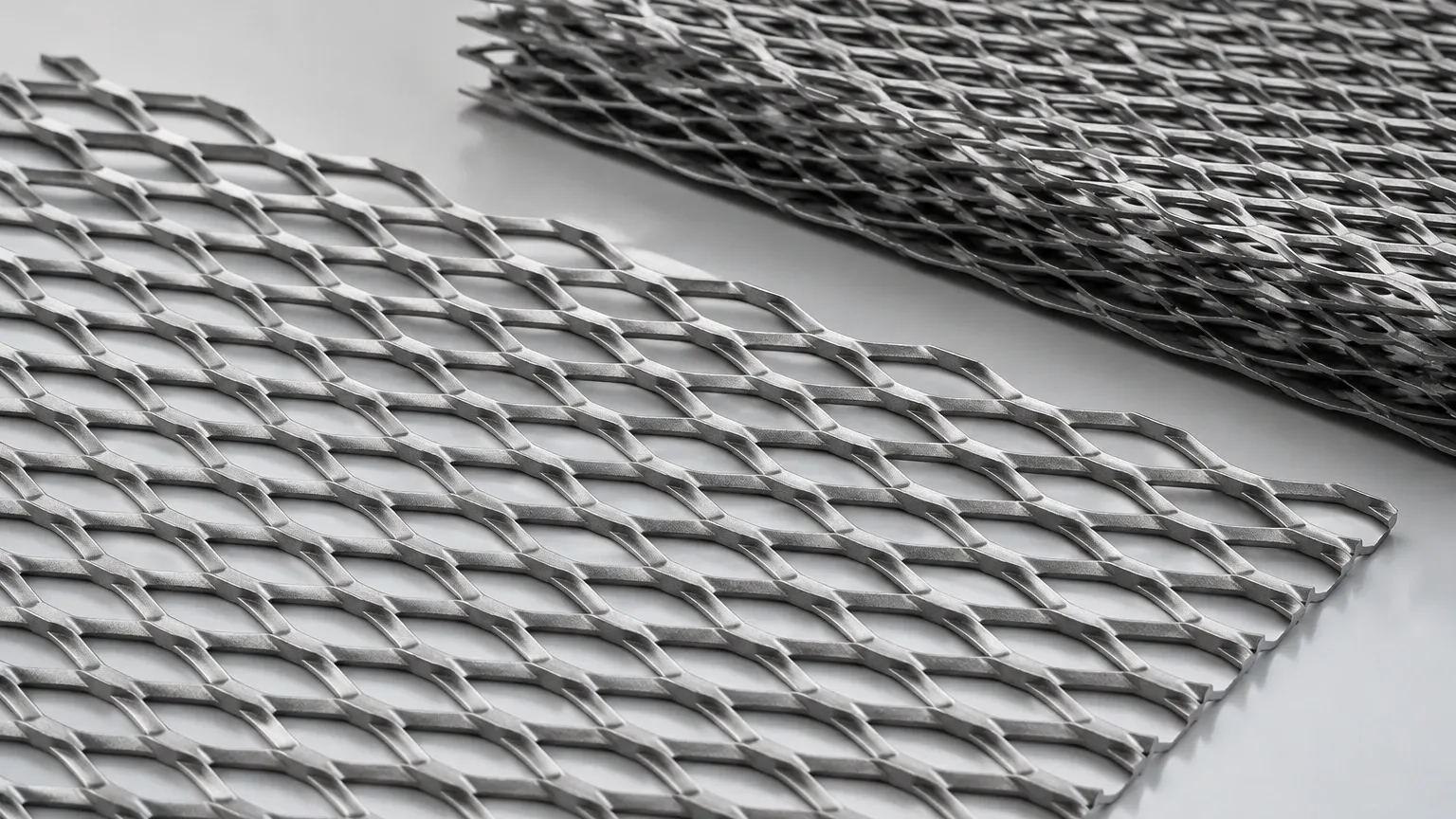
In its standard form, expanded metal comes off the machine with the strands set at a sharp angle to the plane of the sheet. This creates a three-dimensional texture that offers high slip resistance and structural stiffness. In filtration, raised expanded metal is often used as a pre-filter or a protective guard where the directional flow of fluid can be influenced by the angle of the strands. It provides a larger surface area, which can be beneficial in certain catalytic or heat-transfer applications.
Flattened Expanded Metal
Flattened expanded metal is produced by passing the standard expanded sheet through a cold-roll reducing mill. This process flattens the strands and bonds into a single plane, reducing the overall thickness of the sheet and creating a smooth, level surface. For filtration applications, flattened .75 #9 expanded metal is often preferred when it serves as a support for fine wire mesh. The smooth surface prevents the delicate mesh from being punctured or abraded under high-pressure conditions, ensuring a longer service life for the filter element.
The Role of .75 #9 in Industrial Filtration Systems
In industrial filtration, expanded metal rarely acts as the primary filtration medium for fine particles. Instead, it serves as the "backbone" of the filter assembly. .75 #9 expanded metal is particularly valued in high-load scenarios.
Structural Support for Filter Media
Fine stainless steel wire mesh lacks the inherent stiffness to resist collapsing under the weight of heavy fluid columns or high-viscosity liquids. By using .75 #9 expanded metal as a support cage or internal core, manufacturers like Kaifil can create filter cartridges that maintain their shape even at high differential pressures. The 3/4-inch diamond opening provides a large enough open area to prevent significant pressure drops while offering enough contact points to support the mesh evenly.
Pre-Filtration and Debris Protection
In water treatment and chemical processing, .75 #9 expanded metal is used as a primary screen to capture large debris, such as stones, wood chips, or large scale, before the fluid reaches more sensitive downstream components. Its heavy-duty construction allows it to withstand the impact of large solids without deforming. This protective layer is critical for extending the maintenance cycles of fine-pore filtration systems.
Material Selection and Chemical Compatibility
While expanded metal can be manufactured from carbon steel or aluminum, industrial filtration applications almost exclusively demand stainless steel. Kaifil specializes in custom stainless steel solutions, focusing on grades that offer longevity in corrosive environments.
Stainless Steel 304 vs. 316
* Grade 304: This is the standard industrial grade, providing excellent strength and basic corrosion resistance. It is suitable for food and beverage applications and general industrial water filtration.
* Grade 316/316L: For chemical processing, pharmaceutical manufacturing, or marine environments, Grade 316 is required. The addition of molybdenum provides superior resistance to pitting and crevice corrosion, especially in chloride-rich environments. Using .75 #9 expanded metal in 316L ensures that the structural support of the filter does not become the point of failure due to chemical attack.
Weight and Cost Considerations
One of the primary advantages of expanded metal over perforated metal is material efficiency. Because the expansion process involves slitting and stretching rather than punching holes, there is zero material waste (no slugs). This makes .75 #9 expanded metal a more cost-effective solution than a perforated plate of similar thickness and open area, particularly when using expensive alloys like 316L stainless steel.
Engineering Selection: Open Area and Flow Dynamics
When integrating .75 #9 expanded metal into a system, engineers must calculate the percentage of open area to predict flow performance. For standard .75 #9 expanded metal, the open area typically ranges between 60% and 75%, depending on the exact strand width specified during manufacturing.
Pressure Drop (ΔP) Calculations
The diamond-shaped openings of expanded metal create a different flow profile than the circular holes of perforated metal. The angularity of the strands in raised expanded metal can induce turbulence, which may be desirable in mixing applications but detrimental in high-velocity laminar flow systems. For most filtration support roles, the flattened variety is used to minimize turbulence and ensure a predictable pressure drop across the filter element.
Rigidity and Span
Engineers must also consider the span of the expanded metal. Because of the way the diamonds are oriented, expanded metal has a "strong" direction (the Short Way of Diamond) and a "weak" direction. When fabricating cylindrical filter cores, the SWD should ideally run around the circumference to provide maximum crush resistance, while the LWD runs the length of the cartridge.
Customization and OEM Fabrication
Every industrial environment presents unique challenges, from specific housing dimensions to extreme temperature fluctuations. Kaifil provides customized filtration solutions that go beyond off-the-shelf specifications. When ordering .75 #9 expanded metal components, several customization options should be confirmed:
1. Dimensional Tolerances: Standard industrial tolerances may not suffice for precision hydraulic or pharmaceutical filters. Specifying tight tolerances on the SWD and LWD is crucial for a proper fit within filter housings.
2. Edge Treatments: Expanded metal has sharp edges by nature. For many B2B applications, these edges must be deburred, hemmed, or welded into a solid U-profile frame to ensure safety and ease of installation.
3. Surface Finishing: Depending on the industry, the metal may require electropolishing (common in food and pharma) to remove surface impurities and improve corrosion resistance, or simple pickling and passivation.
Conclusion
Selecting .75 #9 expanded metal for industrial filtration or structural support requires a deep understanding of both material science and mechanical engineering. Its high strength-to-weight ratio, coupled with the cost-efficiency of the expansion process, makes it a superior choice for supporting fine filter media and protecting industrial equipment.
By focusing on high-quality stainless steel alloys and precision manufacturing, Kaifil ensures that these components meet the rigorous standards of the chemical, pharmaceutical, and water treatment industries. Whether used as a rigid core for a filter cartridge or a protective screen for large-scale processing, .75 #9 expanded metal provides the durability and performance necessary for modern industrial operations.
