


Bending Expanded Metal
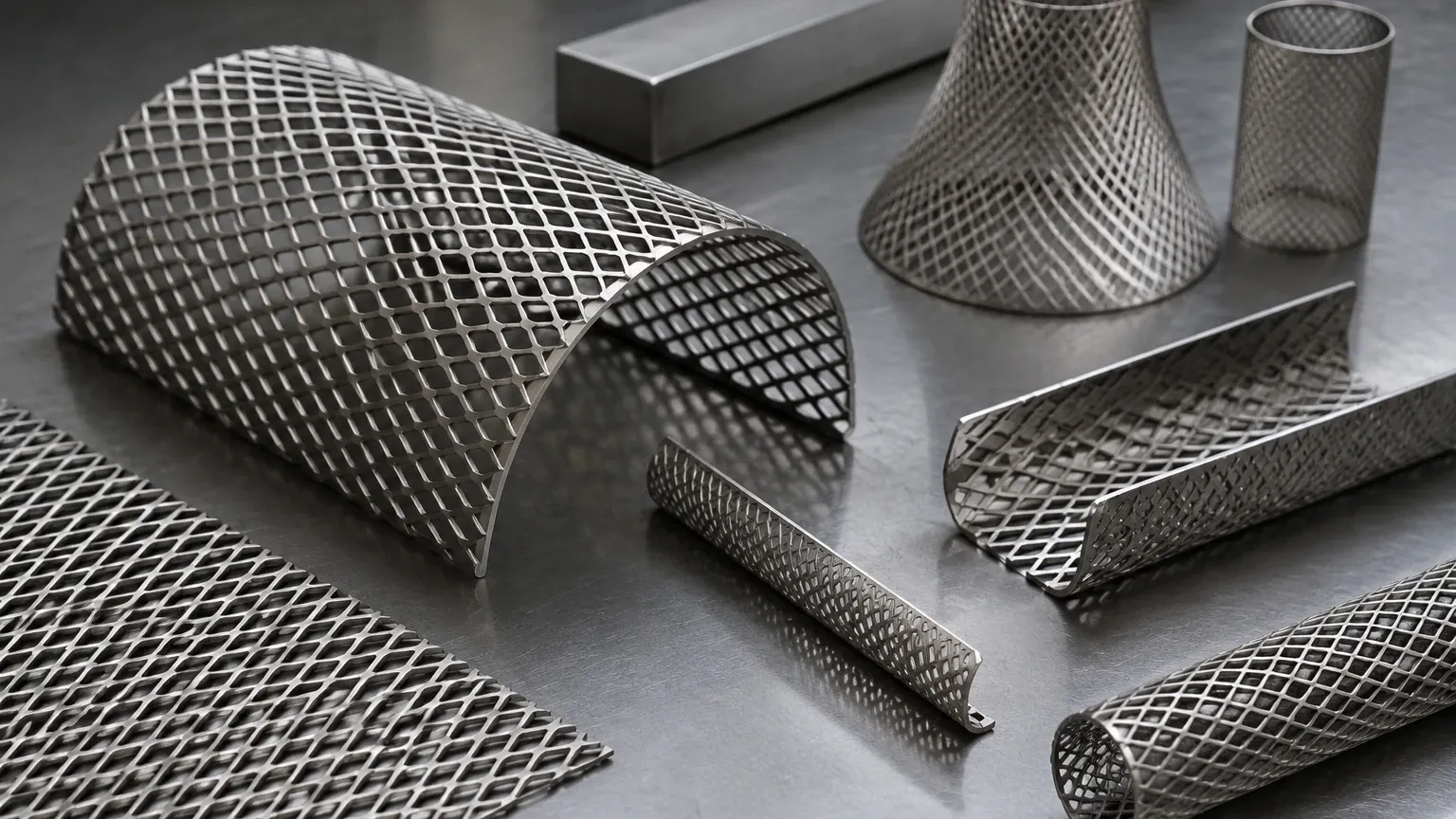
Expanded metal is a versatile industrial material produced by simultaneously slitting and stretching a solid metal sheet. This process creates a diamond-shaped pattern of openings, resulting in a product that is lightweight yet structurally rigid. In industrial manufacturing, particularly in the production of filtration systems and support structures, the ability to manipulate this material through bending is essential.
However, bending expanded metal is significantly different from bending solid sheet metal or even perforated metal. The open area, the orientation of the strands, and the presence of bonds (the intersection points of the strands) create unique mechanical behaviors. For engineers and procurement teams, understanding the technical nuances of bending expanded metal is critical to ensuring structural integrity and dimensional accuracy in the final component.
Understanding the Geometry of Expanded Metal
Before executing a bend, it is vital to understand the terminology and geometry that define expanded metal. The material is characterized by two primary directions: the Long Way of Design (LWD) and the Short Way of Design (SWD).
* LWD (Long Way of Design): This is the dimension across the long axis of the diamond opening. It typically runs parallel to the width of the original coil.
* SWD (Short Way of Design): This is the dimension across the short axis of the diamond. It runs perpendicular to the LWD.
* Strands and Bonds: Strands are the individual metal strips that form the sides of the diamond. Bonds are where these strands intersect.
When bending expanded metal, the orientation of the LWD and SWD relative to the bend line determines the difficulty of the operation and the quality of the radius. Generally, bending parallel to the LWD is easier and results in a more uniform curve, whereas bending parallel to the SWD can place significant stress on the bonds, potentially leading to fractures if the radius is too tight.
Technical Considerations for the Bending Process
Bending expanded metal requires a departure from standard sheet metal calculations. Because the material is not solid, the neutral axis—the theoretical line within the material that neither stretches nor compresses—shifts unpredictably.
Raised vs. Flattened Expanded Metal
Expanded metal is available in two forms: raised (standard) and flattened.
1. Raised Expanded Metal: This is the material as it comes off the expanding machine. The strands are set at an angle to the plane of the sheet, giving it a three-dimensional texture. Bending raised metal is more complex because the tooling must accommodate the thickness of the angled strands rather than just the gauge of the base metal.
2. Flattened Expanded Metal: This material has been cold-rolled after expansion to create a smooth, flat surface. It is easier to bend accurately because its thickness is uniform, and it behaves more like a traditional perforated sheet. However, the cold-rolling process work-hardens the metal, which may increase the risk of cracking during tight bends.
Material Selection and Ductility
The choice of alloy significantly impacts the success of bending expanded metal. Stainless steel (such as Grades 304 and 316) is frequently used in filtration due to its corrosion resistance. However, stainless steel work-hardens rapidly. If a component requires multiple bends or a very small internal radius, the material may require annealing to restore ductility. Carbon steel is generally more forgiving during the bending process but requires post-processing, such as galvanizing or coating, to prevent oxidation.
Equipment and Methods for Bending
Industrial manufacturers like Kaifil utilize several methods to achieve precise bends in expanded metal, depending on the required geometry and the thickness of the material.
Press Brake Bending
The press brake is the most common tool for creating angular bends. When working with Perforated & Expanded Metal, the selection of the V-die is critical. A standard rule of thumb for solid sheet is a die width of eight times the material thickness. For expanded metal, the "effective thickness" (the height of the raised strands) must be used. If the die is too narrow, the mesh can be forced into the opening unevenly, causing the strands to distort or the bend line to wander.
Roll Bending
For applications such as filter cartridge supports or cylindrical guards, roll bending is used. This process involves passing the expanded metal through a series of three or four rollers to achieve a constant radius. The primary challenge here is "end flat," where the leading and trailing edges of the sheet do not receive the full curvature. In filtration applications, these edges are often welded, so precision in the roll-bending phase is essential to ensure a flush seam.
Rotary Bending
Rotary bending uses a rotating cam to fold the metal over a stationary anvil. This method is often preferred for expanded metal because it minimizes the sliding friction between the tooling and the mesh, reducing the risk of marring the surface or snagging individual strands.
Managing Springback and Tolerances
Springback—the tendency of a metal to return to its original shape after the bending force is removed—is highly pronounced in expanded metal. The "openness" of the mesh means there is less internal material to resist the elastic recovery.
Engineers must account for several variables when calculating springback in expanded metal:
* Percent of Open Area: A higher open area generally leads to more unpredictable springback.
* Strand Width: Heavier strands provide more resistance and can help stabilize the bend.
* Bend Direction: Bending across the SWD usually results in more springback than bending across the LWD.
Dimensional tolerances are also harder to maintain. In solid sheet metal, measurements are taken from edge to edge. In expanded metal, the edge may consist of half-diamonds or jagged strands. It is standard practice to define tolerances based on the "overall" dimensions rather than specific strand locations to account for the inherent variability of the expansion process.
Common Risks and How to Mitigate Them
Bending expanded metal is not without risks. If the process is not carefully controlled, the following issues can occur:
1. Bond Fracturing: This is the most common failure. It occurs when the bend radius is too sharp, causing the intersections (bonds) to snap. To mitigate this, always use a radius that is at least equal to the material thickness, and preferably larger for stainless steel.
2. Strand Distortion: If the clamping pressure is too high or the tooling is improperly aligned, the diamond pattern can become elongated or crushed near the bend line. This not only affects aesthetics but can also change the filtration or flow characteristics of the material.
3. Inconsistent Bend Lines: Because the punch of a press brake may land on a bond in one area and an open space in another, the bend line can "stair-step." Using a urethane die pad can help distribute the pressure more evenly and produce a straighter bend line.
Applications in Industrial Filtration
In the context of Kaifil’s expertise, bending expanded metal is frequently a precursor to the assembly of complex filtration components. Expanded metal serves as an ideal support core for fine wire mesh filters. In these applications, the expanded metal is typically rolled into a cylinder and longitudinal-seam welded.
The structural integrity provided by the bent expanded metal allows the filter to withstand high differential pressures without collapsing. Furthermore, the high open area of expanded metal ensures that the support structure does not significantly impede the flow of the medium being filtered, whether it be hydraulic fluid, chemicals, or food products.
Designing for Manufacturability (DFM)
To ensure a cost-effective and high-quality result, engineers should consider the following DFM principles when specifying bent expanded metal components:
* Specify the Bend Direction: Clearly indicate on technical drawings whether the bend should be parallel to the LWD or SWD.
* Avoid Tight Radii: Whenever possible, design with a generous bend radius to prevent material fatigue and cracking.
* Account for Edge Conditions: Decide if the edges should be "random sheared" (which may leave sharp points) or "bond sheared" (which cuts through the intersections for a smoother edge). This choice affects how the piece will fit into a frame or weldment after bending.
* Material State: Indicate if the material should be flattened or raised. Flattened expanded metal is generally more predictable for precision bending.
By understanding the mechanical limits and the geometric properties of the material, purchasing teams and engineers can work more effectively with manufacturers to produce durable, high-performance filtration and industrial components. Whether for a custom filter housing or a heavy-duty industrial screen, the technical execution of bending expanded metal remains a cornerstone of precision metal fabrication.
