


Best Expanded Metal for Grill
In industrial food processing, commercial catering equipment manufacturing, and heavy-duty outdoor cooking applications, selecting the appropriate mesh surface is critical for both performance and longevity. While various materials can serve as a cooking or heat-diffusion surface, expanded metal is often the preferred choice due to its structural integrity, cost-effectiveness, and excellent airflow characteristics. However, identifying the best expanded metal for grill applications requires a technical understanding of material science, manufacturing processes, and mechanical specifications.
This guide examines the engineering considerations necessary to select high-performance expanded metal, focusing on material grades, diamond geometries, and surface treatments suitable for demanding thermal environments.
Understanding Expanded Metal for Industrial and Commercial Grilling
Expanded metal is manufactured through a process of simultaneously slitting and stretching a solid metal sheet. This creates a continuous piece of mesh with diamond-shaped openings. Unlike woven wire mesh, expanded metal has no joins or welds that can fail under repeated thermal cycling. This makes it inherently more durable for high-heat applications.
For B2B applications—such as the production of industrial smokers, commercial rotisseries, or filtration components within high-temperature exhaust systems—the choice of expanded metal impacts heat distribution, cleaning efficiency, and the structural lifespan of the equipment. Engineers must distinguish between "Standard" (raised) and "Flattened" expanded metal, as each offers distinct advantages depending on whether the metal serves as a primary cooking grate or a secondary heat diffuser.
Material Selection: Why Stainless Steel is the Professional Standard
The environment within a grill or industrial oven is highly corrosive, characterized by extreme temperatures, moisture, organic acids from food, and carbon deposits. Choosing the correct alloy is the most significant factor in determining the "best" expanded metal.
304 Stainless Steel
Grade 304 is the most common choice for commercial grill grates. It offers excellent corrosion resistance and can withstand temperatures up to 870°C (1600°F) for intermittent service. It is food-safe and maintains its structural rigidity under heavy loads at elevated temperatures.
316 Stainless Steel
For equipment used in coastal environments or applications involving high salt concentrations (such as brine-heavy food processing), 316 stainless steel is superior. The addition of molybdenum provides enhanced resistance to chloride-induced pitting and crevice corrosion.
Carbon Steel
While carbon steel is frequently used in DIY or low-cost residential grills, it is generally avoided in high-end B2B applications unless a specific coating (such as porcelain enamel) is applied. Without protection, carbon steel oxidizes rapidly at high temperatures, leading to scaling and eventual structural failure. However, for fire grates (where the metal holds charcoal or wood rather than food), heavy-gauge carbon steel remains a cost-effective option if the component is considered a consumable part.
Key Technical Specifications for Grill Mesh
When specifying Perforated & Expanded Metal for a project, engineers must define several geometric variables. These dimensions dictate the "open area" percentage, which directly influences airflow and heat transfer.
1. SWD (Short Way of Design): The distance from the center of a bond to the center of the next bond across the short diamond axis.
2. LWD (Long Way of Design): The distance across the long diamond axis.
3. Strand Width: The amount of metal fed into the expanding machine between each stroke.
4. Strand Thickness: The original thickness of the base metal sheet.
For a cooking surface, a common specification is 1/2" #13 or 3/4" #9. The "#" refers to the gauge of the metal, while the fraction refers to the SWD. A 3/4" #9 stainless steel expanded metal provides a robust, heavy-duty surface that resists warping, while a 1/2" #13 provides a tighter mesh suitable for smaller items that might otherwise fall through the grate.
Standard vs. Flattened Expanded Metal: Which is Best for Grills?
The choice between standard and flattened expanded metal is often the most debated technical aspect of grill design.
Standard (Raised) Expanded Metal
Standard expanded metal is the product as it comes off the expanding machine. The strands and bonds are set at a uniform angle to the plane of the sheet.
* Pros: It provides more structural stiffness and better "grip" for food items. It also allows for slightly better airflow because of the angled strands.
* Cons: The raised edges can be difficult to clean, as grease and carbon build up in the angular recesses. It can also be more abrasive to cleaning tools.
Flattened Expanded Metal
Flattened expanded metal is produced by passing standard expanded metal through a cold-roll reducing mill. This flattens the strands and bonds into a single plane.
* Pros: It provides a smooth, flat surface that is much easier to scrape clean with a grill brush. It offers a larger surface-area-to-food contact ratio, which can be beneficial for achieving specific sear patterns.
* Cons: The flattening process slightly reduces the overall structural rigidity of the sheet compared to the raised version of the same gauge. It also slightly reduces the percentage of open area.
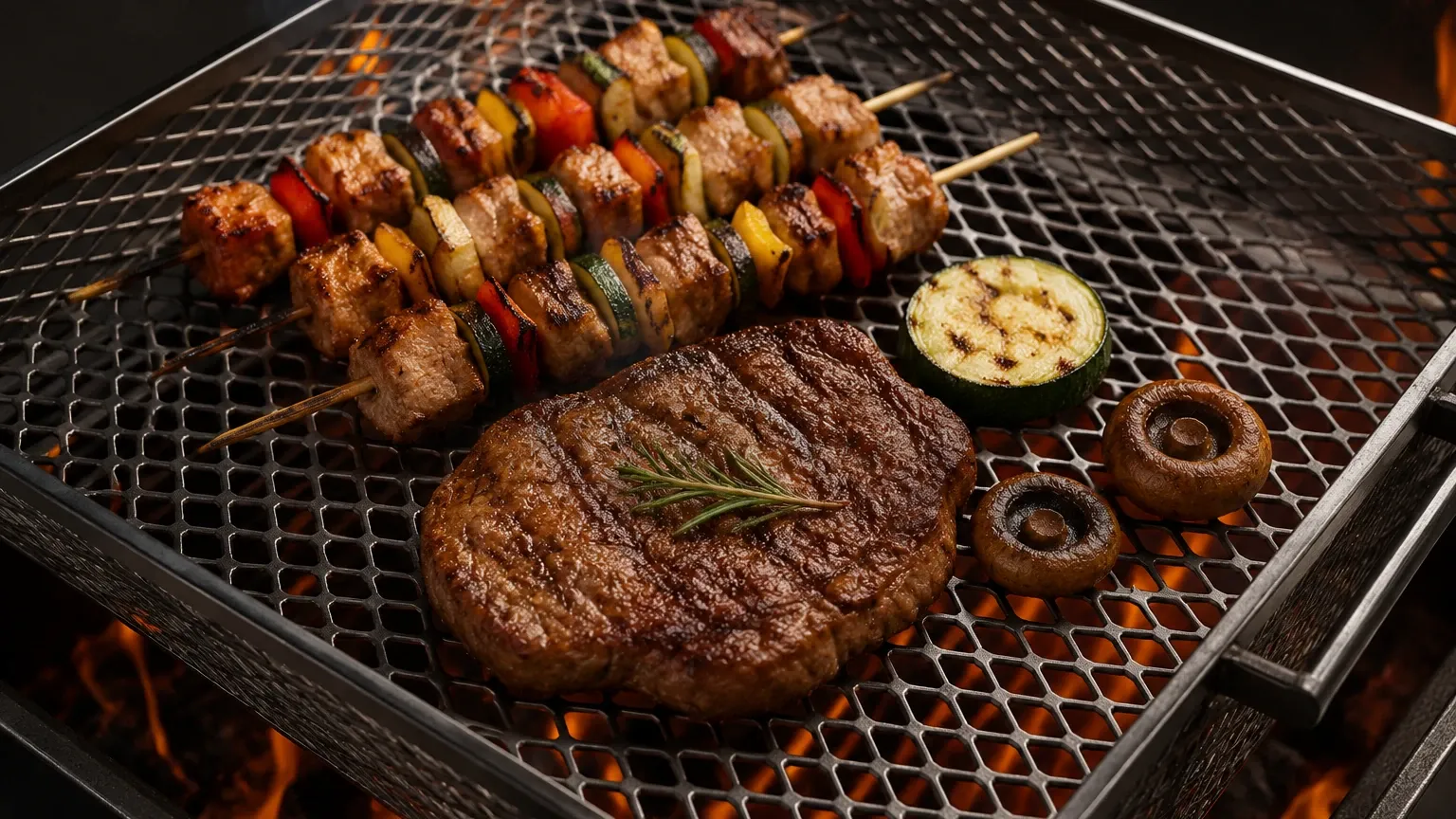
For most B2B commercial cooking applications, Flattened Stainless Steel Expanded Metal is considered the best option because hygiene and ease of maintenance are paramount in professional kitchens.
Engineering Considerations: Durability and Thermal Performance
When integrating expanded metal into a grill or industrial filtration system, engineers must account for several mechanical factors:
Thermal Expansion
Metal expands when heated. In a grill frame, if the expanded metal sheet is welded too tightly around the entire perimeter, it may buckle or "oil-can" as it expands. Engineers should design frames that allow for slight thermal movement or use tack welds at strategic intervals rather than continuous beads.
Load-Bearing Capacity
In large-scale industrial smokers, the weight of the product can be significant. The LWD (Long Way of Design) should typically run parallel to the support spans to maximize the strength of the mesh. Using a heavier gauge (such as 9-gauge instead of 13-gauge) is necessary for spans exceeding 24 inches to prevent sagging.
Open Area and Airflow
Effective combustion and heat distribution require precise airflow. Most expanded metal patterns used for grills offer an open area between 50% and 70%. A higher open area allows for more direct radiant heat, while a lower open area (tighter mesh) provides more conductive heat transfer through the metal itself.
Safety, Finishing, and Compliance
In the B2B sector, particularly for food and beverage applications, the finish of the metal is just as important as the material grade. Raw expanded metal has sharp edges (burrs) where the shears cut the metal. For any component that will be handled by operators or come into contact with food, deburring is a mandatory step.
Furthermore, stainless steel components should undergo passivation. This chemical process removes free iron from the surface and enhances the protective chromium oxide layer, ensuring the material meets food safety standards and remains corrosion-resistant even after the mechanical stress of the expanding process.
For filtration applications within the grilling environment—such as grease filters or spark arrestors—the expanded metal may be layered or combined with fine wire mesh to achieve specific micron ratings while maintaining the structural support provided by the expanded metal substrate.
Maintenance, Cleaning, and Replacement Cycles
Industrial filtration and cooking components are subject to "Total Cost of Ownership" (TCO) evaluations. While stainless steel expanded metal has a higher upfront cost than carbon steel, its replacement cycle is significantly longer.
* Cleaning: Stainless steel can withstand aggressive chemical degreasers and high-pressure steam cleaning, which are standard in commercial food environments.
* Inspection: Engineers should specify regular inspections for "stress cracking," which can occur in the bonds of the expanded metal after thousands of thermal cycles.
* Replacement: When the mesh begins to show signs of permanent deformation (warping) or if the strands have thinned significantly due to repeated cleaning and oxidation, the component should be replaced to maintain safety and performance standards.
Customization and OEM Solutions
Every industrial application has unique requirements regarding dimensions, tolerances, and material properties. Standard off-the-shelf expanded metal sheets often require secondary processing to fit specific equipment.
Working with a manufacturer like Kaifil allows for customized solutions where the expanded metal is cut to size, deburred, and potentially integrated into a frame or housing as part of a larger filtration or cooking assembly. Whether the requirement is for a high-micron grease filter or a heavy-duty rotisserie grate, the precision of the expansion process ensures that the final product meets the exact engineering specifications required for the most demanding industrial environments.
By prioritizing high-grade stainless alloys, selecting the appropriate gauge and diamond geometry, and opting for flattened surfaces for ease of maintenance, B2B purchasers can ensure they are utilizing the best expanded metal for their specific grilling or thermal processing needs.
