


Best Way to Paint Expanded Metal
Expanded metal is a staple in industrial filtration, architectural cladding, and structural reinforcement due to its unique strength-to-weight ratio and open-area characteristics. Unlike traditional woven wire mesh, expanded metal is produced by simultaneously slitting and stretching a single sheet of metal, resulting in a continuous piece without joins or welds. While stainless steel variants are often utilized for their inherent corrosion resistance, many industrial applications require carbon steel or aluminum Perforated & Expanded Metal to be coated for protection against oxidation, chemical exposure, or for aesthetic integration.
Determining the best way to paint expanded metal requires an understanding of its complex geometry. The sharp edges of the strands and the recessed areas where the bonds meet present significant challenges for uniform coating adhesion. For engineers and procurement teams, selecting the correct painting process is not merely about color; it is about ensuring the structural integrity and filtration performance of the component over its service life.
Technical Challenges of Coating Expanded Metal Geometry
The primary difficulty in painting expanded metal lies in its three-dimensional structure. When a flat sheet is expanded, the resulting strands are set at an angle to the original plane of the sheet. This creates "bonds" (where the strands intersect) and "openings" (the diamond-shaped apertures).
From a coating perspective, the sharp edges of the strands are the most vulnerable points. Surface tension naturally causes liquid paint to pull away from sharp edges, leading to a thinner coating layer at the very points where corrosion is most likely to begin. This phenomenon, known as "edge pull," can result in premature failure of the protective barrier. Furthermore, the overlapping nature of the bonds creates tight crevices that can trap air or contaminants, preventing the paint from reaching the substrate.
In filtration applications, the "best way to paint expanded metal" must also account for the risk of "bridging." Bridging occurs when the paint film spans across the openings of the mesh rather than coating the individual strands. This reduces the effective open area of the filter, increases pressure drop across the system, and can ultimately lead to the total failure of the filtration media. Therefore, the application method must be precise enough to coat the strands without clogging the apertures.
Surface Preparation: The Foundation of Industrial Coating
No coating system can perform effectively without rigorous surface preparation. In an industrial B2B context, the longevity of the filter or component is directly proportional to the quality of the bond between the metal and the paint.
Degreasing and Chemical Cleaning
For expanded metal, the manufacturing process often leaves behind residual lubricants and cooling oils. These must be completely removed. The best practice involves an alkaline wash or a solvent degreasing process (complying with SSPC-SP1 standards). If the metal is carbon steel, any mill scale or rust must be addressed through mechanical means or acid pickling.
Mechanical Profiling
To enhance mechanical adhesion, the surface should ideally have a slight "profile" or roughness. For large-scale industrial orders of Perforated & Expanded Metal, abrasive blasting (sandblasting or grit blasting) is the most effective method. This not only removes surface oxides but also increases the surface area for the paint to grip. However, for fine-mesh expanded metal used in precision filtration, engineers must ensure that the blasting pressure does not deform the delicate strands.
Passivation and Priming
For aluminum or galvanized expanded metal, a conversion coating (such as chromate or non-chromate pretreatment) is essential to prevent the formation of metallic soaps that can cause paint to peel. For carbon steel, a high-quality zinc-rich primer is often recommended as a base layer to provide cathodic protection, ensuring that even if the topcoat is scratched, the underlying metal remains protected from rust.
Selecting the Right Coating Material for Industrial Environments
The choice of paint chemistry depends heavily on the operating environment of the filter or component. In industrial filtration, factors such as temperature fluctuations, chemical pH, and abrasion resistance are paramount.
1. Epoxy Coatings: Known for their exceptional chemical resistance and hardness, epoxies are ideal for expanded metal used in chemical processing or wastewater treatment. However, they have poor UV resistance and can "chalk" if exposed to direct sunlight for extended periods.
2. Polyurethane (PU) Coatings: PU coatings offer excellent UV stability and a high-gloss finish. They are often used as a topcoat over epoxy primers to provide a balance of chemical resistance and weatherability.
3. Polyester Powder Coatings: Powder coating is widely considered the best way to paint expanded metal for general industrial use. The dry powder is electrostatically charged and sprayed onto the metal, then cured in an oven to form a hard, continuous film. This method provides superior edge coverage compared to liquid paints.
4. Fluoropolymer Coatings (e.g., PTFE): In specialized filtration where non-stick properties or extreme chemical inertness are required, fluoropolymer coatings may be applied. These are common in food processing and high-temperature gas filtration.
Application Methods: Comparing Efficiency and Coverage
How the paint is applied is just as important as the paint itself. For B2B manufacturers and engineers, the goal is to achieve 100% coverage with minimal waste and no bridging.
Electrostatic Spraying
This is often the preferred method for expanded metal. By giving the paint particles a charge and grounding the metal part, the paint is naturally attracted to the entire surface of the mesh, including the backs of the strands. This "wrap-around" effect significantly improves coverage on the sharp edges and reduces overspray waste.
Powder Coating
As mentioned, powder coating is highly effective for expanded metal. Because the coating is applied as a dry powder before being melted in a furnace, it is less prone to the surface tension issues that cause liquid paints to pull away from edges. It also allows for thicker, more durable coatings in a single pass. For high-volume OEM production, powder coating offers the most consistent results.
Dip Coating (E-Coating)
In Electrophoretic Deposition (E-coating), the expanded metal is submerged in a tank of water-based paint. An electric current is applied, drawing the paint to every nook and cranny of the metal. This is arguably the most thorough way to ensure no area is left uncoated, making it ideal for complex, multi-layered filtration assemblies. It provides a very uniform film thickness, which is critical for maintaining precise filtration tolerances.
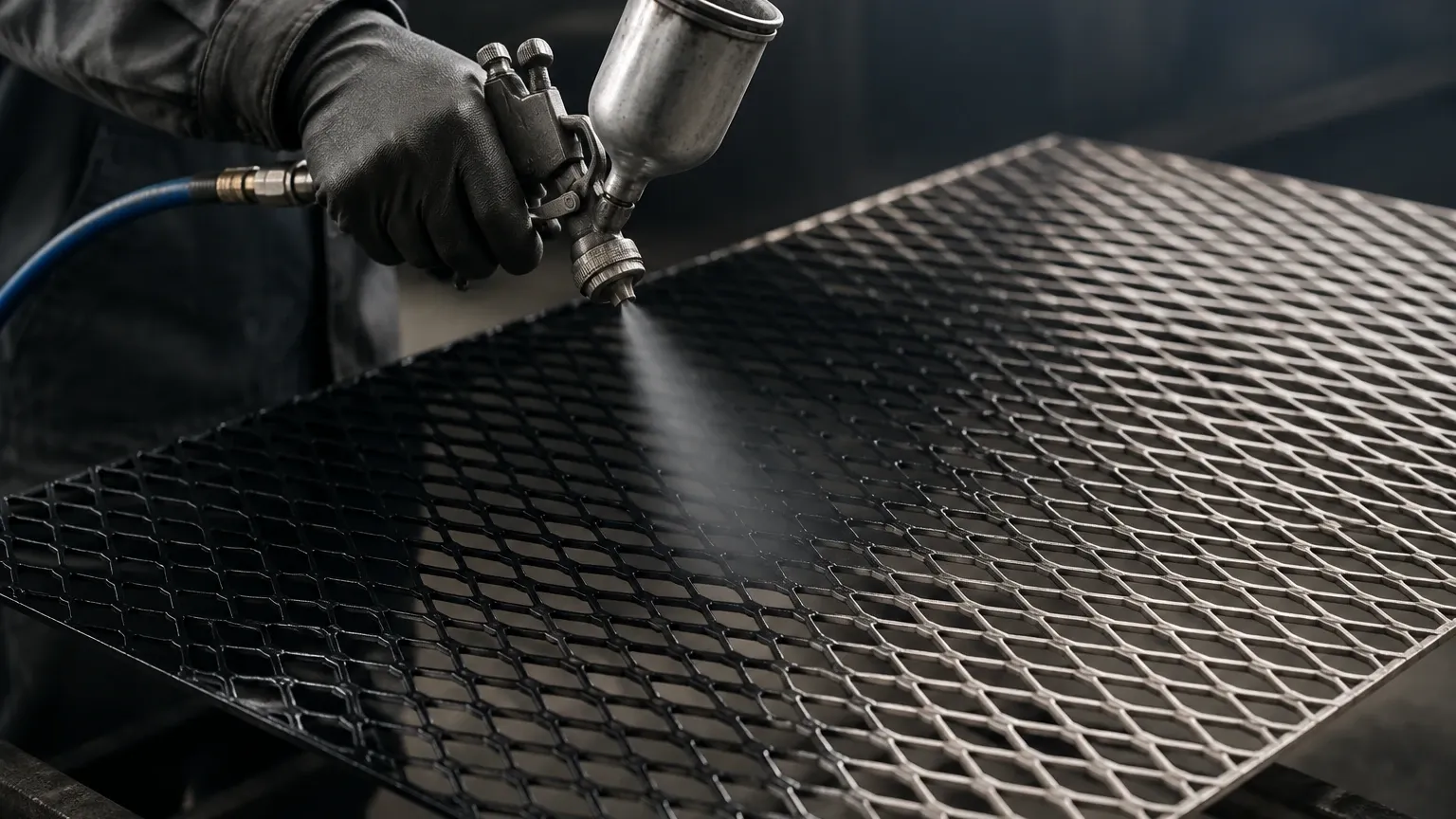
Conventional Airless Spray
While common in field applications, conventional spraying is often the least efficient method for expanded metal. The high volume of air can cause "bounce-back," and the lack of electrostatic attraction means much of the paint passes through the holes of the mesh, leading to high material loss and uneven coverage on the strand profiles.
Engineering Considerations for Filtration Performance
When specifying a painted finish for Perforated & Expanded Metal in a filtration system, engineers must calculate the impact of the coating thickness on the mesh's performance metrics.
* Open Area Reduction: A standard powder coating might add 2 to 4 mils (50 to 100 microns) of thickness to each side of a strand. On a fine expanded metal mesh, this can significantly reduce the percentage of open area. For example, if the original opening is 1mm wide and the coating adds 0.1mm to each side, the opening narrows to 0.8mm, a 20% reduction in linear dimension and an even larger reduction in total flow area.
* Flow Resistance: The added thickness and potential change in surface roughness can alter the flow dynamics (laminar vs. turbulent) of the fluid passing through the filter. This may necessitate a redesign of the pump or housing to accommodate the increased pressure drop.
* Thermal Conductivity: In heat exchange applications where expanded metal acts as a substrate, the insulating properties of a thick paint layer can impede thermal transfer. In such cases, thin-film coatings or specialized conductive paints may be required.
Maintenance and Replacement Cycles
In industrial settings, the "best way to paint expanded metal" also involves planning for the long term. Even the highest quality coating will eventually degrade under the stress of constant flow, chemical cleaning cycles, or mechanical vibration.
Technical teams should establish an inspection schedule to check for "pinholing" or localized corrosion at the bonds. If the expanded metal is part of a removable filter cartridge, it is often more cost-effective to replace the component than to attempt a field recoat, as achieving the necessary surface preparation on a used, contaminated filter is nearly impossible. However, for large architectural or structural expanded metal installations, localized touch-ups using high-solids epoxy repair kits can extend the service life significantly.
Conclusion
Selecting the best way to paint expanded metal is a technical decision that balances protection, performance, and cost. For most industrial B2B applications, electrostatic powder coating or E-coating provides the most reliable edge protection and uniform coverage required for demanding environments. By understanding the relationship between coating thickness and filtration efficiency, engineers can ensure that their Perforated & Expanded Metal components provide long-lasting service without compromising on technical specifications.
When ordering custom filtration solutions, it is essential to communicate the specific environmental challenges to the manufacturer. This allows for the selection of a coating system that is chemically compatible with the media being filtered and physically robust enough to withstand the rigors of industrial operation. Proper preparation, material selection, and application techniques turn a simple metal mesh into a high-performance industrial asset.
