


Best Way to Cut Expanded Metal
In industrial filtration and structural engineering, expanded metal is a staple material valued for its strength-to-weight ratio and open-area consistency. Unlike perforated metal, which is created by punching holes and removing material, expanded metal is produced by simultaneously slitting and stretching a solid sheet. This process creates a unique diamond-shaped pattern of strands and bonds. However, this complex geometry introduces specific challenges when it comes to fabrication. Determining the best way to cut expanded metal depends heavily on the material gauge, the required precision for the final component, and the specific industrial application, such as filter support cages or protective screens.
For engineers and procurement teams working with Perforated & Expanded Metal, selecting the correct cutting method is essential to maintain the structural integrity of the mesh and ensure the safety of the end-users. This guide evaluates the most effective techniques for cutting expanded metal in various industrial contexts.
Understanding Expanded Metal Geometry and Its Impact on Cutting
Before selecting a tool, it is critical to understand the two primary forms of expanded metal: standard (raised) and flattened.
1. Standard Expanded Metal: This material has strands that are turned at an angle to the plane of the sheet. Cutting this requires tools that can handle the varying heights and angles of the strands without snagging or causing excessive deformation.
2. Flattened Expanded Metal: This is standard expanded metal that has been cold-rolled to create a smooth, flat surface. It is generally easier to cut because it behaves more like a solid sheet of metal, though the internal stresses from the expanding process remain.
When searching for the best way to cut expanded metal, one must also consider the "bond" (where the strands intersect) and the "strand" itself. Cutting through a bond is significantly more difficult than cutting through a strand, and the choice of tool must account for this density variation.
Manual Tools for Light-Gauge and Small-Scale Cutting
For thin-gauge materials—typically 18 gauge or lighter—manual tools offer portability and control for small-scale adjustments or prototype development.
Tin Snips and Aviation Snips
For very light expanded metal or fine wire mesh, aviation snips are often sufficient. They allow for detailed maneuvering around corners. However, they are labor-intensive and can cause significant hand fatigue if used for long runs. They also tend to slightly bend the edges of the strands, which may require post-cut straightening.
Bolt Cutters
When working with heavy-duty expanded metal used for security grates or large-scale industrial guards, bolt cutters are a viable manual option. They are particularly effective at cutting through the thick bonds of the mesh. The primary drawback is that bolt cutters do not provide a clean, straight line; they are best suited for rough sizing where the edge will later be concealed by a frame or U-edging.
Power Tools for Field Work and General Fabrication
For most industrial applications, power tools provide the necessary balance between speed and precision. The following methods are commonly employed in fabrication shops and on-site installations.
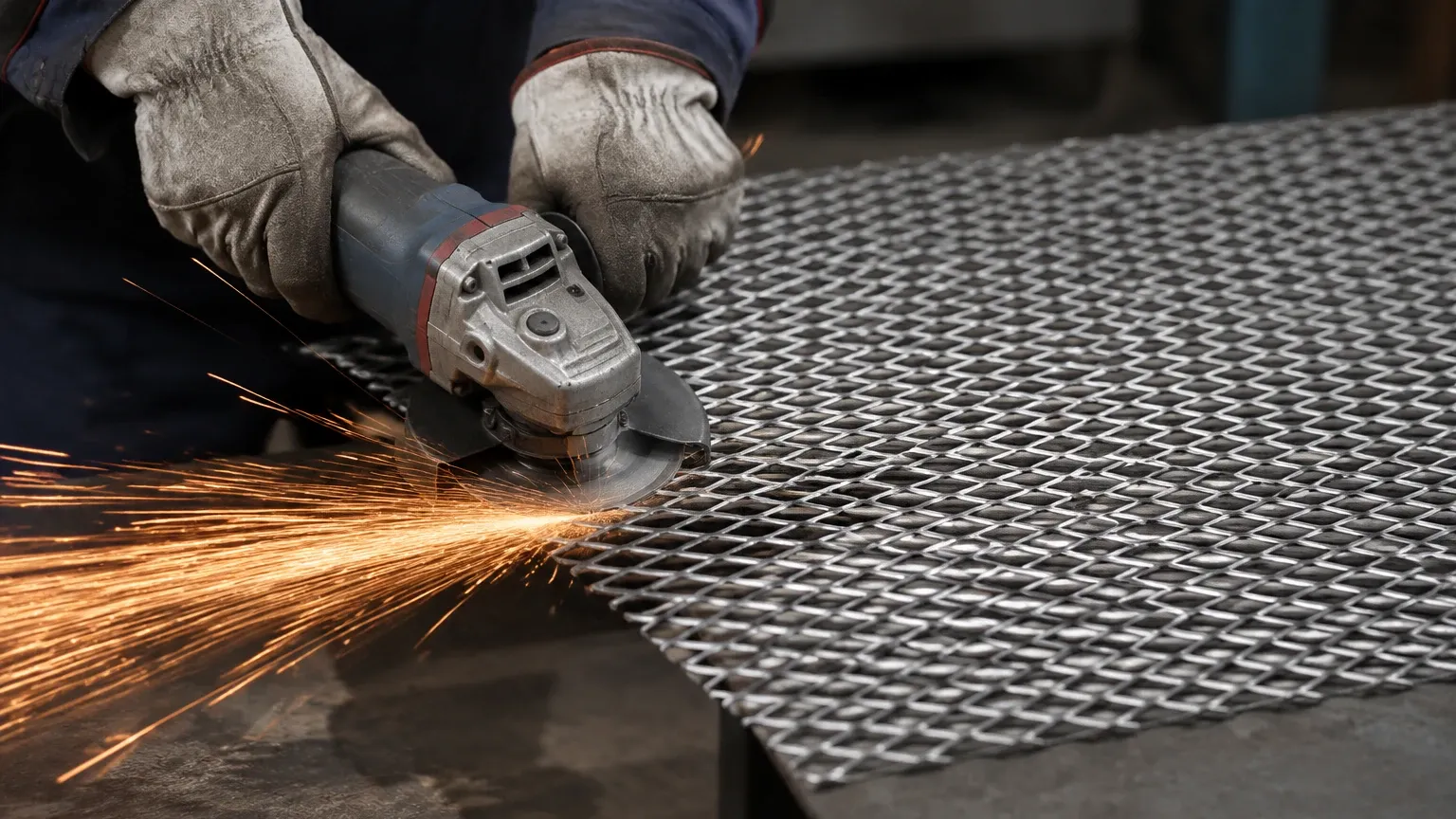
Angle Grinders with Thin Cut-Off Wheels
The angle grinder is perhaps the most versatile tool for this task. When equipped with a high-quality, thin (1/16 inch or less) abrasive cut-off wheel, it can slice through stainless steel expanded metal with relative ease.
* Technique: To achieve the best results, the material should be clamped firmly to a work surface. The operator should follow a marked line, allowing the speed of the wheel to do the work rather than applying excessive downward pressure, which can cause the wheel to shatter or the metal to overheat.
* Pros: Highly portable and capable of making both straight and curved cuts.
* Cons: Produces significant sparks and leaves a burred edge that requires secondary finishing.
Circular Saws with Metal-Cutting Blades
For long, straight cuts in flattened expanded metal, a circular saw equipped with a carbide-tipped metal-cutting blade is often the best way to cut expanded metal. These blades are designed to operate at lower RPMs than wood blades, effectively "chipping" away the metal rather than grinding it.
* Engineering Note: Using a circular saw on standard (raised) expanded metal can be dangerous, as the blade may catch on the angled strands. This method is strictly recommended for flattened varieties or very low-profile mesh.
Reciprocating Saws (Sawzalls)
While not the most precise, a reciprocating saw with a fine-tooth bi-metal blade (24 TPI or higher) is useful for demolition or quick rough-cutting of expanded metal panels. It is particularly effective when the metal is already installed in a frame and needs to be removed.
Industrial Precision Cutting for Filtration Components
In the production of high-performance filtration solutions, such as those provided by Kaifil, precision is paramount. When expanded metal serves as a support structure for fine wire mesh or as a primary filter medium, the edges must be exact and free of contamination.
Guillotine Shearing
Shearing is the standard industrial method for cutting expanded metal sheets into rectangular blanks. A large hydraulic shear can cut through an entire sheet in a single stroke.
* Precision: It provides a very straight edge, but it can cause "draw-down" or slight deformation at the edge of the strands.
* Application: Best for high-volume production where the mesh will be rolled into cylinders or welded into frames.
Plasma Cutting
For thicker stainless steel expanded metal (1/4 inch and above), CNC plasma cutting offers speed and the ability to cut complex shapes. Because plasma uses a high-velocity jet of ionized gas, it can navigate the voids in the expanded metal without the mechanical resistance that a saw blade would encounter.
Laser Cutting
Laser cutting is often considered the best way to cut expanded metal when the application requires extreme tolerances or intricate geometries. The narrow kerf of the laser ensures minimal material waste.
* Filtration Advantage: In filtration, where the structural integrity of every bond is vital to the pressure rating of a filter cartridge, laser cutting provides a clean, heat-sealed edge that minimizes the risk of strand breakage under high-flow conditions.
Waterjet Cutting
Waterjet cutting uses a high-pressure stream of water mixed with abrasive particles. This is a "cold" cutting process, meaning it does not create a Heat-Affected Zone (HAZ). For specialized stainless steel alloys used in chemical processing, avoiding HAZ is critical to preventing localized corrosion (sensitization) near the cut edges.
Safety and Engineering Considerations
Regardless of the method chosen, cutting expanded metal introduces specific safety risks and engineering requirements that must be addressed.
Managing Sharp Edges and Burrs
By its nature, cutting expanded metal leaves "sharps" or "teeth" along the perimeter. In a B2B context, these edges are not just a safety hazard for handlers; they can also damage delicate filter media if the expanded metal is used as a support pleat. Secondary operations such as deburring, grinding, or the application of U-edging (a C-channel trim) are standard requirements for finished components.
Structural Integrity and the "Random Cut" vs. "Bond Cut"
Engineers must specify whether a cut should be a "random cut" or a "bond cut."
* Random Cut: The cut falls wherever the line is drawn, often leaving partial strands that are sharp and structurally weak.
* Bond Cut: The cut is made specifically through the center of the bonds. This results in a much stronger edge and a more uniform appearance, though it requires more careful layout and may limit the exact dimensions of the piece.
Material Selection and Tool Wear
Stainless steel (304, 316, or 316L) is the preferred material for industrial filtration due to its corrosion resistance. However, it is significantly harder than carbon steel. When cutting stainless expanded metal, tools will dull faster, and heat buildup is more rapid. Using cobalt-enriched drill bits or specialized stainless-cutting abrasive wheels is necessary to maintain efficiency.
Summary of Selection Criteria
To determine the best way to cut expanded metal for your project, consider the following matrix:
| Requirement | Recommended Method |
| :— | :— |
| Portability / Field Work | Angle Grinder with thin cut-off wheel |
| High Volume / Straight Lines | Hydraulic Guillotine Shear |
| Intricate Shapes / High Precision | CNC Laser or Waterjet |
| Heavy Gauge / Thick Bonds | Plasma Cutting or Bolt Cutters |
| Thin Gauge / Prototypes | Aviation Snips or Handheld Power Shears |
Conclusion
Choosing the best way to cut expanded metal is a technical decision that impacts the durability, safety, and performance of the final industrial product. While manual tools and common power tools like angle grinders are suitable for general fabrication, precision applications—especially in the filtration and chemical processing industries—often demand the accuracy of CNC shearing, laser, or waterjet cutting.
At Kaifil, we understand that the quality of a filtration system is defined by the precision of its components. Whether you require custom-sized support cages or specialized Perforated & Expanded Metal components, our manufacturing expertise ensures that every cut meets rigorous industrial standards. By selecting the appropriate fabrication method and addressing post-cut finishing, engineers can ensure their expanded metal structures provide reliable service in even the most demanding environments.
