


Buy Expanded Metal
In industrial filtration and structural engineering, selecting the right materials is critical to ensuring system longevity and operational efficiency. When technical professionals and procurement teams look to buy expanded metal, they are often seeking a versatile, cost-effective, and rigid material that can withstand high-pressure environments while maintaining specific flow characteristics. Expanded metal is produced by simultaneously slitting and stretching a solid sheet of metal, creating a diamond-shaped pattern of openings. Unlike perforated metal, this process involves no material waste, making it an economically viable solution for large-scale industrial applications.
For engineers, the decision to incorporate expanded metal into a filtration system or structural assembly depends on a deep understanding of its mechanical properties, material compatibility, and the specific requirements of the application. Whether used as a support structure for fine wire mesh or as a standalone primary filter, the technical specifications of the material dictate its performance in the field.
Engineering Fundamentals of Expanded Metal
The manufacturing process of expanded metal distinguishes it from other mesh types. By using a specialized press that slits and stretches the base metal sheet, the resulting mesh is composed of interconnected strands and bonds. This integral structure provides a high strength-to-weight ratio, as the material remains a single piece of metal without the weak points often found in welded or woven alternatives.
When you buy expanded metal, you must choose between two primary forms: standard (raised) and flattened.
1. Standard Expanded Metal: This is the material as it comes off the machine. The strands and bonds are set at a uniform angle to the plane of the sheet. This configuration provides maximum rigidity and a slip-resistant surface, which is often beneficial in architectural or heavy-duty industrial support applications. In filtration, the raised profile can create turbulence, which may be desirable or detrimental depending on the fluid dynamics required.
2. Flattened Expanded Metal: This is standard expanded metal that has been cold-rolled through a mill to flatten the strands and bonds into the same plane as the sheet. Flattened expanded metal is thinner, smoother, and slightly longer than the original standard sheet. For filtration applications, particularly when the expanded metal serves as a support cage for delicate filter media, the flattened variety is often preferred to prevent abrasion or puncturing of the secondary media.
Critical Technical Parameters for Procurement
To ensure the material meets engineering standards, several dimensional parameters must be confirmed during the procurement process. These measurements define the geometry of the diamond openings and the overall thickness of the mesh.
* LWD (Long Way of Diamond): The distance from a point on a bond to the corresponding point on the next bond across the long axis of the diamond.
* SWD (Short Way of Diamond): The distance across the short axis of the diamond.
* LWO (Long Way of Opening): The internal dimension of the diamond across the long axis.
* SWO (Short Way of Opening): The internal dimension across the short axis. This is a critical metric for determining the size of particles that can pass through the mesh.
* Strand Width and Thickness: These dimensions determine the mechanical strength and the total open area of the sheet.
Calculating the open area is vital for filtration engineers. The open area percentage directly influences the pressure drop across the filter. A higher open area reduces resistance to flow but may compromise the structural integrity of the filter cartridge under high differential pressure. When looking to buy expanded metal, providing these exact dimensions to the manufacturer ensures that the resulting component will perform as expected within the calculated hydraulic parameters.
Material Selection for Demanding Industrial Environments
The environment in which the filter operates dictates the choice of material. Industrial filtration often involves exposure to corrosive chemicals, high temperatures, or strict sanitary requirements.
Stainless Steel
Stainless steel is the most common choice for high-performance filtration. Grades such as 304 and 316L offer excellent corrosion resistance. 316L, in particular, is favored in the pharmaceutical and chemical processing industries due to its low carbon content and resistance to pitting in chloride-rich environments. Stainless steel expanded metal maintains its structural integrity at elevated temperatures and is easy to clean, supporting a longer service life and lower total cost of ownership.
Aluminum
For applications where weight is a primary concern, aluminum expanded metal provides a lightweight alternative with moderate corrosion resistance. It is often used in air filtration systems and HVAC applications where high-strength steel is not required.
Carbon Steel and Specialized Alloys
Standard carbon steel is an economical choice for non-corrosive environments or where the material will be coated or galvanized. In highly specialized sectors, such as aerospace or high-heat chemical processing, alloys like Monel, Inconel, or titanium may be used to meet extreme performance benchmarks.
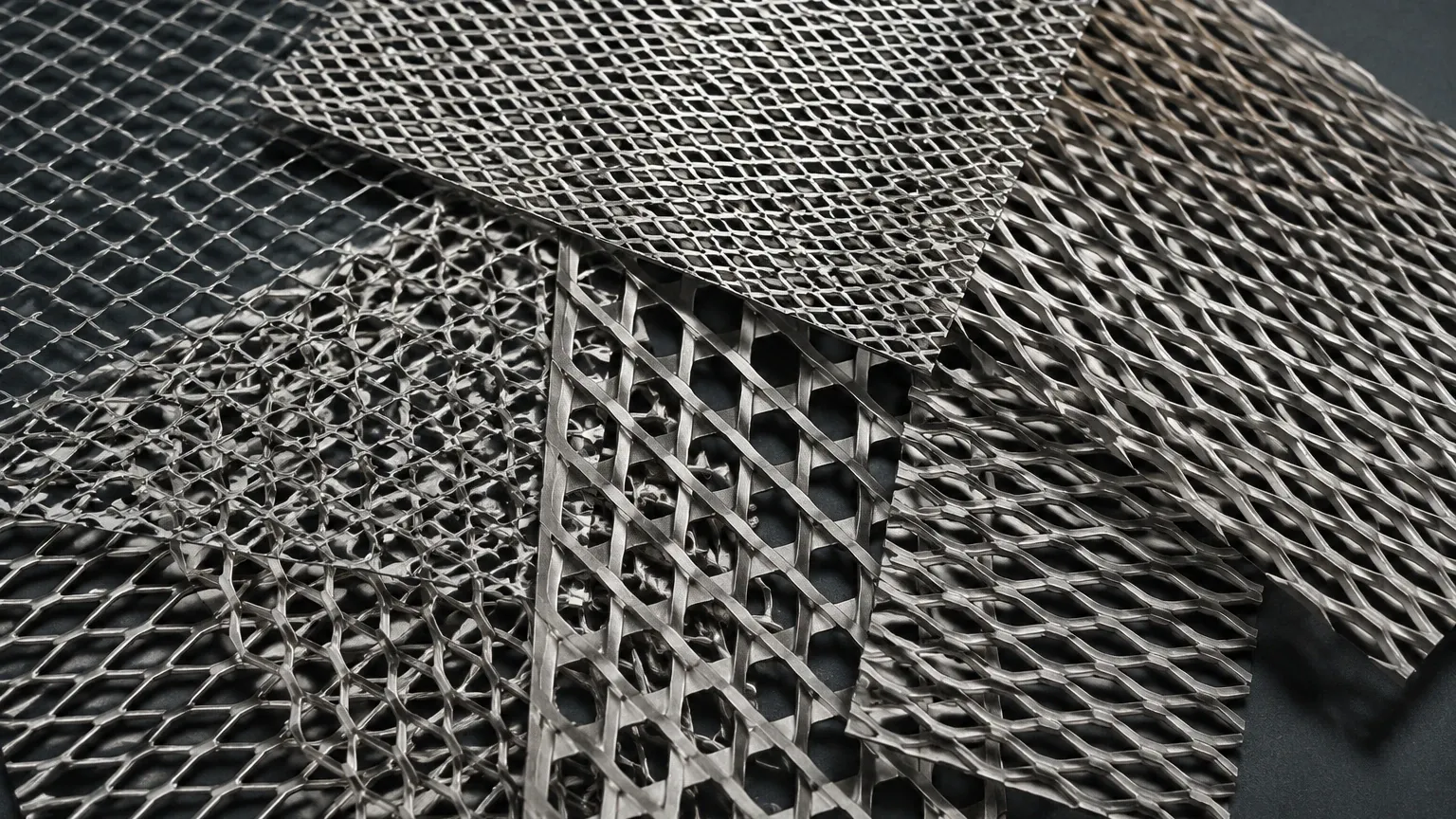
Integrating Perforated & Expanded Metal into Filtration Systems
In many industrial filter designs, expanded metal does not act alone. It is frequently integrated into multi-layer filter cartridges. Its primary role is often providing a rigid "skeleton" for finer filtration media like stainless steel wire mesh or non-woven fabrics.
In a typical cylindrical filter cartridge, the expanded metal can serve as the inner core or the outer protective wrap. As an inner core, it must resist the collapsing pressure of the fluid moving from the outside in. As an outer wrap, it protects the delicate inner mesh from mechanical damage during installation and maintenance. The choice between using perforated metal or expanded metal for these roles often comes down to the required open area and the specific mechanical stress the cartridge will face. Expanded metal typically offers a larger open area than perforated metal of similar strength, which can optimize flow rates and reduce the overall footprint of the filtration unit.
Evaluating Quality and Performance Expectations
When purchasing industrial filtration components, quality assurance is paramount. Engineers should evaluate several factors to ensure the expanded metal meets the rigors of industrial use:
1. Tolerances: Standard industry tolerances for expanded metal can vary. It is essential to specify the allowable variance in LWD, SWD, and overall sheet dimensions, especially if the material is to be automatically welded into filter housings.
2. Edge Conditions: Expanded metal can be supplied with "random" edges (where diamonds are cut through) or "bond" edges (where the cut follows the solid bond). For safety and ease of assembly, bond edges are often preferred, though they may increase production costs.
3. Surface Finish: For food, beverage, and pharmaceutical applications, the surface must be free of burrs, oils, and residues. Processes such as electropolishing or ultrasonic cleaning may be necessary to meet hygienic standards.
4. Flatness and Camber: In high-speed assembly lines, the flatness of the sheet or coil is critical. Excessive camber (the deviation of a side edge from a straight line) can cause alignment issues during the forming of filter cylinders.
Procurement Strategy: Customization and OEM Considerations
Standard off-the-shelf expanded metal rarely meets the precise needs of complex industrial filtration. Most engineering projects require customized solutions tailored to specific flow rates, pressure ratings, and chemical exposures.
Working with a manufacturer that offers OEM capabilities allows for the development of bespoke patterns and sizes. This includes choosing specific strand widths to balance weight and strength or selecting a unique diamond size to optimize the support of a specific wire mesh grade. Furthermore, a manufacturer with expertise in both Perforated & Expanded Metal can provide technical guidance on which material type is better suited for a particular application, considering factors like the direction of flow and the potential for particulate buildup.
When preparing to buy expanded metal for a project, engineers should confirm the following with their supplier:
* Material Certification: Ensure the raw material meets ASTM or ISO standards.
* Secondary Processing: Can the supplier provide cutting, forming, or welding services to deliver a semi-finished or finished component?
* Prototyping: For new filter designs, is there an option for small-batch production to test performance before committing to large-scale procurement?
By focusing on these technical details, purchasing teams can avoid common pitfalls such as premature filter failure, excessive pressure drops, or material incompatibility. The goal is to secure a component that contributes to the overall reliability of the industrial process while maintaining cost-efficiency over the product's lifecycle.
