


California Expanded Metal Products
In the industrial landscape of the Western United States, particularly within the diverse manufacturing sectors of California, expanded metal products serve as critical components for filtration, structural support, and safety guarding. For engineers and procurement professionals, selecting the right material—whether for a chemical processing plant in the Central Valley or a high-tech water treatment facility in Southern California—requires a deep understanding of material science and mechanical properties.
As a specialized manufacturer, Kaifil provides precision-engineered solutions that meet the rigorous demands of these industries. This guide explores the technical nuances of perforated and expanded metal, focusing on the engineering considerations necessary to optimize performance in industrial filtration and structural applications.
Engineering Fundamentals: Expanded vs. Perforated Metal
When evaluating california expanded metal products, it is essential to distinguish between the two primary methods of creating open-area metal sheets: expanding and perforating. Each process yields different mechanical properties and performance characteristics.
The Expansion Process
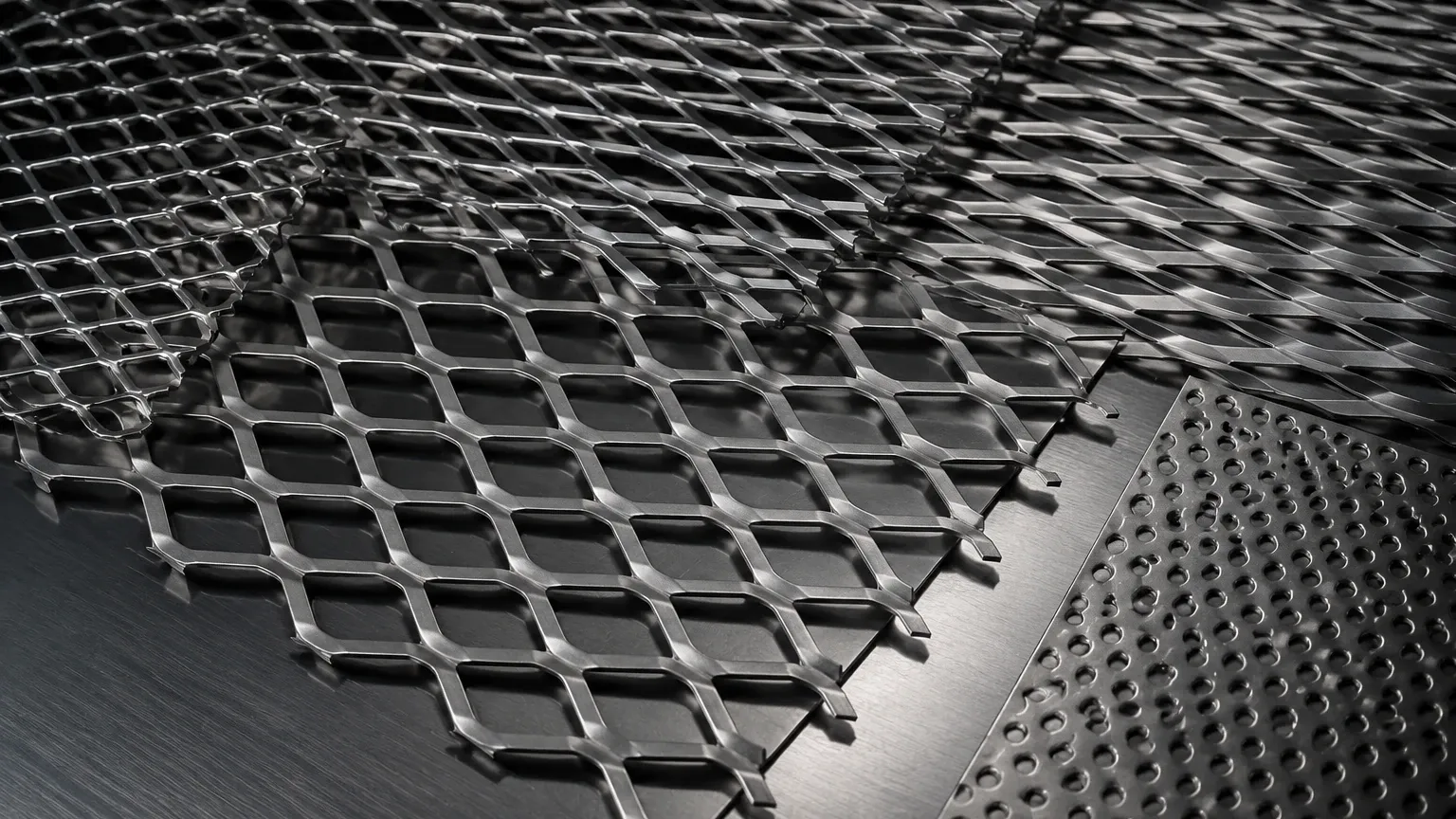
Expanded metal is manufactured by simultaneously slitting and stretching a solid sheet of metal. This process creates a diamond-shaped pattern of openings. Because the metal is stretched rather than punched, there is zero material waste, making it a highly cost-effective and sustainable option for large-scale industrial projects.
The resulting product features "strands" and "bonds." The strands are the individual strips of metal that form the diamond pattern, while the bonds are the points where the strands intersect. This structure provides exceptional strength-to-weight ratios. In filtration, the angular orientation of the strands can be used to influence flow dynamics or provide mechanical support for finer mesh layers.
The Perforation Process
Perforated metal is created by punching a series of holes into a solid sheet using a CNC press or rotary pin. Unlike expanded metal, perforation allows for a wide variety of hole shapes, including round, square, slotted, and decorative patterns. This process offers higher precision in terms of open-area percentage and hole placement, which is critical for applications requiring exact filtration ratings or specific pressure drop characteristics.
For many industrial applications, Perforated & Expanded Metal components are used in tandem. For example, a perforated cylinder may act as the primary structural cage for an expanded metal support layer that holds a fine wire mesh filter media.
Material Selection for Demanding Industrial Environments
The performance of expanded metal products is heavily dependent on the alloy selected. In the California market, where industries range from aerospace and defense to food processing and viticulture, material compatibility is a primary engineering concern.
Stainless Steel (304 and 316L)
Stainless steel is the gold standard for industrial filtration. Type 304 offers excellent corrosion resistance and is suitable for most general-purpose applications. However, for environments involving high chloride concentrations or acidic chemicals—common in pharmaceutical and chemical processing—Type 316L is preferred. The addition of molybdenum in 316L provides superior resistance to pitting and crevice corrosion.
Carbon Steel and Galvanized Options
For structural applications where corrosion is less of a concern, or where the component will be coated (such as powder coating or painting), carbon steel expanded metal is a cost-effective choice. Galvanized steel provides an intermediate level of protection, suitable for outdoor structural use or HVAC intake screens.
Specialty Alloys
In high-temperature or highly corrosive environments, engineers may specify exotic alloys such as Monel, Inconel, or Hastelloy. These materials are often required in California’s oil and gas refineries or specialized chemical synthesis plants where standard stainless steels would fail prematurely.
Key Performance Metrics: Open Area and Flow Dynamics
For filtration engineers, the most critical specification for any Perforated & Expanded Metal component is the percentage of open area. This metric directly influences two vital performance factors: filtration efficiency and pressure drop.
Calculating Open Area
* Expanded Metal: The open area is determined by the Long Way of the Diamond (LWD) and the Short Way of the Diamond (SWD), along with the strand width. Because the strands are often angled (in "raised" expanded metal), the effective open area can change depending on the angle of the fluid flow.
* Perforated Metal: The calculation is more straightforward. For a 60-degree staggered round hole pattern, the formula is:
`% Open Area = (D² × 90.69) / P²`
*(Where D is hole diameter and P is center-to-center pitch)*.
Pressure Drop (ΔP)
A higher open area generally results in a lower pressure drop, which reduces the energy requirements for pumps and fans. However, increasing the open area often decreases the structural integrity of the sheet. Engineers must find the "sweet spot" where the metal is strong enough to withstand the system's operating pressure (including potential pressure spikes) while maintaining the desired flow rate.
Structural Applications and Load-Bearing Capacity
Beyond filtration, california expanded metal products are widely used for structural safety and architectural purposes. In industrial settings, these include:
1. Machine Guarding: Expanded metal provides a high-visibility barrier that protects personnel from moving parts while allowing for airflow and heat dissipation.
2. Catwalks and Grating: Heavy-duty expanded metal (often called "Expanded Metal Grating") provides a slip-resistant surface for industrial flooring. The raised strands offer excellent traction, even in wet or oily conditions.
3. Filter Support Cages: In high-pressure hydraulic or gas filtration systems, the filter media (such as sintered mesh or fiber felt) lacks the structural strength to resist collapse. A perforated or expanded metal core provides the necessary rigid skeleton.
When specifying metal for load-bearing applications, engineers must consider the "direction of the diamond." Expanded metal is significantly stronger when the load is applied across the Short Way of the Diamond (SWD) rather than the Long Way (LWD).
Customization and OEM Capabilities
Kaifil specializes in providing customized filtration solutions that go beyond off-the-shelf specifications. For OEM manufacturers in California and globally, customization is often the key to optimizing a system's total cost of ownership.
Flattened vs. Raised Expanded Metal
* Raised (Standard): The metal is slit and stretched, leaving the strands at an angle to the plane of the sheet. This creates a 3D surface that is excellent for traction and certain types of mechanical filtration.
* Flattened: The raised expanded metal is passed through a cold-rolling reducing mill. This flattens the strands and bonds back into a single plane, resulting in a smooth surface. Flattened expanded metal is often preferred when the component needs to be bonded to other materials or when a smooth finish is required for safety.
Edge Treatments and Fabrication
Customized components can be supplied with specific edge treatments to facilitate installation. This includes "random sheared" edges (where diamonds are cut mid-pattern) or "bond sheared" edges (where the cut follows the intersection points). Furthermore, Kaifil offers secondary fabrication services, including rolling perforated sheets into cylinders, welding end caps, and applying specialized surface finishes like electropolishing for pharmaceutical-grade components.
Evaluating Suppliers and Quality Assurance
When procuring california expanded metal products, technical professionals must look beyond the unit price. The total cost of ownership is influenced by the precision of the manufacturing and the reliability of the supplier.
Material Traceability
In regulated industries such as food and beverage or aerospace, material traceability is non-negotiable. Quality suppliers provide Mill Test Reports (MTRs) that verify the chemical composition and physical properties of the metal batch used. This ensures that a "316L" component actually meets the low-carbon requirements necessary to prevent sensitization during welding.
Dimensional Tolerances
Industrial filtration systems often have tight tolerances. A deviation of even a few millimeters in the diameter of a filter support cage can lead to bypass—where unfiltered fluid escapes around the filter element. Engineers should confirm that their supplier uses precision shearing and forming equipment to maintain strict dimensional accuracy.
Quality Standards
Look for manufacturers that adhere to international quality management systems, such as ISO 9001. This ensures that every step of the production process, from material intake to final inspection, is documented and controlled.
Maintenance and Replacement Cycles
To ensure the longevity of Perforated & Expanded Metal components, a proactive maintenance schedule is required. In filtration applications, the primary concern is "blinding" or "plugging," where particles become lodged in the openings.
Cleaning Methods
* Backwashing: For many liquid filtration systems, reversing the flow can dislodge particles from the expanded metal support.
* Ultrasonic Cleaning: For high-value stainless steel filters, ultrasonic baths can remove fine contaminants that mechanical scrubbing cannot reach.
* Chemical Cleaning: In the food and beverage industry, Clean-in-Place (CIP) systems use caustic or acidic solutions to sanitize metal components. This is why 316L stainless steel is frequently specified for its resistance to these cleaning agents.
Indicators for Replacement
Components should be inspected for signs of mechanical fatigue, such as cracked bonds in expanded metal or deformed holes in perforated sheets. If the pressure drop across a clean filter remains higher than the baseline, it may indicate permanent fouling or structural collapse, necessitating immediate replacement to prevent downstream contamination.
Conclusion: Selecting the Right Solution
Choosing between perforated and expanded metal—and selecting the appropriate alloy and pattern—requires a balance of mechanical engineering, chemistry, and fluid dynamics. For the California industrial sector, where innovation and efficiency are paramount, partnering with a manufacturer like Kaifil ensures that these components are not just "parts," but engineered solutions tailored to specific application needs.
Whether you are designing a new filtration system or seeking to optimize an existing process, focusing on material integrity, open-area precision, and structural durability will lead to better performance and lower long-term costs. By understanding the technical boundaries of california expanded metal products, engineers can make informed decisions that enhance the reliability of their industrial operations.
