


Copper Expanded Metal Mesh
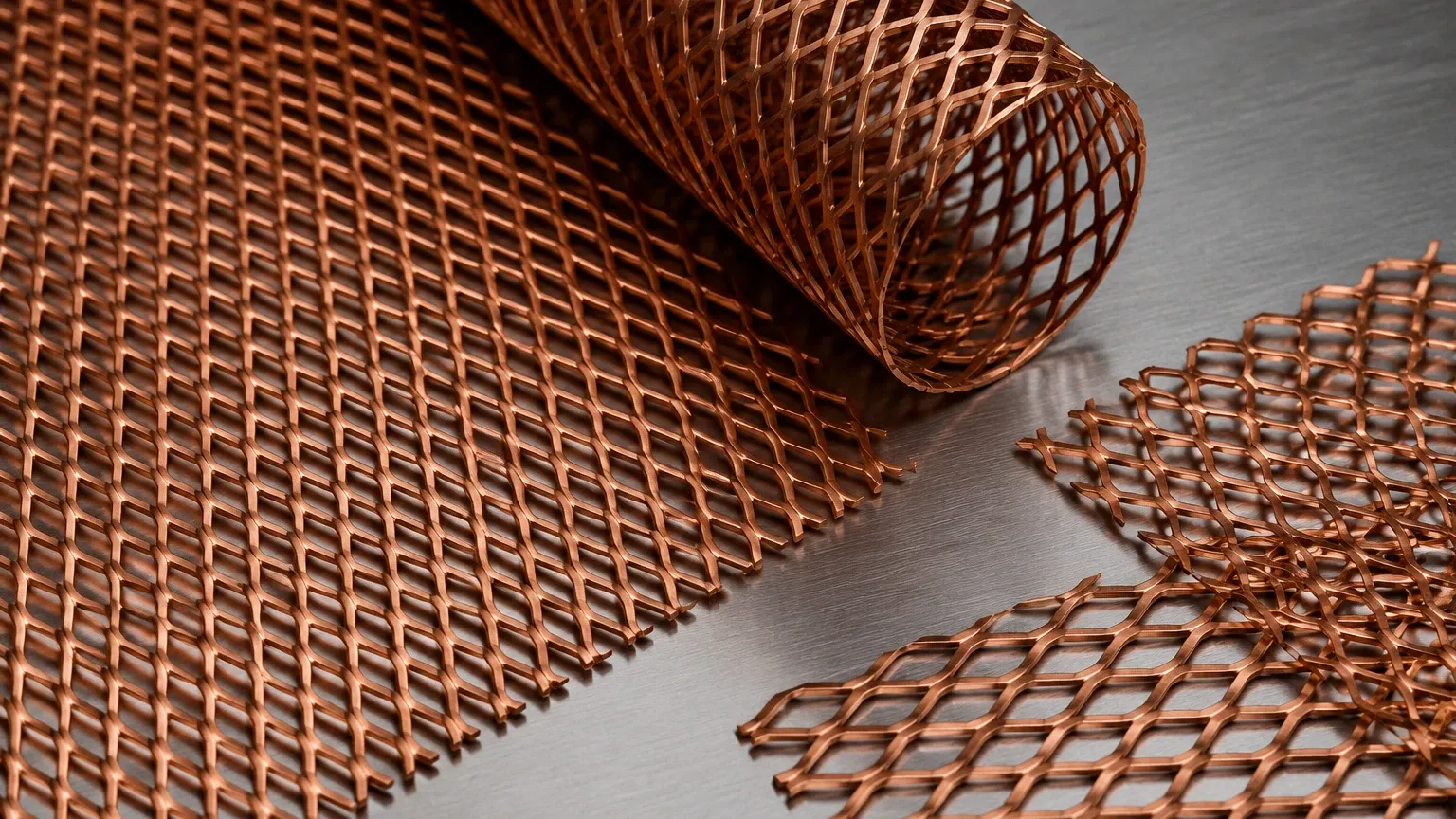
In the landscape of industrial materials, copper expanded metal mesh represents a specialized solution that combines the unique physical properties of copper with the structural advantages of the expansion process. Unlike perforated metals, which are created by punching holes and removing material, expanded metal is manufactured by simultaneously slitting and stretching a solid sheet. This process creates a continuous, jointless mesh that maintains the structural integrity of the original metal while offering significant weight reduction and increased surface area.
For engineers and procurement professionals, selecting the right Perforated & Expanded Metal requires a deep understanding of material grades, geometric specifications, and the specific demands of the application environment. Copper, specifically, is chosen not just for its aesthetic appeal, but for its superior electrical and thermal conductivity, corrosion resistance, and antimicrobial properties. This guide explores the technical nuances of copper expanded metal mesh to assist in informed decision-making for industrial filtration, shielding, and structural components.
Understanding the Manufacturing and Structure of Copper Expanded Metal
The production of copper expanded metal mesh involves a precision machine that slits and stretches copper sheets in a single motion. This results in a diamond-shaped pattern. Because no material is lost during the manufacturing process—unlike perforated metal where the "slugs" are discarded—expanded metal is often a more cost-effective and environmentally sustainable choice for high-value materials like copper.
The Geometry of the Mesh
To specify copper expanded metal mesh accurately, engineers must utilize four primary measurements:
1. Long Way of Diamond (LWD): The distance from the center of a joint to the center of the next joint across the long axis of the diamond.
2. Short Way of Diamond (SWD): The distance from the center of a joint to the center of the next joint across the short axis of the diamond.
3. Strand Width: The amount of metal fed into the precision dies for each stroke.
4. Strand Thickness: The gauge or thickness of the original copper sheet.
These dimensions dictate the "open area" percentage, which is critical for applications involving fluid flow, air ventilation, or light transmission. A larger open area reduces weight and resistance but may sacrifice structural rigidity.
Material Properties: Why Choose Copper for Industrial Mesh?
Copper is a non-ferrous metal that offers a distinct set of characteristics that stainless steel or aluminum cannot match in certain environments. When processed into a copper expanded metal mesh, these properties are leveraged for high-performance industrial tasks.
Electrical and Thermal Conductivity
Copper is the gold standard for conductivity among non-precious metals. In expanded form, it provides an excellent path for heat dissipation and electrical grounding. This makes it a preferred material for battery electrodes, fuel cells, and heat exchangers. The expanded structure increases the surface area-to-volume ratio, enhancing the efficiency of thermal transfer.
Corrosion Resistance
Copper develops a protective patina (typically a brownish or greenish carbonate layer) when exposed to the atmosphere, which inhibits further corrosion. This makes it suitable for marine environments or industrial settings where moisture is prevalent. However, engineers must be cautious of galvanic corrosion if the copper mesh comes into contact with dissimilar metals in the presence of an electrolyte.
Antimicrobial Efficacy
Copper is inherently antimicrobial. In food processing or pharmaceutical filtration environments, copper surfaces can actively reduce the growth of bacteria and fungi. While stainless steel is more common in these industries due to its ease of cleaning with harsh chemicals, copper expanded mesh is utilized in specialized filtration stages where microbial control is a secondary functional requirement.
Technical Specifications and Engineering Parameters
When integrating copper expanded metal mesh into a system, several engineering parameters must be evaluated to ensure performance and longevity.
Raised vs. Flattened Mesh
There are two primary forms of expanded metal:
* Raised (Standard) Expanded Metal: This is the mesh as it comes off the machine. The strands are set at an angle to the plane of the sheet. This creates a 3D texture that provides excellent grip and high structural strength. In filtration, raised mesh can create turbulence, which may be desirable or detrimental depending on the flow dynamics required.
* Flattened Expanded Metal: The raised mesh is passed through a cold-rolling reducing mill. This flattens the strands and bonds into a single plane. Flattened copper mesh is thinner, smoother, and slightly elongated. It is often used as a support layer for finer filter media (like wire mesh) because the smooth surface prevents the delicate mesh from being punctured or abraded under pressure.
Material Grades
Most industrial copper expanded mesh is produced from high-purity electrolytic tough pitch (ETP) copper (such as C11000). For applications requiring even higher conductivity or specific welding characteristics, oxygen-free copper may be specified. It is essential to confirm the material grade to ensure it meets the chemical resistance requirements of the intended application.
Key Applications in Industrial Filtration and Shielding
Copper expanded metal mesh serves critical roles across various sectors, particularly where its conductive and structural properties intersect.
EMI and RFI Shielding
One of the most prominent uses for copper expanded mesh is Electromagnetic Interference (EMI) and Radio Frequency Interference (RFI) shielding. The mesh acts as a Faraday cage, protecting sensitive electronic components from external signals or preventing internal signals from escaping. Because it is expanded, it allows for airflow and visibility while maintaining electrical continuity across the shield.
Industrial Filtration Support
In the filtration industry, copper mesh often acts as a "spacer" or a "support pleat" in high-temperature or high-conductivity environments. It provides the necessary rigidity to maintain the shape of a filter cartridge under high differential pressure. In hydraulic systems, copper components may be used to prevent static buildup within the fluid, which can occur with certain synthetic oils and non-conductive filter media.
Chemical Processing and Catalysis
Due to its reactive surface area, expanded copper can be used as a substrate for catalysts in chemical reactors. The diamond apertures allow for uniform distribution of gases or liquids across the catalytic surface, optimizing the reaction rate.
Evaluation Criteria and Quality Control for Procurement
Buying copper expanded metal mesh for industrial use involves more than just checking dimensions. Quality control is paramount to ensure the mesh performs reliably over its service life.
Dimensional Tolerances
Engineers should specify tolerances for LWD, SWD, and overall sheet flatness. In precision filtration, even a slight deviation in strand width can alter the flow characteristics or the structural integrity of the filter element. Standard industrial tolerances are usually sufficient, but custom applications may require tighter controls.
Surface Finish and Cleanliness
For pharmaceutical and food-grade applications, the mesh must be free of oils, lubricants, and burrs. The expansion process uses lubricants to prevent the copper from tearing; these must be thoroughly removed through ultrasonic cleaning or chemical degreasing before the mesh is integrated into a final product.
Edge Treatment
Expanded metal has "sharp" edges where the diamonds are cut. For many B2B applications, the mesh is supplied with "random sheared" edges, meaning the cut can occur anywhere through the diamond. If the mesh is to be handled frequently or integrated into a housing without a frame, "bond sheared" edges (cut through the joints) or U-edging may be required to prevent injury and ensure a secure fit.
Addressing Common Risks in Mesh Selection
While copper is a robust material, certain risks must be mitigated during the design phase.
1. Work Hardening: Copper work-hardens during the expansion process. If the mesh needs to be further formed, pleated, or bent into tight radii, it may require annealing to restore ductility. Failure to account for work hardening can lead to cracking at the joints of the diamonds.
2. Structural Deformation: Copper is softer than stainless steel. Under high pressure or mechanical load, copper expanded metal mesh may deform more easily. Engineers should calculate the required strand thickness to ensure the mesh can withstand the operational stresses without collapsing.
3. Environmental Compatibility: While copper is resistant to many environments, it is susceptible to attack by ammonia, certain acids, and high-sulfur environments. A compatibility study should be performed if the mesh will be exposed to aggressive chemicals.
Customization and OEM Solutions
In many industrial scenarios, off-the-shelf mesh does not meet the exact requirements of a specialized filtration system or electronic enclosure. This is where OEM and customized manufacturing become essential. Customization options for copper expanded metal mesh include:
* Variable Mesh Density: Adjusting the LWD and SWD to achieve specific filtration ratings or shielding effectiveness.
* Custom Sheet Sizes: Reducing waste by ordering mesh cut to the exact dimensions required for the final assembly.
* Integrated Components: Combining the expanded mesh with frames, connectors, or other filtration layers (such as stainless steel wire mesh) to create a complete filtration component.
Working with a manufacturer that understands the interplay between material science and mechanical design allows for the development of high-performance components that meet specific application requirements. Whether it is material selection for a chemical processing plant or defining the filtration accuracy for a hydraulic system, technical expertise is the bridge between a raw material and a functional solution.
Conclusion
Copper expanded metal mesh is a high-performance material that offers unique advantages in conductivity, antimicrobial properties, and structural efficiency. By understanding the technical parameters—from LWD/SWD dimensions to the choice between raised and flattened profiles—engineers can optimize their designs for durability and cost-effectiveness. As industries move toward more specialized and efficient filtration and shielding solutions, the role of precision-manufactured metal components continues to grow. For those seeking reliable, high-quality Perforated & Expanded Metal, focusing on technical accuracy and material purity is the key to achieving long-term operational success.
