


Expanded Mesh 7503
In industrial filtration and structural engineering, the selection of support media is as critical as the selection of the primary filter membrane. Expanded mesh 7503 represents a specific category of precision-engineered material used extensively where high structural integrity must be balanced with a high percentage of open area. As a specialized pattern within the broader field of Perforated & Expanded Metal, the 7503 specification is frequently sought after by engineers for its unique geometric properties and its performance in demanding fluid dynamics environments.
Understanding the technical nuances of expanded mesh 7503 is essential for procurement teams and design engineers who require reliable components for chemical processing, hydraulic systems, and high-pressure water treatment. This article examines the technical specifications, manufacturing considerations, and application-specific advantages of this material.
Technical Specifications of Expanded Mesh 7503
The nomenclature "7503" typically refers to the diamond dimensions and the strand thickness of the mesh. In the context of industrial expanded metal, these figures define the Short Way of the Diamond (SWD) and the Long Way of the Diamond (LWD), along with the strand width and the base material thickness.
For expanded mesh 7503, the geometry is characterized by a relatively small diamond opening. This fine structure makes it an ideal candidate for supporting delicate filter media, such as wire cloth or non-woven membranes, preventing them from collapsing under high differential pressure.
Key Geometric Parameters:
* SWD (Short Way of Diamond): The distance from the center of a bond to the center of the next bond across the short axis.
* LWD (Long Way of Diamond): The distance across the long axis of the diamond opening.
* Strand Width: The amount of metal between the openings.
* Strand Thickness: The gauge of the original sheet before expansion.
* Open Area Percentage: A critical calculation for engineers to determine flow rates and pressure drop. Expanded mesh 7503 is designed to maximize this percentage while maintaining the rigidity of the metal frame.
Manufacturing Process and Material Integrity
Unlike perforated metal, which is created by punching holes and removing material, expanded mesh is produced through a simultaneous slitting and stretching process. This manufacturing method offers two distinct advantages for B2B applications: it produces zero waste (as no metal is removed) and it results in a continuous piece of material without joins or welds within the mesh structure itself.
When specifying expanded mesh 7503, material selection is paramount. At Kaifil, we prioritize stainless steel—specifically grades 304, 316, and 316L—due to their superior corrosion resistance and mechanical strength. In chemical processing or pharmaceutical applications, the use of 316L stainless steel ensures that the mesh can withstand aggressive cleaning agents and high-temperature sterilization cycles without compromising the structural integrity of the filter cartridge.
The Role of Expanded Mesh 7503 in Industrial Filtration
In many high-performance filtration systems, expanded mesh 7503 serves as the "backbone" of the filter element. Its primary role is to provide a rigid cage or support layer that protects the finer filtration media from mechanical stress.
Pleated Filter Support
In pleated filter cartridges, expanded mesh 7503 is often used as an inner or outer support layer. Because the mesh is expanded rather than woven, it does not have intersecting wires that can shift or fray. This stability ensures that the pleats remain evenly spaced, which is vital for maintaining a consistent surface area and preventing "pleat blinding," where the folds of the filter close up under pressure.
Pre-Filtration and Debris Capture
While often used as a support structure, expanded mesh 7503 can also function as a primary pre-filter. Its diamond-shaped openings are effective at capturing larger particulate matter before it reaches more expensive, fine-micron stages. The angular nature of the strands in the 7503 pattern helps to break up flow patterns, which can sometimes assist in the impingement of particles in gas filtration applications.
Engineering Considerations: Flow and Pressure Drop
One of the most common questions engineers face when selecting Perforated & Expanded Metal is how the mesh geometry will impact the total cost of operation through energy consumption. The pressure drop ($ΔP$) across a filter is directly influenced by the open area of the support mesh.
Expanded mesh 7503 is engineered to provide a high strength-to-weight ratio. This allows designers to use thinner strands without sacrificing the burst pressure rating of the filter. By optimizing the strand angle and width, manufacturers can ensure that the mesh provides minimal resistance to fluid flow. Engineers must confirm the following before finalizing a 7503 specification:
1. Direction of Flow: The orientation of the diamond (LWD vs. SWD) relative to the flow can affect turbulence and pressure loss.
2. Bond Area: The size of the "bond" (where the strands meet) affects the overall rigidity. A larger bond increases strength but reduces the open area.
3. Surface Finish: For food and beverage or pharmaceutical use, the mesh may require electropolishing to remove microscopic burrs and ensure a smooth, easy-to-clean surface.
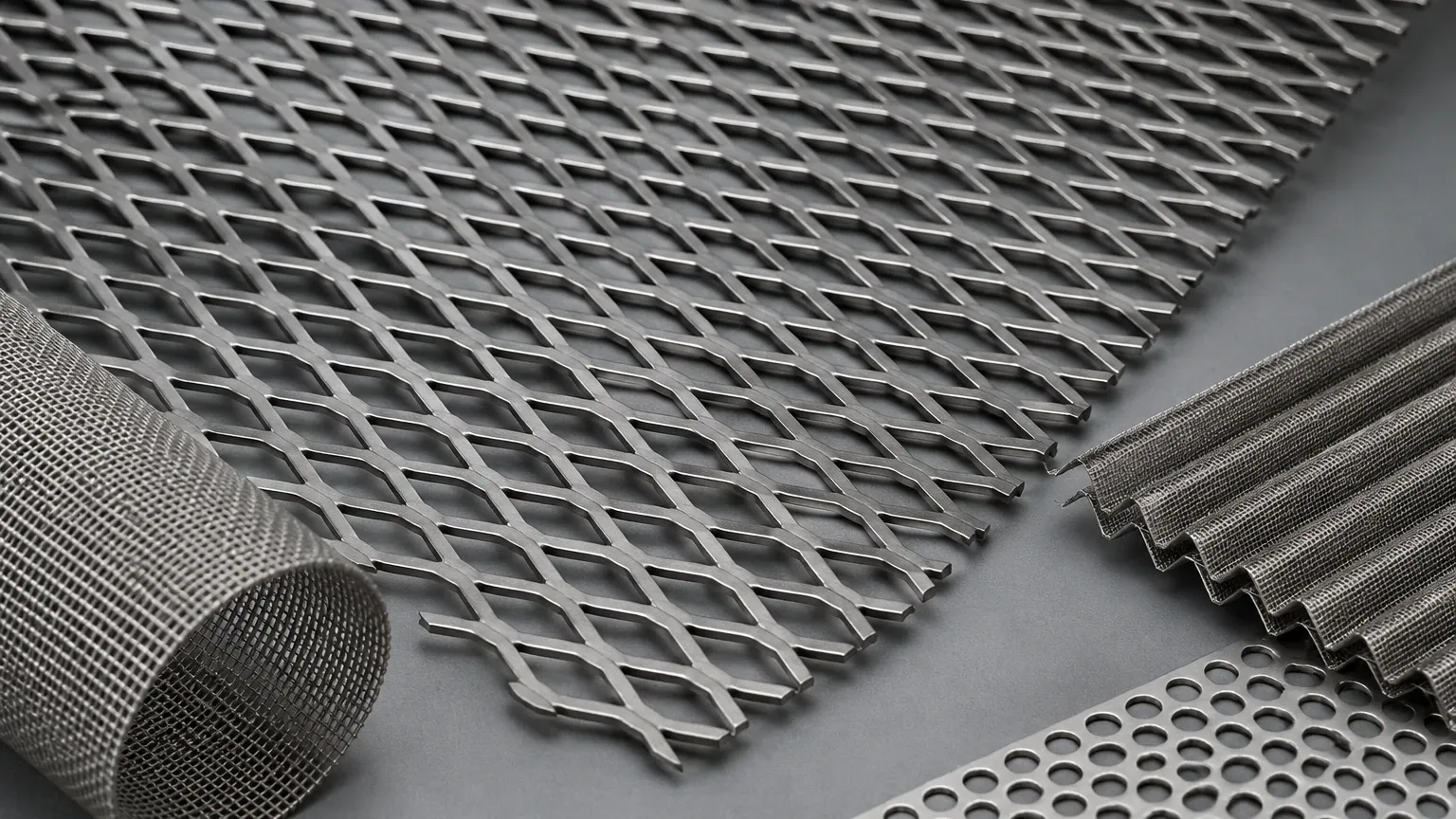
Comparing Expanded Mesh to Perforated Metal
While both expanded mesh 7503 and perforated metal are used for filtration support, they offer different performance profiles. Perforated metal provides a flat surface which is easier to weld into cylinders, but it involves higher material waste and often results in a heavier component.
In contrast, expanded mesh 7503 provides a three-dimensional profile. This "raised" structure can be beneficial in certain applications as it creates a gap between the support mesh and the filter housing, allowing for better fluid distribution. However, if a completely flat surface is required to prevent abrasion of a delicate membrane, the mesh can be "flattened" through a cold-rolling process after expansion. This maintains the 7503 pattern but reduces the thickness to a uniform plane.
Quality Assurance and Procurement Checklist
When sourcing expanded mesh 7503 for industrial projects, purchasing teams should verify several quality benchmarks to ensure long-term performance and avoid premature failure of the filtration system.
Dimensional Accuracy
Consistency in the SWD and LWD is vital. Variations in the expansion process can lead to uneven diamond sizes, which creates weak points in the filter structure. High-precision manufacturing ensures that the 7503 pattern remains uniform across the entire sheet or roll.
Material Certification
In regulated industries like pharmaceuticals or water treatment, material traceability is non-negotiable. Suppliers should provide Mill Test Reports (MTRs) confirming the chemical composition of the stainless steel used. This prevents issues such as stress corrosion cracking (SCC) which can occur if lower-grade materials are substituted.
Weldability and Fabrication
Expanded mesh 7503 must often be formed into tubes or welded to end caps. It is essential to confirm that the mesh can be seam-welded without burning through the strands. The choice of 316L (low carbon) stainless steel is particularly beneficial here, as it reduces the risk of carbide precipitation during the welding process.
Maintenance and Replacement Cycles
The durability of expanded mesh 7503 typically exceeds that of the primary filter media it supports. However, in heavy-duty industrial environments, the mesh should be inspected during routine maintenance for signs of:
* Erosion: High-velocity fluids containing abrasive particles can wear down the strands over time.
* Chemical Attack: Pitting or discoloration can indicate that the process fluid is more aggressive than initially accounted for, necessitating a move to a higher alloy.
* Mechanical Deformation: If the system has experienced pressure spikes beyond the design limit, the mesh may show signs of bowing or stretching.
Because expanded mesh 7503 is a robust component, it can often be cleaned and reused through ultrasonic cleaning or backwashing, provided the structural integrity of the bonds remains intact.
Conclusion
Expanded mesh 7503 is a versatile and high-performance solution for engineers requiring precise support in industrial filtration. By offering a balance of high open area, structural rigidity, and material efficiency, it stands as a superior choice within the category of Perforated & Expanded Metal.
Whether used as a protective cage for hydraulic filters or a support layer in chemical processing, the success of the 7503 pattern depends on precise manufacturing and correct material selection. For technical professionals, confirming the geometric tolerances and material grades at the outset of a project is the most effective way to ensure the longevity and efficiency of the filtration system. As industrial requirements become increasingly stringent, the reliance on specialized components like expanded mesh 7503 will continue to grow, driven by the need for reliable, cost-effective, and high-performance filtration solutions.
